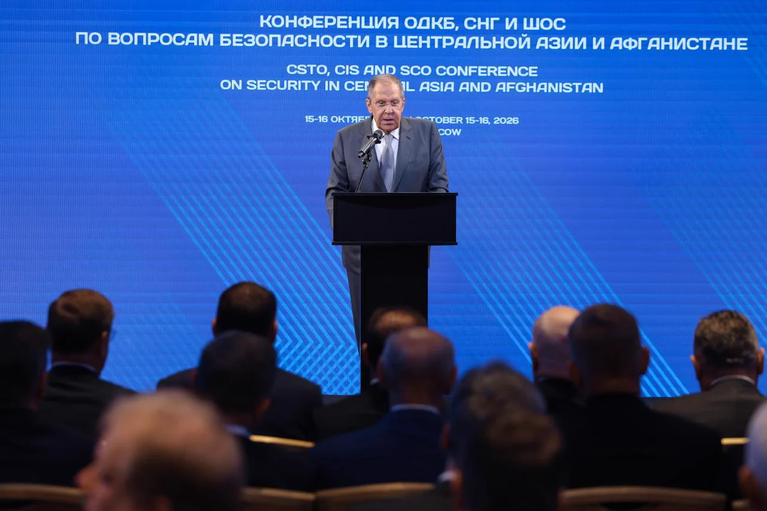
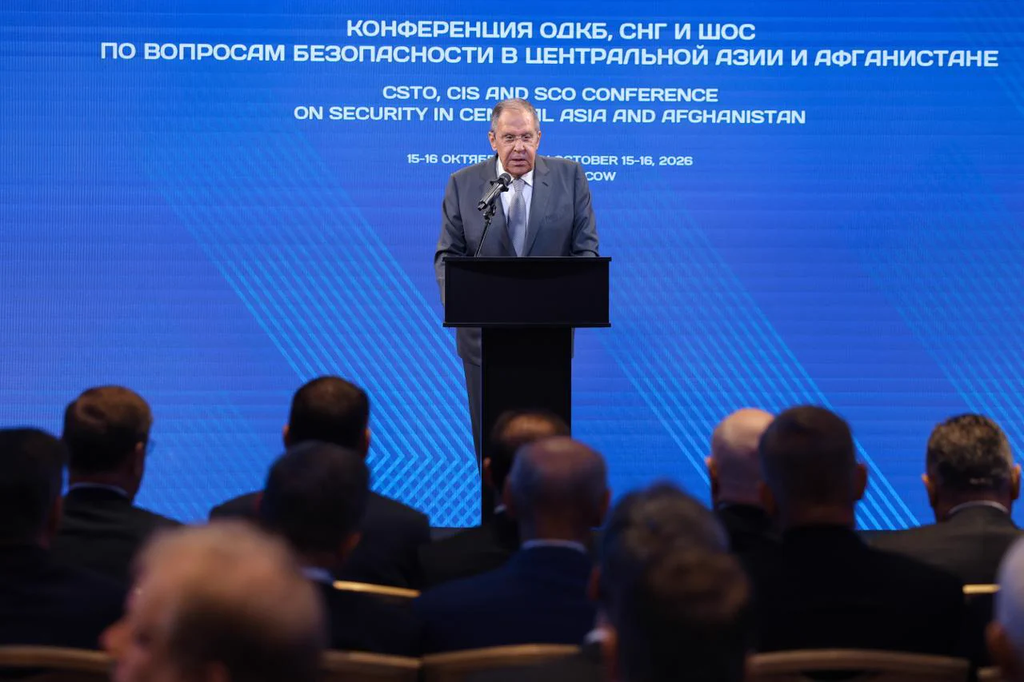
Russian Foreign Minister Sergey Lavrov’s remarks at the October 16, 2026, conference on security in Central Asia and Afghanistan reveal a strategic vision that extends far beyond counterterrorism or the immediate question of Afghanistan’s stability. Beneath Moscow’s language of regional cooperation, collective security and a multipolar world lies a broader ambition to reshape the Eurasian security order in ways that strengthen Russia’s influence while limiting the strategic reach of the United States and NATO. Afghanistan, in this calculation, is not merely a source of instability on Russia’s southern periphery but an important arena in a wider contest over who will define the region’s political and security future.
Lavrov’s criticism of NATO’s eastward expansion and his warning against what Moscow describes as Western interference in the affairs of neighbouring states reflect a longstanding Russian grievance that has become central to its foreign policy. Russia portrays the post-Cold War expansion of the Western alliance as a gradual encroachment on its strategic space, although NATO members argue that enlargement has been driven by the sovereign choices of states seeking collective defence. The historical irony is that NATO emerged during the Cold War partly in response to fears of Soviet power, while contemporary Russia is now advocating a continental security framework that could reduce the influence of the very alliance it continues to regard as a threat.
The proposed Greater Eurasian Partnership is central to this ambition. By calling for closer coordination among the Shanghai Cooperation Organisation (SCO), the Collective Security Treaty Organisation (CSTO), the Commonwealth of Independent States (CIS), the Eurasian Economic Union (EAEU) and other regional groupings, Moscow is seeking to connect existing institutions into a wider continental arrangement. Lavrov’s insistence that Eurasia requires its own security architecture, rather than one shaped by NATO, reflects Russia’s desire to establish regional rules and partnerships that give Moscow and its strategic partners a greater role in determining the continent’s future. Although presented as an inclusive initiative, the proposal also serves Russia’s interest in building an alternative to Western-led security arrangements and limiting Washington’s ability to shape developments across the region.
Afghanistan has become particularly important to this strategy since the withdrawal of US and NATO forces in 2021, which ended the Western military presence but did not end the geopolitical competition surrounding the country. Moscow has since pursued engagement with the Taliban authorities, culminating in Russia’s recognition of their government in July 2025, making it the first country to do so. This decision reflects not only a willingness to deal with the political reality in Kabul but also Russia’s interest in maintaining influence in a country whose instability could threaten Central Asia and, by extension, Russian security.
Lavrov’s latest remarks illustrate how this strategic calculation is shaping Moscow’s public narrative. While acknowledging the continued presence of terrorist and extremist groups in Afghanistan, he identifies Wilayat Khorasan, the regional branch of Islamic State, as the principal threat and praises the Taliban authorities for their campaign against it. Russia’s concern is not without foundation: Islamic State Khorasan Province (ISKP) has demonstrated its capacity to conduct attacks beyond Afghanistan, including the March 2024 attack on Crocus City Hall near Moscow, claimed by the group. For Russian policymakers, cooperation with Kabul offers a potential means of containing a threat that could spread into Central Asia and Russia itself.
Yet this security dilemma also creates a political opening for the Taliban. By placing particular emphasis on the threat posed by Wilayat Khorasan and presenting the Taliban as a partner in counterterrorism, Moscow increasingly adopts a framing that aligns with Kabul’s interests and strengthens its claim to be treated as a legitimate regional actor. This does not establish that Russia accepts every Taliban assertion or considers Afghanistan’s security problems resolved; rather, it suggests that Moscow’s immediate threat perceptions are shaping which aspects of the Afghan security picture receive the greatest diplomatic attention. Other concerns, including the threat posed by militant groups operating across regional borders, do not necessarily disappear simply because Russia’s priorities differ from those of its neighbours.
The wider geopolitical context is equally significant. With Russia facing sustained confrontation with the West and several of its partners in the Middle East under pressure, the development of stronger Eurasian partnerships offers Moscow another avenue for preserving influence and demonstrating that it remains a central power beyond the European theatre. Its engagement with Kabul therefore serves two purposes: managing a genuine security concern and consolidating a regional position that Western withdrawal has left open to competition.
Lavrov’s statement should consequently be read as more than a diplomatic appeal for cooperation. It outlines Russia’s attempt to connect counterterrorism, regional integration and continental security into a single strategic vision, one in which Afghanistan is both a security challenge and a geopolitical opportunity. The central question is whether Moscow can build a durable Eurasian order without becoming too dependent on the Taliban’s preferred account of regional security. In the new Great Game, Russia is not simply responding to threats emerging from Afghanistan; it is also trying to ensure that the political future of Eurasia is shaped less by Washington and NATO and more by Moscow and the partnerships it seeks to build.

Our Editorial Desk is the intellectual engine of Digital Debate, responsible for the rigorous research that anchors every conversation. Our team deep-dives into data, checks every source, and consults academic literature to move beyond headlines and identify the questions behind the questions.