In a single week, two cases that had shaken Pakistani public opinion ended not with a verdict but with the death of the principal accused, and the relief that greeted both outcomes says more about the condition of our criminal justice system than any official statement could.
Waseem Abbas, a fifteen-year-old orphan from Muzaffargh who lived in an unregistered orphanage, was chased on foot and then by car before being run over, and CCTV footage of the pursuit set off widespread public anger. The accused, Touqeer Nazir, was arrested and remanded in police custody for four days by a court, only to be killed in an alleged Crime Control Department encounter in Bahawalpur before the remand had expired. Police have yet to explain how a suspect held on remand escaped custody and reached Bahawalpur from Multan.
The Laiba Ijaz case followed the same arc, though in Islamabad and under the capital’s police rather than the CCD. Laiba, a twenty-two-year-old gold medallist, was found hanging near a weekly bazaar on October 9, and her death was investigated as a suspected suicide linked to an alleged fraud of Rs9.3 million. The FIA registered a case against Muhammad Noman and a second accused over forged admission letters and fee receipts, and Noman was arrested. Days later, police said he was fatally shot by his own accomplices, who ambushed the team taking him to recover evidence. Police sources had also alleged that he defrauded dozens of women and sexually harassed twenty-six of them, which makes his death a loss for every other victim who might have testified against him.
The public mood is easy to understand. A society that has watched witnesses retract, investigations collapse, and powerful defendants walk free will naturally cheer when a visible villain meets a swift end, and Laiba’s father thanked the prime minister and the interior minister for their efforts. That gratitude is genuine, and it is also an indictment, because a citizen who thanks the state for a suspect’s death rather than a conviction has already concluded that the courtroom cannot be trusted to deliver.
Yet the pattern behind these cases is far from reassuring. The Human Rights Commission of Pakistan documented at least 670 CCD encounters in the first eight months of 2025, in which 924 suspects were killed, while only two police officials died in the same period. HRCP’s later figures counted 808 encounters and at least 1,100 suspects killed since the CCD was created in April 2025. The CCD maintains that it acts strictly within the law and that those killed were criminals, and the Punjab government has denied that the chief minister ordered any encounters, but a denial of orders does not explain why the same outcome keeps recurring in the cases that provoke the loudest outrage.
What these killings deliver is closure of the file, and closure is easily mistaken for justice. A dead accused cannot be cross-examined on who else profited from his crimes, and the child protection chairperson herself urged legal action against the orphanage’s owner, an inquiry that now proceeds without its main witness. Nor can a dead accused be convicted, so the family never receives a court’s finding of what happened, and the public never learns whether the evidence would have held.
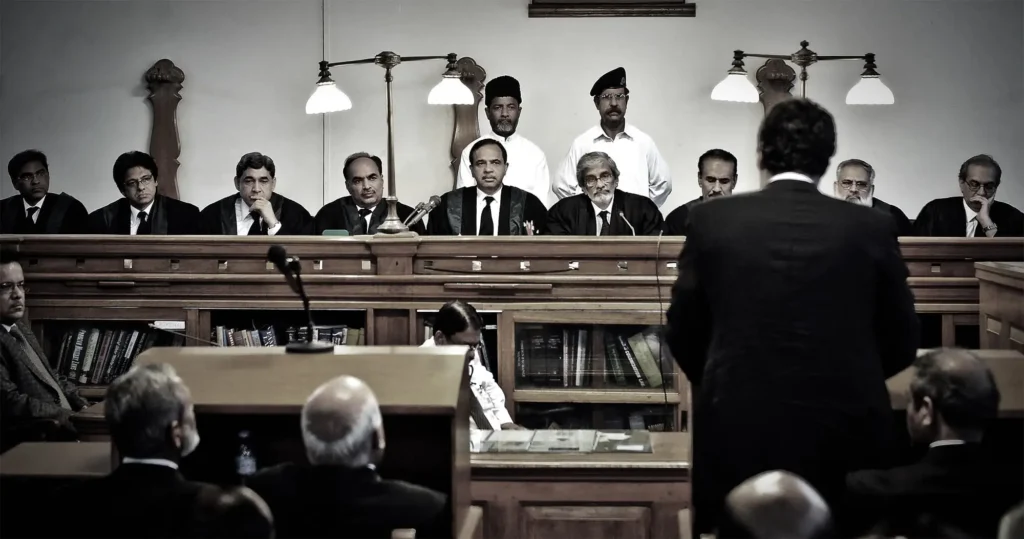
The deeper cause lies in the slowness of the courts, and no reform of policing will matter until it is confronted. According to the Law and Justice Commission of Pakistan, more than 2.36 million cases were pending in the country’s courts at the end of September 2026, and in May 2026 the same body’s data showed 1,153 district courts non-functional for want of judges, 808 of them in Punjab. A citizen who knows that a civil dispute can take years, sometimes decades, to resolve will not believe that a murder trial will end quickly, and that disbelief is what turns an extrajudicial killing into applause. Delayed justice has therefore done more than deny relief to litigants, because it has taught a generation to regard the gun as the only institution that answers. Until the state fills its courts, speeds its trials, and secures convictions within months, not decades, every encounter will be celebrated as justice, and every celebration will mark another step in its retreat from the law it claims to enforce.
Read more: https://digdebate.com/waseem-abbas-murder-case-fix-child-protection/

Our Editorial Desk is the intellectual engine of Digital Debate, responsible for the rigorous research that anchors every conversation. Our team deep-dives into data, checks every source, and consults academic literature to move beyond headlines and identify the questions behind the questions.