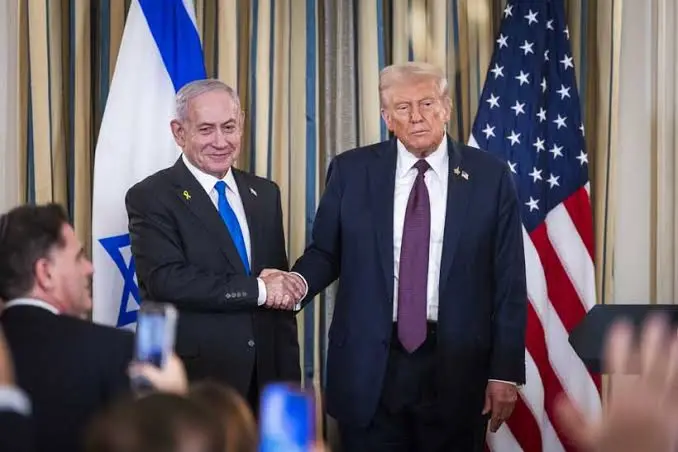
Israel votes on 27 October and the United States follows on 3 November, and most commentary treats these as two separate contests whose winners will each set a new course for the Middle East. The more useful question is what a region at war does while both of its principal patrons are, for different reasons, unable to commit to anything. The war in question is not a metaphor, since the US and Israeli strikes on Iran began on 28 February and the ceasefire deal collapsed on 8 July after attacks on shipping in the Strait of Hormuz. Even now unknown projectiles are striking merchant vessels there, and Iran’s seven-day ceasefire proposal, which Trump rejected, remains on the table while talks between Tehran and Washington sit at a standstill.
Begin with Washington, where the likely story is a leash rather than a reversal. Nate Silver’s model gives the Democrats an 86 percent chance of taking the House but only 57 percent in the Senate, which points to a divided Congress that can investigate, defund and force war-powers votes but cannot override a veto or take the commander-in-chief’s authority away. The pressure is real all the same, because the Fox and AP-NORC polls both place the Iran war among voters’ top four concerns, and the Fox survey found 75 percent worried about it, largely because the Hormuz disruption has fed the gas prices and cost of living that voters feel. A president facing that arithmetic has every incentive to seek a face-saving deal on Hormuz before or soon after polling day, and Tehran knows it.
Israel’s election works the other way, producing more fog than clarity. A late Maariv poll puts the governing bloc at 51 seats, short of the 61 needed, with Likud down to 18 and the Arab parties at a combined high of 14, and nearly 40 percent of Israelis say that if the vote ends without a clear winner they would prefer a unity government headed by Netanyahu. That implies weeks of coalition bargaining in which no Israeli leader can easily accept concessions on Lebanon, where Israel has been occupying the south since March, or on any Iran arrangement that looks like a climb-down. So Washington will be pressing for flexibility at precisely the moment Jerusalem has the least room to offer it.
This is why the dull interval after the votes matters more than the votes. For perhaps two months the American president will be weakened at home, the Israeli prime minister or his successor will be tied up in coalition arithmetic, and Iran will be deciding whether to wait them out or to test them. The danger is not only that nothing gets decided but that each actor reads the other’s paralysis as an opening, which is how a stalemate turns into an escalation.
The deeper shift is in the foundations of the alliance rather than in any single policy. The Chicago Council survey finds that 72 percent of Democrats and 64 percent of independents want US military aid to Israel reduced or ended, while 68 percent of Republicans want it maintained or increased, and the same survey found “no new wars” Republicans, as well as young Democrats, uneasy over the relationship. Support for Israel is therefore moving from a bipartisan assumption to a partisan bargaining chip, and Israel’s next government will have to plan for an America whose backing depends on who controls which chamber.
Gulf capitals and mediators, meanwhile, should expect to keep carrying the diplomatic load. Qatar says indirect US-Iran messages continue despite a seven-month deadlock, and Russia is now offering to mediate as well. The most realistic forecast for the region is not peace or a wider war but a narrow window in which a limited Hormuz-for-blockade deal becomes possible, followed by a fresh round of hardening once the new governments settle in.

Our Editorial Desk is the intellectual engine of Digital Debate, responsible for the rigorous research that anchors every conversation. Our team deep-dives into data, checks every source, and consults academic literature to move beyond headlines and identify the questions behind the questions.