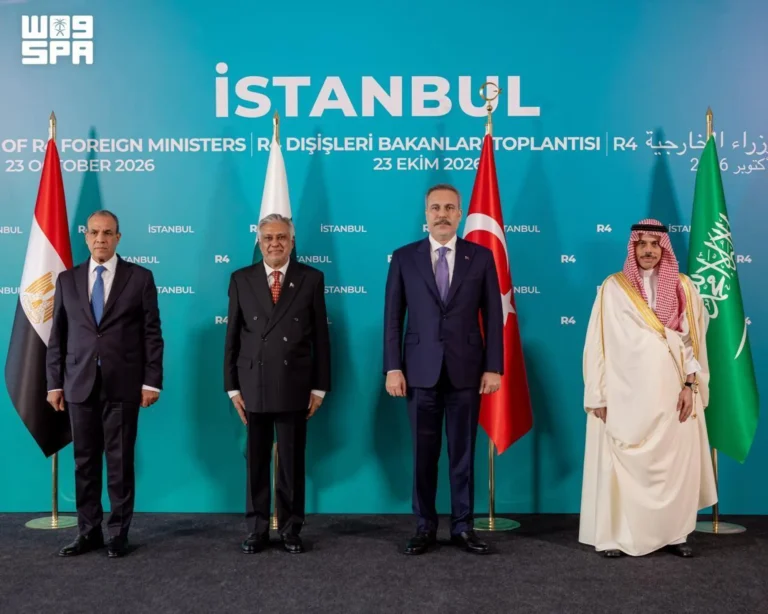
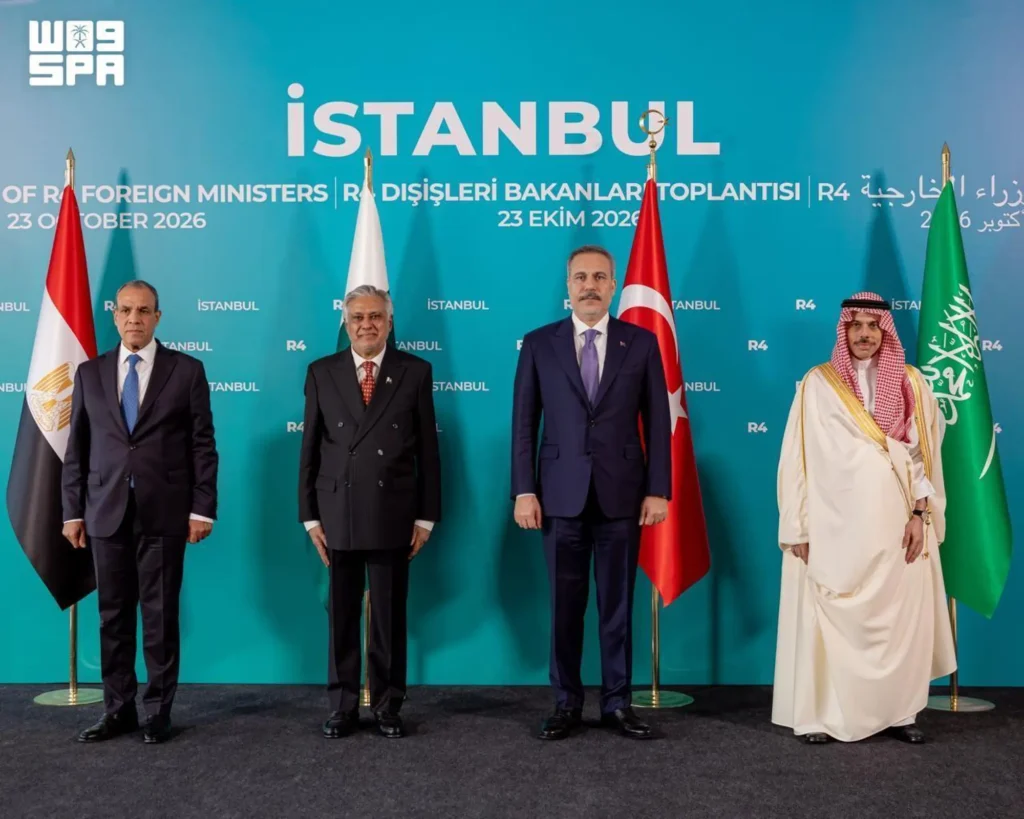
Pakistan, Türkiye, Egypt and Saudi Arabia, together with France, Germany, Italy and the United Kingdom, have called for resolving regional conflicts through dialogue, diplomacy and de-escalation. The call came in a joint statement issued after a foreign ministers’ meeting in Istanbul on October 23, according to Pakistan’s Foreign Office.
The meeting brought together the foreign ministers of the R4 group (Türkiye, Egypt, Pakistan and Saudi Arabia) and their counterparts from the four European countries. It was the first meeting between the R4 and these European states. Turkish Foreign Minister Hakan Fidan hosted the talks, and Deputy Prime Minister and Foreign Minister Ishaq Dar represented Pakistan.
The ministers discussed regional and international issues, including the conflict involving the United States, Israel and Iran, the Israeli-Palestinian conflict, Houthi attacks on Saudi Arabia and Yemen’s government, and threats to freedom of navigation. They also expressed concern over rising tensions around the Strait of Hormuz, Bab el-Mandeb and the Black Sea.
In the joint statement, the ministers reaffirmed their commitment to diplomatic efforts for peace and stability in the region and beyond. They called for lasting, negotiated solutions to all outstanding conflicts in line with relevant United Nations resolutions.
The statement also pointed to the security, economic and trade costs of regional instability, particularly for international shipping and maritime routes. The ministers agreed to continue dialogue in this format to prevent conflicts and advance peace and stability.
The R4 group was formed in March and comprises Pakistan, Egypt, Saudi Arabia and Türkiye. It has focused on regional security and diplomatic coordination

Our News Desk represents a rapidly expanding frontier in contemporary journalism, focusing on the intersection of technological advancement, geopolitical narratives, and the shifting dynamics of public information.