What Happened
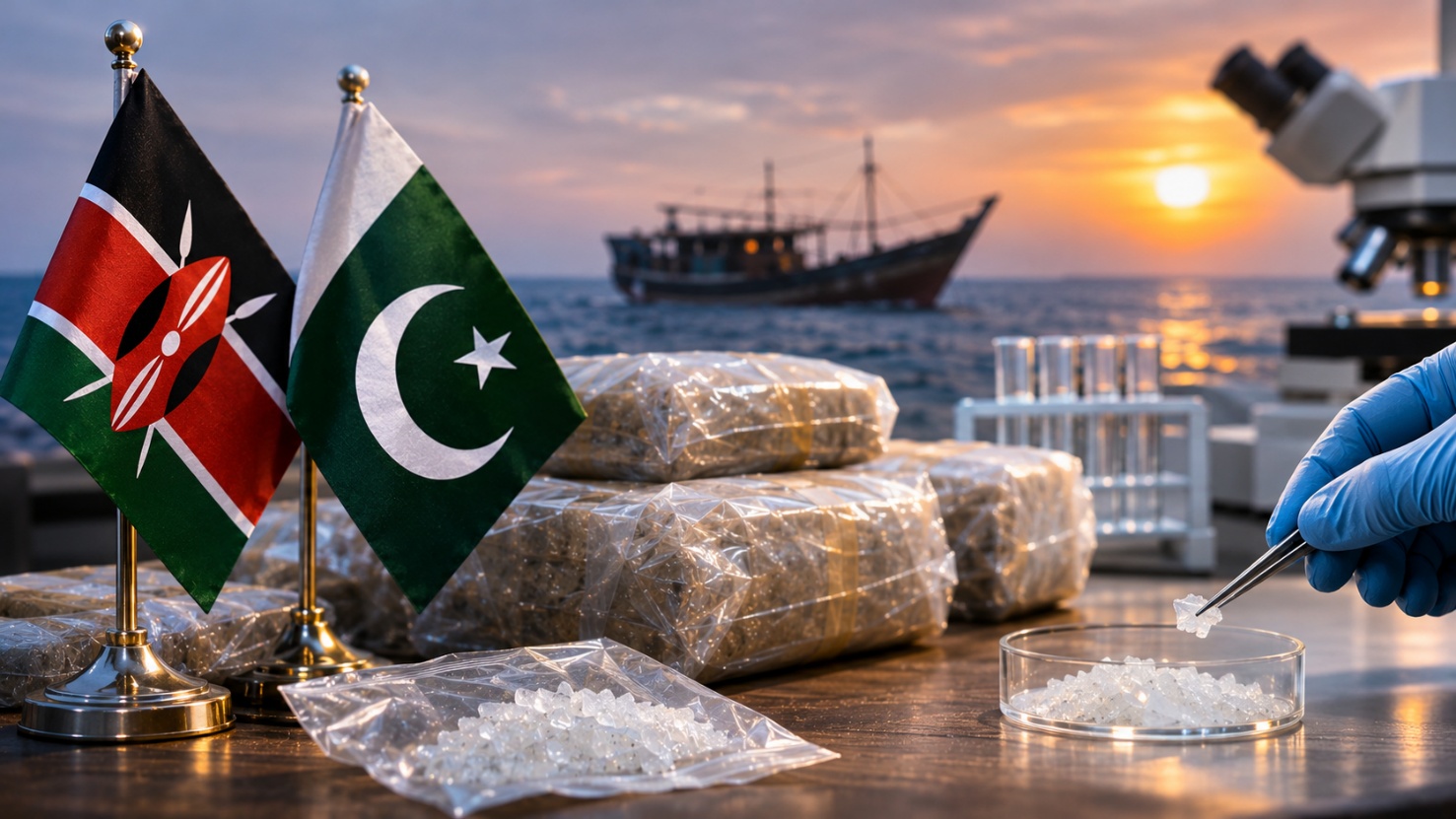
On 7 November, in an intelligence-led operation with Tanzanian authorities, Kenya’s Directorate of Criminal Investigations (DCI) recovered 454 kg of suspected methamphetamine valued at Sh3.6 billion in Kwale County, about US$27 million.
At a briefing in Mombasa on 9 November, DCI Director Mohamed Amin said preliminary investigations point to Pakistan as the source, and that the drugs were destined for East and Southern African countries. Several Kenyan outlets reported the claim as a confirmed origin. Pakistan has rejected it.
What Kenya Has Actually Said
- The finding is preliminary. Amin’s own word was “preliminary”, and the Kenya News Agency reported that preliminary investigations point to Pakistan.
- The basis is comparative. Amin said the Kwale haul was unrelated to the 1,036 kg seized from the vessel MV Mashaallah, which Kenya traced to Iran, citing differences in the labelling, packaging and nationalities involved.
- Laboratory results are pending. The substance was awaiting laboratory confirmation and had been sent to the government chemist for formal analysis.
- No Pakistani has been named. Those arrested in Kenya were two Tanzanian nationals and a Ugandan woman. Across the linked Kenyan and Tanzanian operations, police reported seven suspects in total: five Tanzanians and two Ugandans. None of the reports DD reviewed names a Pakistani national, vessel, port or container.
- The investigation continues. Amin said Kenya wants to reach “the financiers, the organisers and the beneficiaries”.
Pakistan’s Position
Officials at Pakistan’s Ministry of Interior rejected any insinuation linking Pakistan to the seizure. Their main points:
- The claim is preliminary. The DCI itself calls its findings “preliminary” and “early stage”. No forensic report has been released and no court has made any finding.
- No Pakistani link has been established. All those arrested are Tanzanian or Ugandan nationals. No Pakistani vessel, port, container or national has been named.
- Packaging is not proof of origin. Transnational cartels routinely use false labelling, transshipment and third-country packaging to disguise where drugs come from. Treating packaging as proof of origin is neither credible nor professional.
- The evidence points to Afghanistan. UNODC documents Afghan-origin methamphetamine moving along the Southern Route, via the Makran coast, to East and Southern Africa. Transit is not origin.
- Pakistan is a partner, not a source. Pakistan faces the same flows, seizes tonnes of methamphetamine every year, and offers full cooperation through the Anti-Narcotics Force (ANF) and the Federal Investigation Agency on any evidence Kenya holds.
Source, Route and Transit
International monitors agree on where much of this methamphetamine starts. UNODC describes heroin and, increasingly, methamphetamine trafficked along the Southern Route from Afghanistan and moved by sea from the Makran coast to Eastern and Southern Africa. In 2023 UNODC called Afghanistan the world’s fastest-growing maker of methamphetamine, with suspected Afghan meth seized in East Africa.
The route does cross Pakistan. The Global Initiative Against Transnational Organized Crime has reported that meth produced in Afghanistan is being smuggled through Pakistan and via traditional heroin maritime routes to eastern and southern Africa. That is the distinction at the heart of this dispute: a country on a trafficking route is not the same as the source of the drugs.
Pakistan’s Interdiction Record
| Date | Operation | Methamphetamine seized |
|---|---|---|
| Oct 2025 | Pakistan Navy ship Yarmook, under the Saudi-led Combined Task Force 150, Arabian Sea | More than 2 tonnes (with cocaine); about $972 million |
| Nov 2025 | Pakistan Navy ship Tabuk, Arabian Sea | More than 2,000 kg; about $130 million |
| Nov 2025 | ANF, LPG container truck, Balochistan | 553.5 kg (plus 40 kg heroin) |
| Sep 2026 | ANF with Sri Lanka and the US DEA, Karachi and Colombo ports | 671 kg, linked to an Afghanistan-based network |
In the September case, the ANF said the network had sought to use Pakistani territory as a transit route to international markets, and that it arrested an Afghan national it described as the “mastermind”. The Kwale seizure fits the same pattern of a route, not a single country.
More Here:
- Opinion · A Government That Cannot Govern Its Own
- Brief · The Unsigned Guarantee
Reading the Week
- Kenya’s claim is narrower than its coverage. The DCI said “preliminary” and gave a comparative basis. Several reports dropped those qualifiers.
- Packaging tells you about networks, not countries. It helped Kenya separate the Kwale and Mashaallah cases. On its own, it cannot establish where the drugs were made.
- The answer is evidence-sharing, not attribution. Laboratory profiling, suspects’ communications and financial trails will settle origin. Pakistan has offered ANF and FIA cooperation; Kenya has said it wants the financiers.
Why It Matters
- For Pakistan: An unproven “source country” label can harden into reputation, affecting shipping, trade checks and diaspora travel.
- For East Africa: Treating a transit country as the source risks missing the producers and financiers further up the chain.
- For the region: The Southern Route links Afghanistan, the Arabian Sea and the African coast. No single country can close it alone.
Related:
- Infolytics · UN Security Council Report S/2026/651
- Blog · The Red Sea Front: How the Houthi–Saudi Conflict Is Threatening Global Trade
What to Watch
- Kenya’s government chemist report: Whether laboratory profiling links the Kwale haul to Afghan production, Iranian methods or another source.
- Court filings in Kenya: What prosecutors say about origin when the suspects are charged.
- A Pakistan–Kenya channel: Whether the ANF and the DCI open formal evidence-sharing, or coordinate through UNODC or Combined Task Force 150.
Watch:
- Event · Beyond Kabul: Taliban and the Emerging Power Equation
- The Debate · All episodes
- YouTube · Digital Debate on YouTube

Our Editorial Desk is the intellectual engine of Digital Debate, responsible for the rigorous research that anchors every conversation. Our team deep-dives into data, checks every source, and consults academic literature to move beyond headlines and identify the questions behind the questions.