On his 149th birth anniversary, from a Delhi courtroom to Dhaka’s newsrooms, the dilemma he named in 1930 that who protects a community’s voice when power won’t? is still waiting for its answer…
Let’s start with a wedding.
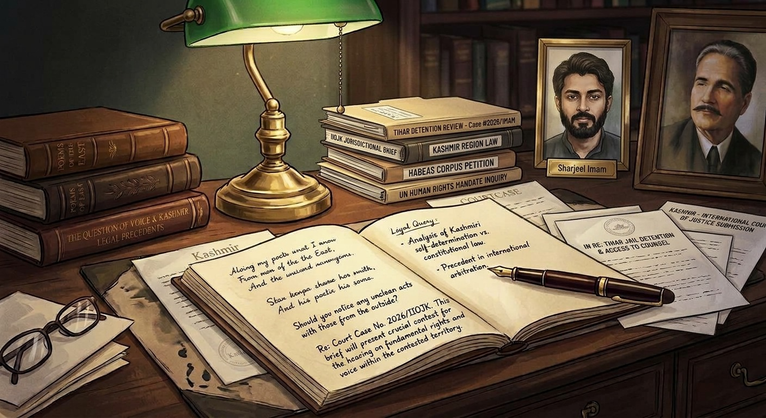
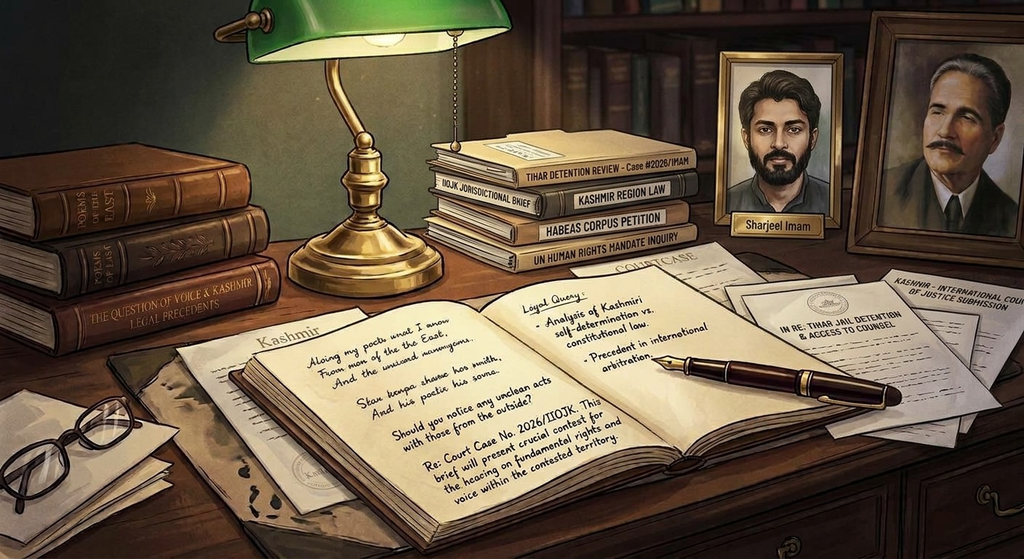
Not a grand one. Just seven days of borrowed freedom, granted so that Sharjeel Imam could attend his cousins’ weddings, with orders to be back at Tihar jail by the evening of 10 October. Hours before that deadline, Delhi Police asked a court to cancel the bail, alleging he had broken a condition barring contact with the media. He has been in custody since 2020.
Sit with that number for a moment. Six years and nine months. By Imam’s own account, in a petition filed in the Supreme Court on 4 November, the prosecution has not yet examined a single witness.
That is one side of the story. Here is the other.
Delhi Police call Imam and his co-accused Umar Khalid “masterminds” of the February 2020 northeast Delhi riots, which left 53 people dead and more than 700 injured. In January, the Supreme Court found a prima facie case against both under the anti-terror law, the Unlawful Activities (Prevention) Act (UAPA), called them the “ideological drivers” of the alleged conspiracy, and said they could seek bail again only after protected witnesses are examined or a year passes, whichever comes first. They deny the charges.
A court must test those claims. That is the whole point of a court. But nearly seven years on, the testing has not begun, and justice this late stops feeling like justice. It starts to feel like a sentence handed down in advance. To be fair, India’s own Supreme Court has noticed. In May, it referred the question of prolonged UAPA detention to a larger bench.
Imam is not alone. In an opinion made public in March, the United Nations (UN) Working Group on Arbitrary Detention, a panel of independent experts, found Umar Khalid’s detention arbitrary, after a petition by the New York-based Human Rights Foundation. The opinion is not binding on India.
We want to be careful here. Iqbal did not write Imam’s speeches, and nobody should pretend he did. Guilt or innocence is for a court to decide. The thread running from a poet in Sialkot to a prisoner in Delhi is not just ideology alone. It is a question, one Iqbal asked out loud 96 years ago, and one South Asia keeps answering badly.
What Iqbal actually asked
Today, 9 November, is the 149th birth anniversary of Allama Muhammad Iqbal, a poet, philosopher, barrister, the man we call Shair-e-Mashriq, the Poet of the East. Born in Sialkot in 1877, he gave a bruised people a reason to stand tall. Asrar-e-Khudi, Bang-e-Dra and Bal-e-Jibril taught the young one a stubborn idea that know your worth, then act on it.
On 29 December 1930, in Allahabad, he stood before the All-India Muslim League and gave the speech people still argue about. Read it yourself. It was not a sermon of hatred. It was a plea for security. A community that depends only on a majority’s goodwill can be left exposed the day that goodwill runs out. He wanted the Muslim-majority provinces of the north-west amalgamated into a single state, and historians still debate whether he imagined it inside a united India or beyond it. Either way, the fear underneath was plain, and deeply human that what happens to us if nobody is obliged to protect us?
Kashmir: The Oldest Wound
Iqbal’s family came from Kashmir, and the valley still carries the question. In January, Pakistan’s Foreign Office condemned the reported profiling of mosques and their management committees in Indian Illegally Occupied Jammu and Kashmir (IIOJK), Pakistan’s official name for Indian-held Kashmir. Police had reportedly handed out forms to collect personal and financial details of imams and committee members. Islamabad called it systematic harassment aimed at instilling fear among worshippers. New Delhi did not immediately respond.
In March, a Delhi court sentenced Kashmiri leader Asiya Andrabi to life imprisonment under the UAPA, and two associates to 30 years each. Prosecutors had alleged a conspiracy to carry out militant activities. Pakistan’s Foreign Office rejected the verdict, citing concerns over due process and judicial independence.
The wider record is heavy. In November 2025, UN experts raised alarm over “serious human rights violations” in Indian-held Kashmir after the 22 April Pahalgam attack, in which gunmen killed 26 people. They said the sweeping operations that followed led to the arrest and detention of around 2,800 people, including journalists and human rights defenders. They also urged India and Pakistan to settle the dispute peacefully. New Delhi has denied such accusations in the past.
India calls Kashmir an integral part of the country. Pakistan holds that unilateral claims of sovereignty have no bearing on the territory’s internationally recognized disputed status. Maps can be argued over forever. But a dispute over maps cannot excuse the denial of a fair trial, or the fear a worshipper carries into a mosque.
For Kashmiris, Iqbal still offers a reason to hope:
نہیں ہے ناامید اقبالؔ اپنی کشتِ ویراں سے
ذرا نم ہو تو یہ مٹی بہت زرخیز ہے ساقی
“Iqbal is not hopeless about his barren field. With a little moisture, this soil is very fertile.”
Beyond the Valley, more than 170 Million People
More than 170 million Muslims live in India, according to the 2011 census, and many carry that same quiet fear into ordinary towns and villages. On 4 March, the US Commission on International Religious Freedom (USCIRF) recommended, for the seventh year running, that India be designated a “Country of Particular Concern.” New Delhi called the report “motivated and biased”. The recommendation is advisory, not binding.
The advocacy group South Asia Justice Campaign publishes the India Persecution Tracker. These are advocacy counts and deserve scrutiny, and where authorities have given their side, we note it. But the numbers are hard to ignore:
- 44 Muslims killed in hate-related violence in the first seven months of 2026: 19 by state actors and 25 by Hindu nationalist assailants, according to the tracker.
- At least 23 Muslim religious structures demolished in under two months across six states, and over 1,000 Muslim homes, businesses and religious sites razed in at least 21 demolition episodes in eight states. Authorities in states governed by the Bharatiya Janata Party (BJP) typically cite encroachment on government land.
- In Gujarat’s Kutch district, the mosque committee and the Muslim clerical organization Jamiat Ulama-i-Hind say the Juna Kandla mosque, registered with the state Waqf Board since 1965, was razed at night without notice. (A waqf is property held in trust for Islamic religious or charitable use.)
- In Uttar Pradesh, officials say more than 31,000 waqf properties were rejected or canceled on the government’s UMEED portal after the Waqf (Amendment) Act, 2025 made registration mandatory. Officials cite mismatched land and ownership details, and owners can appeal to a Waqf Tribunal.
- The tracker also reports hundreds of homes of Bengali-origin Muslims demolished in Assam.
This is exactly what Iqbal feared. A minority needs more than promises. It needs fair trials, safe homes and protected places of worship. Without them, citizenship becomes a word on paper. And behind every figure sits a name, a family, and a dinner table with an empty chair.
Bengal, where the Muslim League began
Iqbal’s question was never only a north-western one. Bengal is where the story starts. The All-India Muslim League was founded in Dhaka on 30 December 1906, at the Ahsan Manzil palace, with Nawab Khwaja Salimullah as host. Thirty-four years later, Bengal’s chief minister, A. K. Fazlul Huq, moved the Lahore Resolution of 1940. And Iqbal travelled east through verse. His Tarana-e-Milli was translated into Bengali as early as 1916–17, and scholars writing in the Iqbal Academy’s journal argue that Bengali Muslim thought owes him much. Even Amiya Chakravarty, once Rabindranath Tagore’s secretary, translated Iqbal in the early 1930s.
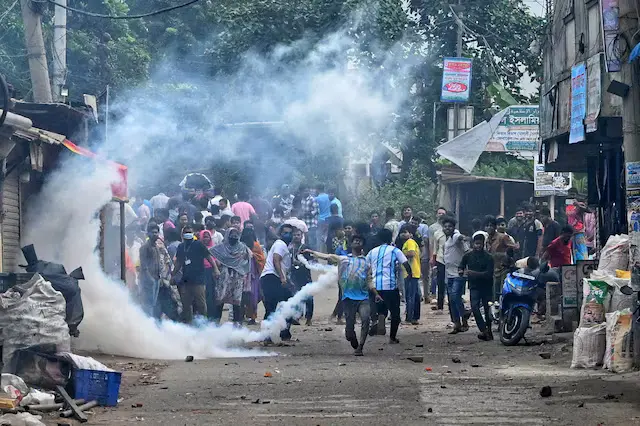
Today, one name dominates Bangladesh’s politics, Sheikh Hasina Wajed, daughter of the country’s founding president, Sheikh Mujibur Rahman. She led the country for 15 years, until the 2024 student-led uprising, and now lives in India. In November 2025, Bangladesh’s International Crimes Tribunal sentenced her to death in absentia for crimes against humanity over the crackdown in which hundreds of protesters died. She calls the verdict “biased and politically motivated.” In September, a second tribunal sentenced seven senior leaders of her banned Awami League to death. Amnesty International and Human Rights Watch have both raised fair-trial concerns, including over her lack of a lawyer of her own choosing.
Two things can be true at once. The families of those killed in 2024 deserve justice, and they have waited long enough. And anyone accused, however powerful or unpopular, deserves a fair trial and a verdict that cannot be mistaken for revenge. Her government was itself long accused by rights groups of silencing critics. The answer to that cannot be to repeat it.
The pressure has outlived every change of government. CIVICUS, the global civil society monitor, rates Bangladesh’s civic space “repressed”. Reporters Without Borders (RSF) says five journalists have been detained since 2024, still awaiting trial, and Amnesty says two of them now face “vague new charges” over a story aired more than a decade ago. After February’s election brought the Bangladesh Nationalist Party (BNP) to power, Human Rights Watch documented arrests over social media posts critical of the government, calling it “an alarming continuation of the previous government’s repressive practices”.
That is Iqbal’s question again that whose safety depends on whose goodwill? A voice that can be jailed at will is not a voice. It is a favour. Bengal helped to ask this question first, and Bengal deserves a good answer.
Pakistan’s own test
Pakistan has a duty to keep these questions alive at the UN and every forum that will listen, with documents, dates and names. Slogans do not move the world. Evidence does. But Iqbal would not let us skip the uncomfortable part: the mirror.
Two-thirds of Pakistanis are under 30, about 67 million of them aged 15 to 29, according to the Economic Survey 2025–26. This is the generation Iqbal wrote to, and the one we are failing. Official unemployment is 6.3 percent, but the youth aged 15 to 35 are hit hardest, and the United Nations Development Program (UNDP) found that 29 percent of young Pakistanis have no education at all. When they go online to say so, they meet a state that is nervous.
A Message to the Young
To young people in Pakistan, who are two-thirds of this country, and in Kashmir, India and Bangladesh, wherever you’re scrolling from, anger is easy. Anger trends for a day. Skill lasts. Learn law. Learn research. Learn to document, archive and tell your story so well that the world can’t file it under noise. Keep receipts.
Iqbal called it khudi. Knowing your own worth so well that nobody else gets to set the price. He never asked his young to be loud. He asked them to be fearless and true. On his birthday, the best tribute isn’t a hashtag. It’s an answer.
آئینِ جواں مرداں، حق گوئی و بے باکی
اللہ کے شیروں کو آتی نہیں روباہی
“The code of the brave is to speak truth without fear. Lions of God do not learn the fox’s cunning.”

Our Editorial Desk is the intellectual engine of Digital Debate, responsible for the rigorous research that anchors every conversation. Our team deep-dives into data, checks every source, and consults academic literature to move beyond headlines and identify the questions behind the questions.