Commander National Strategic Command (CNSC) General Syed Aamer Raza said Pakistan’s role in facilitating the Islamabad Accord reflects its lasting commitment to peace, diplomacy and regional stability. He also made clear that Pakistan will not tolerate any aggression or violation of its sovereign borders.
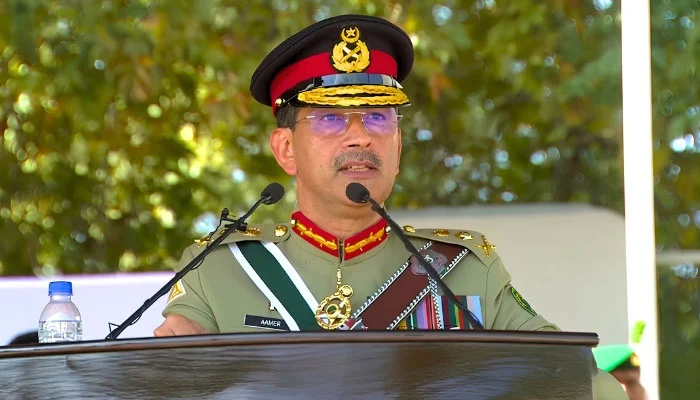
Speaking as chief guest at the passing out parade at the Pakistan Military Academy (PMA) Kakul on Saturday, General Raza said recent geopolitical shifts, particularly the Middle East conflict, have again shown Pakistan’s strategic importance.
He pointed to the Islamabad Accord as proof of Pakistan’s consistent push for peaceful resolution and diplomatic engagement. Pakistani officials have presented the accord, signed earlier this year as a framework for addressing the Middle East conflict, as a diplomatic achievement and a basis for continued dialogue.
General Raza congratulated the graduating cadets of the 154th PMA Long Course, 39th Technical Graduate Course, 73rd Integrated Course and 28th Lady Cadet Course, along with their parents. He said the day marks the end of their foundational military training at one of the world’s premier military academies and will stay a memorable milestone as the young officers enter professional service.
The CNSC said fast-spreading disruptive technologies have changed the character of modern warfare and made many traditional operational doctrines less relevant. In response, he said, the Pakistan Armed Forces are carrying out a swift multidomain transformation to strengthen the country’s military posture and meet new security challenges.
General Raza sent a firm message to potential adversaries. He called Pakistan’s position on territorial integrity “absolute and unyielding” and said a nuclearised environment leaves no space for conflict or war. Any miscalculation, he warned, would bring a response “far beyond the imagination or calculation of the initiator.” He said the armed forces are ready to defend the motherland at all costs.
Referring to the May 2025 conflict between Pakistan and India, General Raza alleged that the adversary, after the failure of “Operation Sindoor,” is trying to fracture Pakistan’s social cohesion and state infrastructure through proxy terrorism, subconventional warfare and disinformation.
He said hostile elements are trying to exploit internal vulnerabilities and turn the armed forces and the people against each other, but he insisted these efforts will not weaken national unity.
General Raza described Pakistan as a state that wants peace, has consistently chosen restraint, dialogue and regional stability, and has made immense sacrifices for that goal. He cautioned, however, that Pakistan’s commitment to peace should not be mistaken for weakness, and its restraint should not be read as a lack of resolve.
He framed Pakistan’s defence policy around two principles: sincere diplomacy and credible deterrence. Islamabad seeks stability through dialogue and regional cooperation, he said, but it will respond decisively to any threat to its sovereignty, territorial integrity or national security.


Our News Desk represents a rapidly expanding frontier in contemporary journalism, focusing on the intersection of technological advancement, geopolitical narratives, and the shifting dynamics of public information.