Every year on September 8, the world marks International Literacy Day. Most people scroll past it. A few schools hold an assembly, a minister tweets something hopeful, and by evening the topic is forgotten. But for a country like Pakistan, this day should not be a formality. It should be a mirror.
The numbers are not new, but they still sting. Pakistan’s literacy rate hovers somewhere around 60 percent, and that figure hides more than it reveals. In some rural districts, especially for girls, the real number is far lower. Millions of children who should be in school are instead out selling things at traffic signals, working in homes, or simply sitting idle because there was never a school close enough, or safe enough, or affordable enough.
We often talk about literacy as if it only means reading a newspaper or signing your name. That is too small a definition. Literacy decides who gets to understand a contract before signing it, who can read the label on a medicine bottle, who can follow the news instead of just the rumour that reached them first. A person who cannot read is not stupid. They are simply locked out of rooms that decide their own life.
This matters even more in a country that talks endlessly about strategy, security, and sovereignty. You cannot build a strong state on a population that cannot read its own constitution. You cannot claim to compete in the modern world while a large share of your people never finished primary school. Every debate about Pakistan’s future, its economy, its politics, its place in the region, rests quietly on this one uncomfortable fact: too many Pakistanis were never given the basic tool to take part in that future.
The excuses are familiar by now. Not enough budget. Too many children. Cultural resistance in some areas. Some of these are real problems. But they are also, often, convenient cover for decades of low priority. Education has rarely been where the money or the attention goes first. It shows.
There are things that do work, though, and they deserve more attention than they get. Community-run schools in remote areas. Programs that pay families a small amount to keep girls in class instead of pulling them into work. Local NGOs that have quietly taught thousands of adults to read using nothing more than volunteers and borrowed rooms. None of this is glamorous. None of it makes headlines. But it is proof that the problem is not impossible, only under-resourced.
And then there is the view right next door. In Afghanistan, this day carries a much darker weight. Girls above grade six have now been barred from classrooms for years. Universities shut their doors to young women who had spent their whole childhood dreaming of a degree. Whole generations of Afghan girls are growing up being told, quite openly, that their minds do not matter. It is hard to think of a clearer example of what the opposite of literacy day looks like. While the rest of the world reads speeches about the “right to education,” Afghan girls are reading nothing at all, because they are not allowed to.
It should shame everyone watching. Not because Pakistan has solved its own problems, it clearly has not, but because at least here the door is open, even if narrow and uneven. In Afghanistan, for millions of girls, the door has been shut and locked from the outside. A whole country has decided that half its population does not need to read. History will not be kind to that decision, and neither should we be, in silence.
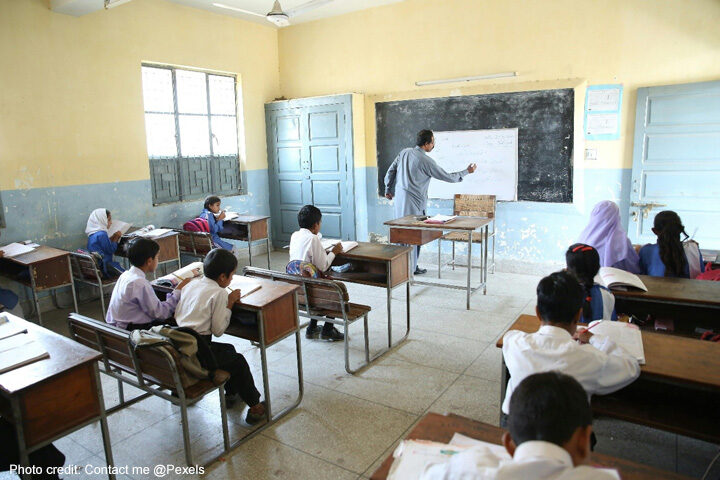
On a day like this, we also owe something to the people who quietly carry this whole system on their backs: teachers. Not the ones in glossy education ministry photos, but the ones in small government schools with no chairs, no proper walls, sometimes no salary paid on time. The ones who teach forty children in one room and still remember every child’s name. The private tutors working for almost nothing in poor neighbourhoods just because they believe a child deserves a chance. The Afghan women who, even now, teach girls in secret home classrooms, risking real danger just so a few more girls can read a sentence.
These teachers rarely get thanked. No one puts their names on buildings. No one gives them awards. But every literate person you meet, every doctor, engineer, writer, or simply someone who can read a letter from their child, owes that to a teacher who decided to show up on a bad day, in a bad room, and teach anyway. If this day belongs to anyone, it belongs to them.
International Literacy Day is not really about slogans or hashtags. It is a yearly reminder of a debt this country owes its own citizens. Every child who leaves school unable to read a sentence is not a statistic. They are a future voter, a future worker, a future parent who will decide whether their own children go to school. The cycle repeats unless someone breaks it.
If there is one thing worth taking from this day, it is this: literacy is not charity, and it is not a side project for NGOs to worry about while the state focuses on “bigger” things. It is the foundation everything else stands on. A country serious about its own future cannot keep treating it as an afterthought.
Read more:https://digdebate.com/pakistan-governance-gap-local-government-devolution/

Our Editorial Desk is the intellectual engine of Digital Debate, responsible for the rigorous research that anchors every conversation. Our team deep-dives into data, checks every source, and consults academic literature to move beyond headlines and identify the questions behind the questions.