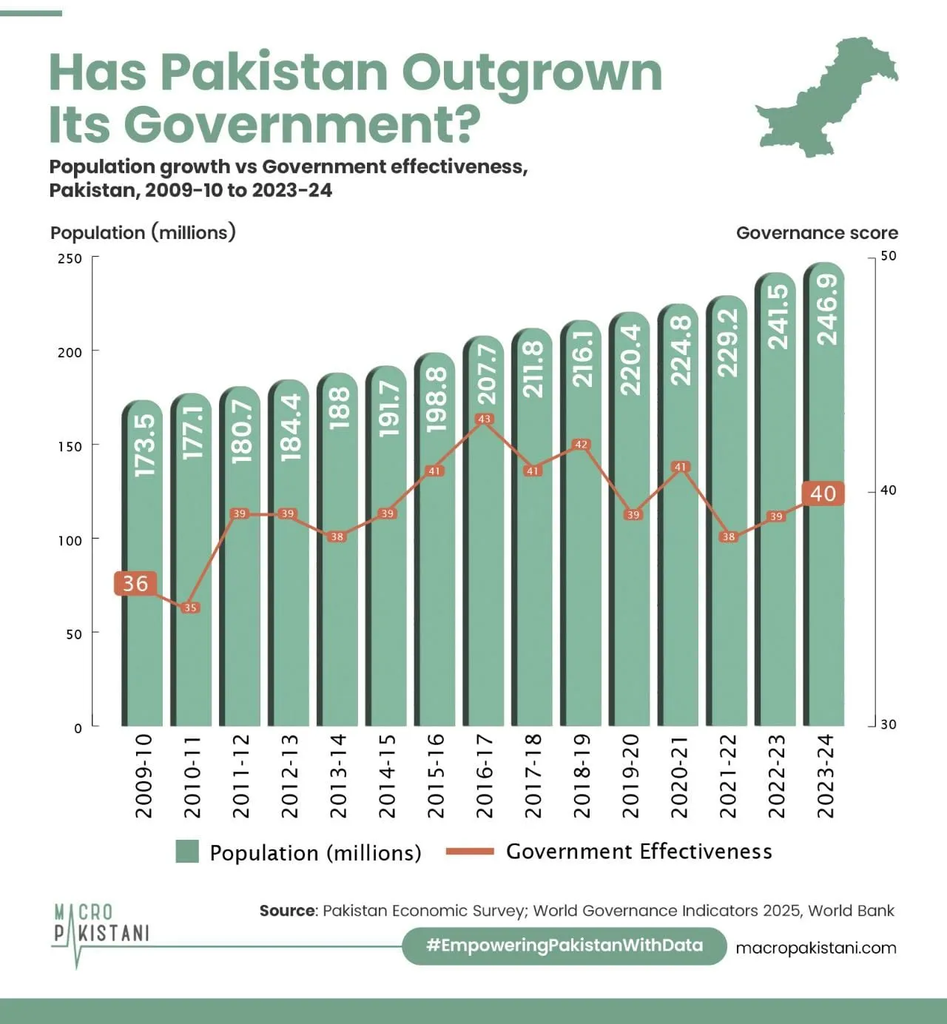
There is a governance gap, and part of the gap comes from population growth while the other comes from how the state distributes money and authority once it has them. As the population grows faster than administrative capacity, the case for restructuring government becomes harder to ignore. But Pakistan’s own history shows that drawing new administrative lines does little without actually giving those units real authority and resources.
Pakistan has tried decentralisation three times. In the first round, Ayub Khan introduced Basic Democracies in 1959, then Zia-ul-Haq introduced the Local Government Ordinance in 1979, and our last experience was with Musharraf, who launched his devolution plan in 2001. Each shifted some authority towards local governments, which was later weakened by the civilian governments that followed. The 18th Amendment in 2010 went further by devolving federal subjects to the provinces, but left much of the authority stuck there instead of pushing it down to districts and tehsils.
Fifteen years later, the fiscal structure helps quantify the problem. Provinces budgeted about Rs 1.2 trillion in their own taxes for FY2024-25, compared with Rs 7.24 trillion received through their share of federal taxes. In other words, locally raised revenue therefore covered only about 12.6% of provincial spending. There is a gap between the provincial governments’ incentives to serve their people. Provinces control large budgets, but raise relatively little of the money themselves, which translates to a government that doesn’t need to prove its service quality to collect taxes.
A country as large as India has also had a similar experience and offers a useful lesson, especially the process that began with the 1955 States Reorganisation Commission. The commission did not treat population as a reason to create or redraw a state. It assessed proposals across several factors: national unity and security, cultural and linguistic ties, administrative convenience, and financial and economic viability. The question was whether a new administrative unit could actually function to solve governance challenges.
That approach matters particularly for a multiethnic country like Pakistan. India’s later experience also shows that smaller administrative units do not automatically translate to better economic outcomes. In fact, research on state reorganisations has found no consistent growth advantage for newly created or reorganised states. One more useful example came from Uttar Pradesh in 1992, when the state reorganised village councils. The reform reduced the size of governing units, bringing administration closer to residents.
Pakistan should take that lesson seriously. At this point, the real question is whether smaller units would have the revenue, administrative capacity and political authority to actually govern better. India’s experience suggests that the answer depends less on the number of units than on what powers they receive and whether those powers survive after the reform is announced.
Pakistan has spent decades creating administrative structures and then allowing the tier above them to reclaim the power and money. Before drawing another set of boundaries, there are bigger problems on the agenda.
On Pakistan’s 80th Independence Day (79 years of independence), as a nation, we are faced with greater challenges than ever before. Yet independence has always meant more than the absence of foreign rule. It is also the freedom to shape the country we want to live in, to learn from what has worked elsewhere, and to build institutions that serve every Pakistani better. This Independence Day, that work remains ours to do.
Read more:https://macropakistani.com/
by Sharmeen Sajjad
As Pakistan heads into its 80th year of existence, it is accompanied by a reflection on regrets and heartaches, yet underscored by an undeniable optimism for the path ahead. May we live to see the Pakistan of our dreams. Youm-e-Azadi Mubarak! Pakistan Zindabad.
Read more:https://macropakistani.com/pakistan-as-a-political-economy/