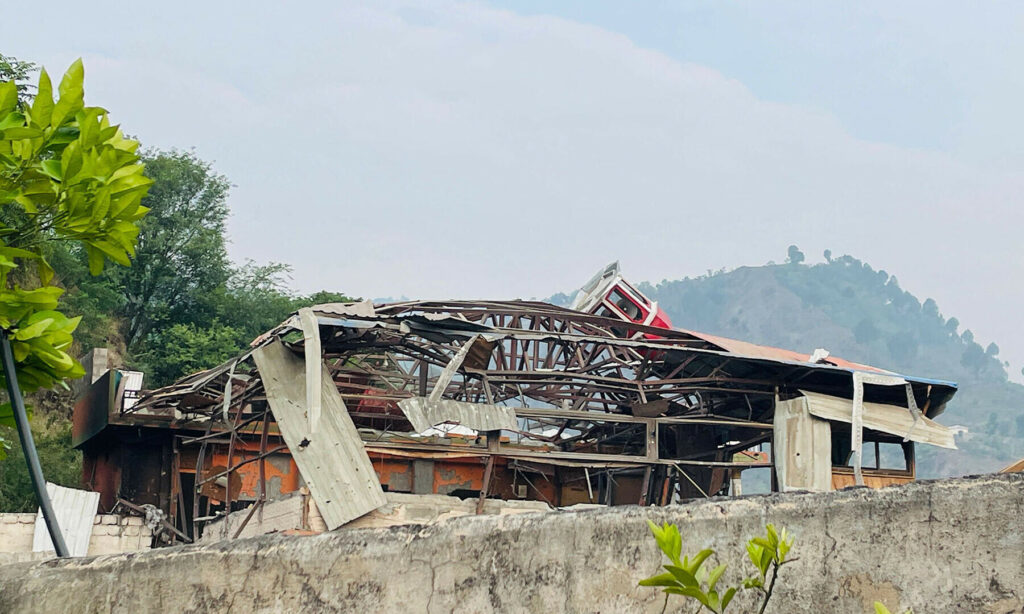
There is a question AJK’s protest organizers have never satisfactorily answered. When a shutter-down strike closes Muzaffarabad’s markets for three days, who pays for those three days? Not the political leadership of the Jammu Kashmir Joint Awami Action Committee. Not Islamabad’s federal government. The trader whose stall remained dark, the transporter whose truck sat idle, and the daily-wage worker who went home empty-handed absorb the cost entirely. A loss of a day’s wages to any of the shutter-down strikes in Muzaffarabad does not have a remedy post-facto in the form of any subsidy announcement. This is the contradiction at the center of AJK’s recurring protest cycle, and it has now repeated itself often enough to constitute a pattern rather than a crisis.
The JKJAAC was a grassroots organization of traders, transporters, lawyers, and students who had valid complaints regarding electricity rates and wheat prices. In May 2024, its protests escalated into a long march toward Muzaffarabad, resulting in at least three civilian deaths and one police officer martyred. The federal government responded with a Rs23 billion ($83 million) grant to AJK, slashing electricity rates for residential consumers to as low as Rs3 per unit and reducing wheat prices from Rs3,100 per 40kg to Rs2,000, compared to Rs3,900 in the rest of Pakistan. The JKJAAC itself described this as a historic win and called off its protests. No such relief was provided to the wider population of Pakistan, who paid their electricity bills at Rs35 to Rs50 per unit and wheat flour at market rate.
In September 2025, the JKJAAC returned with a 38-point charter of demands, comprising legislative reform, elimination of refugee-reserved seats in the AJK assembly, accountability for police action, as well as increased subsidy commitments. A coordinated lockdown brought multiple districts to a standstill. Nine people were killed in clashes, including two police officers. On October 4, 2025, the government agreed to most of the JKJAAC’s core demands and signed the Muzaffarabad Agreement. AJK’s budget for FY2025-26 reached a historic Rs310 billion, an increase of over Rs86 billion from the previous year. The federal PSDP for 2026-27 earmarked Rs54.1 billion specifically for AJK. In the federal budget 27-28, the tariff differential subsidy for AJK was increased from Rs74 billion to Rs81 billion.
What Dialogue Has Already Delivered
The financial picture tells a story that protest rhetoric consistently obscures. AJK is not a “neglected territory” that gets nothing from Islamabad. It is a territory with a constitutionally guaranteed special status, subsidized electricity rates, subsidized wheat, an exclusive federal PSDP allocation and a territorial budget significantly subsidized by the federal government. The wheat available at Rs2,000 per 40kg in AJK sells at nearly double that price in Lahore and Karachi. There is no preferential treatment given to the residents of Sindh and Punjab who contribute to the national exchequer from which AJK gets its subsidy.
The Muzaffarabad Agreement of October 2025 was a genuine answer to the justifiable demands. It promised reforms, subsidies, compensation for victims, and formal inquiries into incidents of violence. The partial implementation of it, referred to as the JKJAAC as rationale for renewed agitation and is a real grievance. The way that this grievance is being voiced, however, via shutter-down strikes, wheel-jam stoppages and long marches that coincide with election nomination periods, implies that it is more than just an attempt at accountability.
The June 9, 2026, strike call came at a time when nomination papers had been opened for the July 27 AJK Legislative Assembly polls. Political parties that have participated in AJK governance for years, including those that sat in the very cabinet accused of non-implementation, positioned themselves behind the JKJAAC’s demands rather than before them, arriving at the protest movement after the federal government had already absorbed the cost of the previous agreements. That sequence- government delivers, political actors claim credit, protests resume on a new charter- should be legible to anyone following AJK politics since 2023.
Who Benefits from the Noise
The deeper cost of AJK’s cyclical unrest is not measured in days of lost business or federal subsidy packages. It is calculated in column inches and broadcast minutes which could be allocated elsewhere. The rights situation in the Indian-occupied Kashmir has been described in detail by the UN, Amnesty International and Human Rights Watch. In November 2025, the experts of the United Nations documented the arrest and detention of approximately 2,800 people after the attack on Pahalgam, communication blackouts, destruction of Muslim houses, and collective punishment that was manifested by the demolition of Muslim houses. Indian authorities have detained hundreds of Kashmiris without trial.
The demands the JKJAAC raises- affordable electricity, subsidized wheat, accountability for police violence, and fair electoral representation- are legitimate. Pakistan’s federal government has demonstrated, repeatedly and at measurable fiscal cost, that it takes those demands seriously and responds to them through negotiation rather than suppression. The state is investing Rs 286 billion in the AJK budget for 2026-27 and Rs 81 billion in the electricity subsidy, an indicator of the state’s commitment not to abandon its relationship with the AJK people.
Proper requests must be met with proper means. The unimplemented provisions of the Muzaffarabad Agreement must be negotiated at tables, parliamentary debating chambers, electoral accountability and judicial forums. Bazaar closures are designed to deprive traders of income and generate international attention, which doesn’t help the people of AJK or its political and moral cause. The fight for Kashmir’s fate is an ongoing and actual one. The question is whether those who claim to lead it are spending their energy where it matters.

Our Editorial Desk is the intellectual engine of Digital Debate, responsible for the rigorous research that anchors every conversation. Our team deep-dives into data, checks every source, and consults academic literature to move beyond headlines and identify the questions behind the questions.