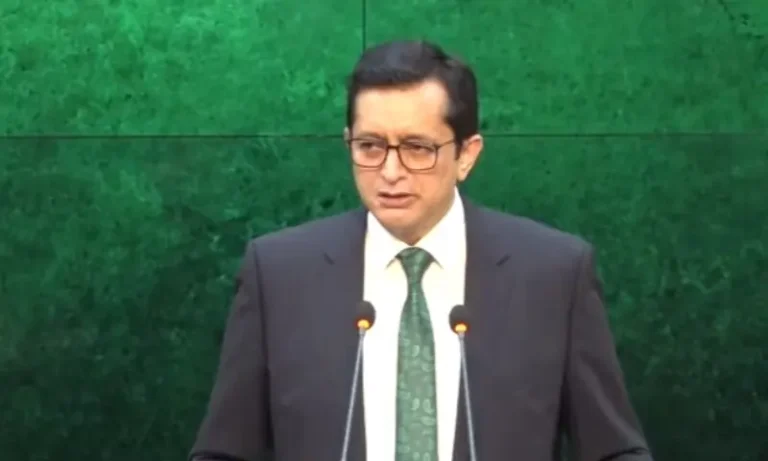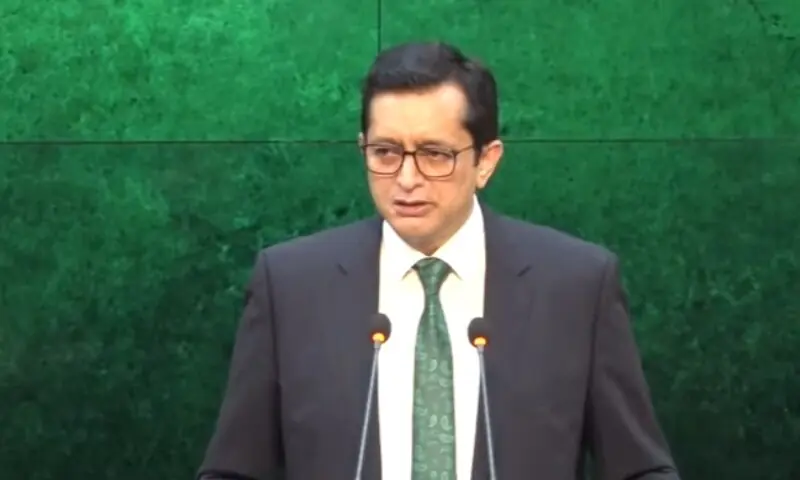
Pakistan’s first Economic Summit, held in Islamabad on Thursday, was designed to bring together business leaders and policymakers to discuss economic direction. The Federal Minister for Interior Mohsin Naqvi told the audience that he usually avoids making political speeches but felt it was necessary to speak about politics on this occasion, signaling that his intervention was meant to be taken as more than routine commentary.
Naqvi told those gathered that they, too, shared some responsibility for the country’s current condition, and said the existing system the country operates under has effectively broken down. His framing suggested that Pakistan’s difficulties are not purely economic in nature but tied to how the state itself is organized and run. He noted that representatives from Sindh, Punjab, Balochistan, and Khyber Pakhtunkhwa had each described problems specific to their provinces, using this as evidence that governance strain is being felt unevenly across the country rather than in one region alone.
Reflecting on his three and a half years within the political system, Naqvi said that without meaningful change, the same issues are likely to still be under discussion a decade from now. He also discussed the ways that change could be achieved. He clarified that he supports democracy but said there is more than one way a democratic system can be structured, and that new administrative units or provinces were one option worth considering, though he did not present this as the only solution or offer specific details.
A recurring theme in his remarks was a distinction between visible, easily announced measures and the harder work of institutional reform. He said that providing young people with modest cash payments or tablets is not, by itself, sufficient, and that the country’s more basic problems need to be resolved first. He also asked directly who would take responsibility for making those changes, a question that read as a challenge to those in the room as much as a statement of his own position.
Why the Setting Matters
The choice of venue is worth noting. Economic summits typically emphasize investment climate, fiscal policy, and business confidence, and Naqvi is generally seen as a minister with a measured public tone. It is noteworthy that he did not limit his remarks to economic policy and instead raised concerns about governance structure, implying that he believed there was a linkage between them and that continued economic growth might be hard to achieve without tackling more fundamental issues of governance and service delivery first.
It is also worth being cautious about reading too much into the remarks. Naqvi did not announce a policy, propose a specific number of new provinces, or lay out a timeline. His remarks were more of an observation and perhaps a hint of what the government was thinking than a formal proposal. Administrative reform of the magnitude he intimated would, in any event, necessitate constitutional amendment and a significant degree of political accord, and such measures tend to be slow to materialize, even if a single speech focuses upon them.
Naqvi’s remarks also come when the debate on provincial structure has already been raised in other parts of the country as well, by regional political parties voicing their concerns over fiscal issues. Naqvi’s remarks are best understood as one part of a wider, ongoing conversation about how Pakistan’s institutions function, rather than a standalone announcement, and it will likely take further statements from other officials to clarify whether his comments reflect a shift in government thinking or a personal observation offered in the moment.

Our Editorial Desk is the intellectual engine of Digital Debate, responsible for the rigorous research that anchors every conversation. Our team deep-dives into data, checks every source, and consults academic literature to move beyond headlines and identify the questions behind the questions.