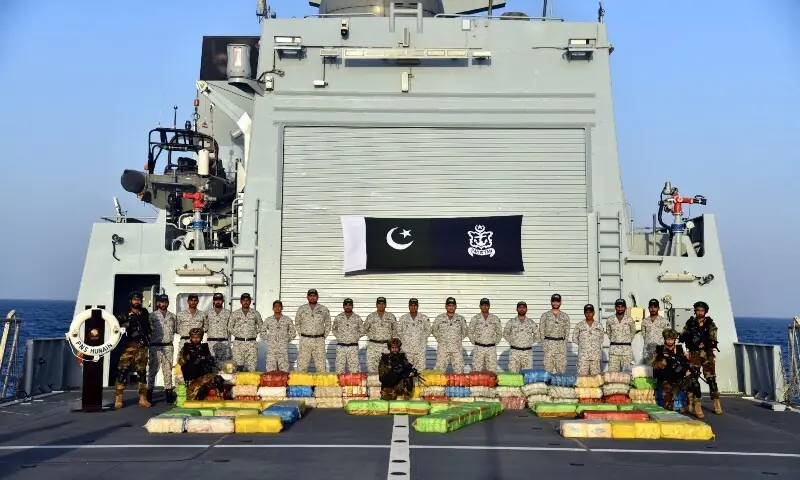

A joint Pakistan-U.S. operation, coordinated with Sri Lankan authorities, seized roughly 463kg of Afghan-origin crystal meth worth an estimated $21 million. Officials are calling it a major counter-narcotics success, and it is. But the bust also exposes both the strength of current regional enforcement cooperation and the stubborn realities that keep large-scale drug trafficking alive in South Asia.
This operation proves the value of port-level intelligence and cross-border coordination. Pakistan’s Anti-Narcotics Force (ANF) flagged suspicious containers at Karachi before they left Pakistani waters.
That early warning went to the U.S. DEA, then to Sri Lanka’s Police Narcotics Bureau in Colombo, allowing authorities to intercept the shipment at a critical transshipment point. This is how modern anti-trafficking work is supposed to function: risk profiling at origin ports, real-time information sharing, and synchronized action at destination or transit hubs.
The meth was hidden in bath towels, a classic concealment method. That detail is a reminder that human judgment and targeted screening still matter, even as scanners and data analytics improve.
A Seizure That Exposes Scale and Sophistication
Still, the scale of the seizure calls for sober reflection, not just celebration. 463 kilograms of high-purity crystal meth is not a small-time operation. It points to a well-resourced network with access to production, logistics, and international distribution channels.
Calling the drugs “Afghan-origin” and the network Pakistan-based fits a long-standing pattern: Afghanistan remains a major producer of synthetic drugs alongside opiates, and Pakistani ports and overland routes continue to be exploited to move narcotics toward the Middle East, Africa, and Southeast Asia.
Colombo’s role as a transshipment hub makes it an ideal handoff point, which is exactly why traffickers use it, and exactly why this interception mattered.
The timing matters too. This bust comes amid a broader spike in meth seizures across Pakistan and the region, including a separate Karachi case where police say they disrupted an Afghanistan-linked “ice” supply network and seized nearly 20kg of meth.
Together, these cases suggest either intensified law enforcement pressure, an attempt by trafficking groups to push larger volumes through existing routes despite the risk, or both. Either way, they show how deeply drug logistics are embedded in the regional economy, and how hard it is to dismantle networks that can absorb losses this large and keep operating.
Unanswered Questions on Accountability and Transparency
Real questions about transparency and accountability remain unresolved. Sri Lankan authorities have reportedly opened an internal probe into “shortcomings and irregularities” around the Colombo port raid, and the U.S. Embassy in Colombo has declined to comment on that investigation.
Public details on the arrests, including how many suspects were caught, their nationalities, specific charges, and whether any high-level facilitators were among them, are still thin.
For a case this size, vague references to “several suspects, including Pakistani nationals” leave room for speculation and weaken the deterrent message these operations are supposed to send.
From a policy standpoint, this operation reinforces a few priorities. First, it justifies continued investment in port security, container profiling, and joint task forces linking ANF, DEA, and South Asian narcotics bureaus. Second, it underscores the need for more systematic information sharing, not just on seizures but on financial trails, shipping companies, and front entities that enable these movements.
Third, it points to the need to balance enforcement with prevention and treatment: as long as demand for meth stays high in consumer markets, new networks will keep emerging to replace the ones that are disrupted.
What This Means for Pakistan and the Region
For Pakistan, the takeaway cuts two ways. On one hand, the ANF’s ability to detect and act on suspicious cargo at Karachi shows institutional capacity that deserves support and expansion.
On the other, the repeated appearance of Afghanistan-linked networks using Pakistani territory should push a deeper conversation about border management, corruption risks at ports, and the economic pressures that make communities vulnerable to recruitment by traffickers.

Enforcement wins matter, but they won’t hold unless Pakistan also addresses the conditions, corruption, weak oversight, and economic hardship, that let these networks keep operating.
In the end, this bust is a real win, but it’s also a reminder: seizing 463kg of meth stops one shipment, not an industry. The real test is whether this momentum turns into sustained pressure on the financial and logistical infrastructure behind these networks, matched by real transparency about arrests and prosecutions.
Only then does a single operation become part of a pattern that actually weakens the region’s drug trafficking capacity, instead of just interrupting it for a while.

Our Editorial Desk is the intellectual engine of Digital Debate, responsible for the rigorous research that anchors every conversation. Our team deep-dives into data, checks every source, and consults academic literature to move beyond headlines and identify the questions behind the questions.