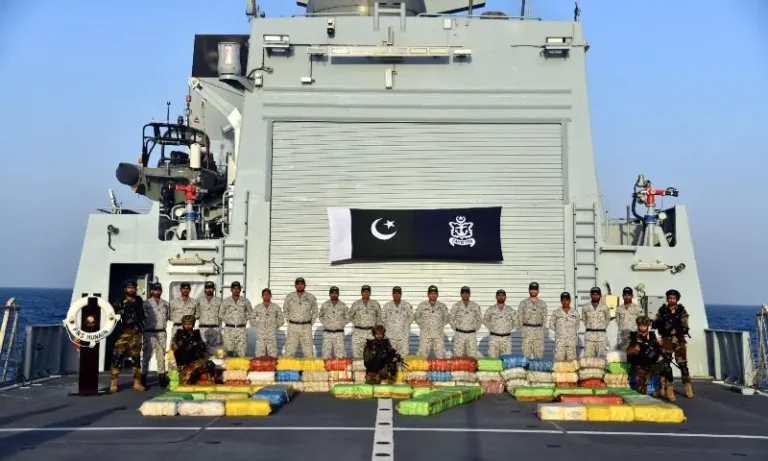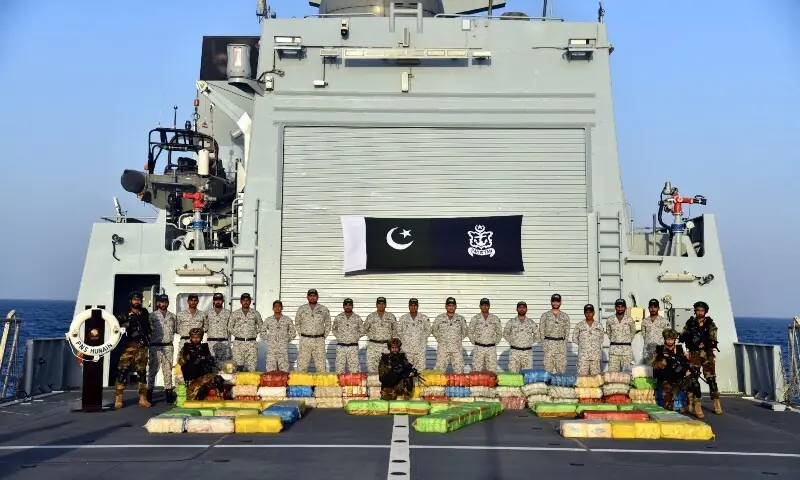

The Pakistan Navy has pulled off a major counter-narcotics operation in the Arabian Sea, seizing more than 2,800 kilograms of illegal drugs with an estimated international market value of around USD 750 million.
Two frontline warships, PNS HUNAIN and PNS YARMOOK, intercepted a suspicious vessel during routine maritime security patrols and, after a boarding and search, recovered the narcotics from hidden compartments, according to the Inter-Services Public Relations (ISPR).
As per the ISPR statement, the two ships were on a standard patrol mission aimed at maintaining security and stability in Pakistan’s maritime approaches when they identified and flagged down a boat showing suspicious behavior.
A naval boarding team went aboard and carried out a detailed inspection, during which a large quantity of narcotics was found stashed in specially built compartments designed to evade detection.
The seizure, valued at roughly USD 750 million, is one of the largest single maritime drug busts publicly reported by Pakistan in recent years and highlights how sea routes continue to be used for large-scale smuggling.
The operation was conducted under the Navy’s ongoing Maritime Security Operations framework, which focuses on denying criminal and terrorist networks the use of the sea for illicit trafficking, smuggling, and other unlawful activities.
In reaffirming the Navy’s commitment to maritime security, the ISPR noted that such interdictions are a regular part of patrols in the Arabian Sea, where Pakistan cooperates with regional and international partners to monitor key shipping lanes and stop suspicious vessels.
The latest seizure adds to a string of high-profile counter-narcotics operations in the North Arabian Sea, including earlier interdictions of methamphetamine and cocaine consignments under multinational task forces.
At the national level, the operation has drawn strong appreciation from the country’s leadership. President Asif Ali Zardari commended Pakistan Navy personnel for their professionalism, vigilance, and effectiveness in disrupting illicit trafficking networks at sea.
The presidential commendation reflects the strategic importance Islamabad attaches to maritime security, not only as a defense priority but also as a critical element in broader efforts to combat organized crime, drug financing, and cross-border smuggling.
Following the seizure, standard procedure calls for the narcotics to be handed over to the relevant anti-narcotics authorities, such as the Anti-Narcotics Force (ANF), for forensic examination, legal case registration, and further investigation.
Investigators are expected to focus on identifying the vessel’s origin, the nationality and affiliations of those on board, the intended destination of the consignment, and any links to larger smuggling syndicates operating across the region.
Such inquiries often involve coordination between naval intelligence, law enforcement agencies, and, where applicable, international counterparts, given the transnational nature of drug trafficking routes in the Arabian Sea and adjoining waters.
The scale of this interdiction also carries wider implications for regional security and public health. Large drug consignments moving by sea are frequently tied to organized crime groups that exploit weak governance zones, conflict-affected areas, and complex maritime traffic to move illicit cargo.
By removing a significant quantity of narcotics from circulation, the Pakistan Navy has not only disrupted a major smuggling attempt but also signaled its capacity to detect and act against sophisticated concealment methods used by traffickers.
For domestic audiences, the operation reinforces the role of the armed forces in supporting civilian agencies on issues that straddle security, law enforcement, and public welfare.

Our News Desk represents a rapidly expanding frontier in contemporary journalism, focusing on the intersection of technological advancement, geopolitical narratives, and the shifting dynamics of public information.