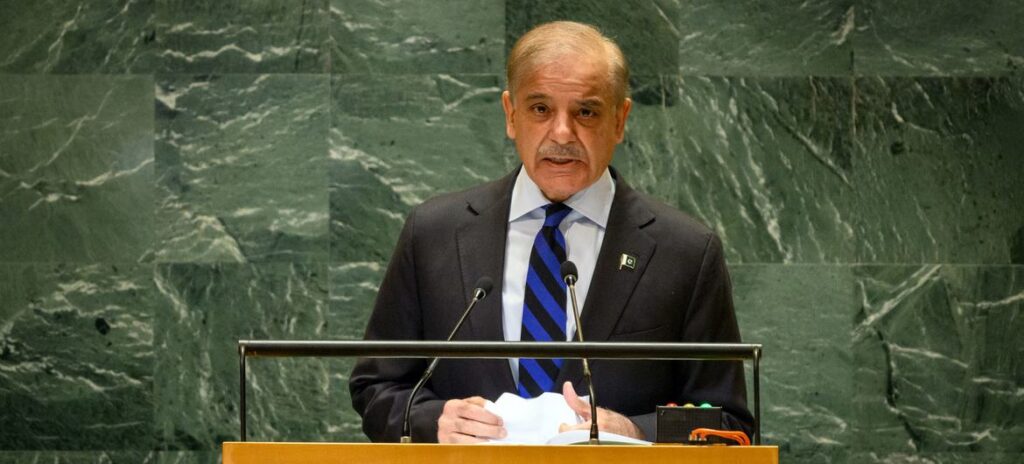

Prime Minister Shehbaz Sharif’s address to the 81st UN General Assembly was less a routine national statement than a carefully staged doctrine of peace backed by deterrence.
Over 24 minutes, he moved from Middle East mediation to South Asian flashpoints, from Gaza’s moral test to Pakistan’s economic and climate case, all under one unifying claim: trust will not return through rhetoric, but through concrete choices that privilege dialogue over escalation and cooperation over coercion.
The speech’s strongest through‑line was its reframing of diplomacy as courage. Shehbaz Sharif insisted that war is a choice, but so is peace, and that the harder and braver task is often to prevent conflict rather than to win it.
He anchored this argument in Pakistan’s recent role as a “sincere and honest mediator” between Washington and Tehran, recalling the June Islamabad Memorandum of Understanding signed by himself, President Trump and Iranian President Masoud Pezeshkian.
That deal, he said, was designed to halt hostilities, reopen the Strait of Hormuz and launch talks on sanctions and Iran’s nuclear programme. Even as he acknowledged that events after the signing became unpredictable, he noted that Pezeshkian has reaffirmed the MoU remains acceptable to Iran, signaling that Islamabad intends to keep this diplomatic channel alive.
That mediation logic extended to the broader Middle East. Shehbaz Sharif pressed for the Strait of Hormuz and Bab al‑Mandeb to remain open as arteries of global trade, warning that these waters must carry “the promise of prosperity, not the perils of war.”
On Saudi Arabia, his tone hardened: he condemned Houthi attacks and declared any threat to the safety and sanctity of the Haramain Sharifain a red line that must never be crossed.
He also clarified that the Pakistan–Saudi–Türkiye Makkah Joint Defence Agreement is not aimed at any country, but is a collective commitment to regional stability an important nuance for audiences wary of new Cold‑War‑style blocs.
South Asia’s Flashpoints: Kashmir, Water and the War on Gaza
On South Asia, Shehbaz Sharif returned to last year’s cross‑border clashes with India, stating that Pakistan acted in self‑defence and that its armed forces, under Field Marshal Asim Munir, responded with “precision and professionalism.”
He credited President Trump’s intervention at a critical moment with helping prevent further escalation between the two nuclear‑armed neighbours. He then tied lasting regional peace to a just settlement of Jammu and Kashmir, calling the dispute Pakistan’s “jugular vein” and reiterating support for UN‑mandated self‑determination.
In his speech, he accused India of “arbitrary detentions, extrajudicial killings, enforced disappearances, sexual violence, and collective punishment” in Indian‑administered Kashmir, and alleged that New Delhi is seeking to alter the territory’s legal status and demographic character through unilateral measures.
On water, Shehbaz Sharif described the Indus system as the “lifeblood” of Pakistan and the wider region. He rejected India’s decision to hold the Indus Waters Treaty in abeyance as having “no legal basis,” and said the position taken by UN experts and the Court of Arbitration had “vindicated Pakistan’s stance” on the treaty’s continuing validity.
His warning was explicit: “Pakistan would regard any attempt by India to stop, impede or divert its rightful share of the waters as an act of war,” adding, “India must make no mistake about it.”
On Gaza, Shehbaz Sharif devoted a significant portion of his address to the suffering of Palestinians. He invoked the deaths of children, including Hind Rajab and eight‑year‑old Wafaa Akila, asking,
“Does not a child born in Gaza deserve the same life, the same future and the same dream as a child anywhere else in the world?” He called their tragedies “an indictment of our collective silence and inaction,” condemned widening violence in the West Bank, Lebanon and Syria, and restated Pakistan’s position that an independent and viable Palestinian state based on the pre‑1967 borders, with Al‑Quds Al‑Sharif as its capital, offers the only just and lasting solution.
Domestically, the speech doubled as a progress report and a pitch. Shehbaz Sharif cited nearly 100,000 Pakistani civilians and security personnel killed and over $150 billion in losses in the fight against terrorism, warning that Afghan soil continues to be used by the TTP and BLA to destabilize Pakistan.
He called on the Taliban to take verifiable action against such groups and to respect Afghan women’s and girls’ rights. On the economy, he argued that structural reforms and fiscal discipline have stabilized Pakistan, outlining plans to modernize agriculture and industry, develop mineral resources, digitize the economy and build AI and IT skills among youth.
He praised China’s global development initiatives and pressed for faster debt relief, cheaper long‑term financing and a stronger voice for developing countries in global financial institutions. On climate, he stressed that Pakistan contributes under 1% of global emissions yet suffers severe impacts, urging developed countries to meet finance commitments and accelerate loss‑and‑damage funding.
The closing argument returned to trust. Shehbaz Sharif insisted that trust cannot be restored by words alone; it must be earned when rivers become tools of cooperation rather than triggers for conflict, when those who fuel the climate crisis protect the most vulnerable, and when guns give way to handshakes.
His final line was not a policy detail but a plea: choose peace for the people alive today and for generations to come.
Shehbaz Sharif presented Pakistan as a state that wants diplomacy to work, yet is prepared to mark clear red lines where it perceives existential stakes on water, on Kashmir, and on the sanctity of the Haramain.
The test now is whether that combination of mediated openings and firm deterrence can translate into measurable de‑escalation in the region, or whether it will remain another well‑crafted statement in a crowded UNGA week.

Our Editorial Desk is the intellectual engine of Digital Debate, responsible for the rigorous research that anchors every conversation. Our team deep-dives into data, checks every source, and consults academic literature to move beyond headlines and identify the questions behind the questions.