The government is racing a Senate election, a governor’s rule, and a constitutional amendment at the same time. A deadline can force a decision. It cannot replace consent.
Three dates and one vote now sit on the table.
The first week of March 2027 brings Senate elections. On 10 April 2027, governor’s rule in Khyber Pakhtunkhwa could end. In the first half of 2027, the proposed 28th Amendment could arrive. And before it, a referendum may come.
The new provinces debate began as a constitutional question. It is now also a calendar problem.
The clock the government is watching
Government sources say progress on new provinces is considered necessary before the Senate elections. Reports say a referendum could be held before the 28th Amendment, and the government is considering asking the Federal Constitutional Court to clarify the referendum’s legal status. Early plans place the amendment in the first half of 2027, with initial steps in the first quarter.
If the PPP and PTI do not support the amendment, sources say the government could turn to Parliament to pursue the referendum route.
Why March matters
Forty-eight Senate seats come up in 2027. Twelve are from Khyber Pakhtunkhwa, which has been under governor’s rule since 11 October. Officials say that rule could run until 10 April, which threatens the province’s Senate polls.
Pakistan has seen this before. In 2024, Senate elections slipped to 2 April after the PTI boycott, which demanded the postponement until KP’s Senate elections were held.
The Senate also carries a deeper question. It was created to give the provinces equal representation. A Senate built for four equal provinces cannot absorb ten or twelve without redesign. That is a reading, and it is a reason to plan the transition, not to rush it.
The steps have an order
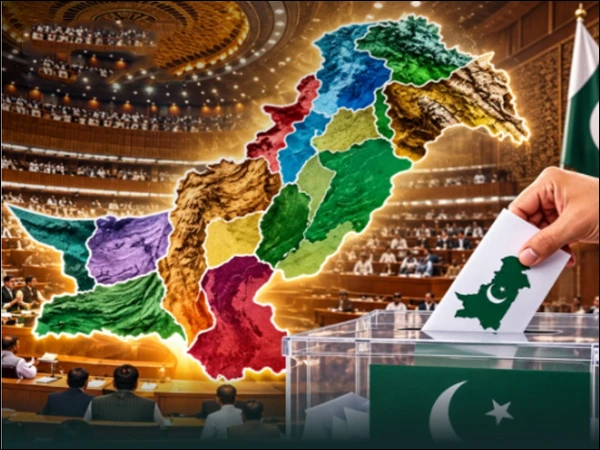
The process runs in a fixed sequence. Under Article 48(6), a joint sitting of Parliament must first approve a referendum. The question can be answered only with yes or no. A referendum itself would not create a province, because boundary changes must still follow the constitutional process.
That process is Article 239. It requires two-thirds of both houses and two-thirds of each affected provincial assembly. After that, the Election Commission has to redraw constituencies. The last exercise, after the 2023 census, produced final delimitations on 14 December 2023. New assemblies, budgets and institutions follow.
Each step takes months. Compress them, and the whole structure invites a legal challenge.
Politics sets the pace
The calendar does not run itself. President Zardari and PM Shehbaz reportedly agreed that Parliament cannot be bypassed, and Zardari reiterated PPP opposition to dividing Sindh. Parliamentary Affairs Minister Tariq Fazal Chaudhry said no initiative will proceed without the agreement of all allied parties.
Sindh Chief Minister Murad Ali Shah called the proposal outdated and warned that no bloodshed would be allowed over it. The Punjab Speaker backs a referendum. A resolution on new provinces is also expected in the Balochistan Assembly.
Coalition arithmetic will decide the timing as much as any date on a page.
A calendar that serves the reform
Pakistan needs new provinces. A country of 241 million cannot keep running on a map built for a smaller population. But a reform this large needs a roadmap, not a sprint to March.
Six milestones would keep it lawful and credible:
- An all-party parliamentary committee, formed this winter.
- An early reference to the Federal Constitutional Court, so the referendum’s legal status is settled before anyone votes.
- Published maps, budgets and a plan for Senate representation.
- A referendum, only after those steps, and only if the court and Parliament approve it.
- March Senate elections held on the current map, with KP’s polls on time.
- Then the amendment and the delimitation, in that order.
Deadlines can focus a government. They cannot manufacture consent. New provinces will last only if Pakistan sets the date after it has done the work.
Read More: Mohsin Naqvi’s Referendum Plan: New Provinces, Lawful Route

Our Editorial Desk is the intellectual engine of Digital Debate, responsible for the rigorous research that anchors every conversation. Our team deep-dives into data, checks every source, and consults academic literature to move beyond headlines and identify the questions behind the questions.