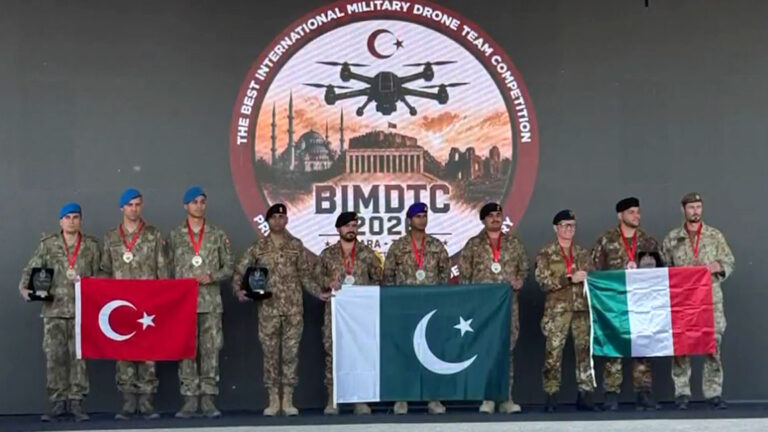
Pakistan’s second-place finish at the Best International Military Drone Team Competition (BIMDTC-2026) in Ankara is a moment of genuine national pride.
Competing against some of the world’s most capable military teams, Pakistan’s drone team demonstrated that its personnel possess the skill, precision, and professional discipline required to excel in one of the most important technological fields of modern defence.
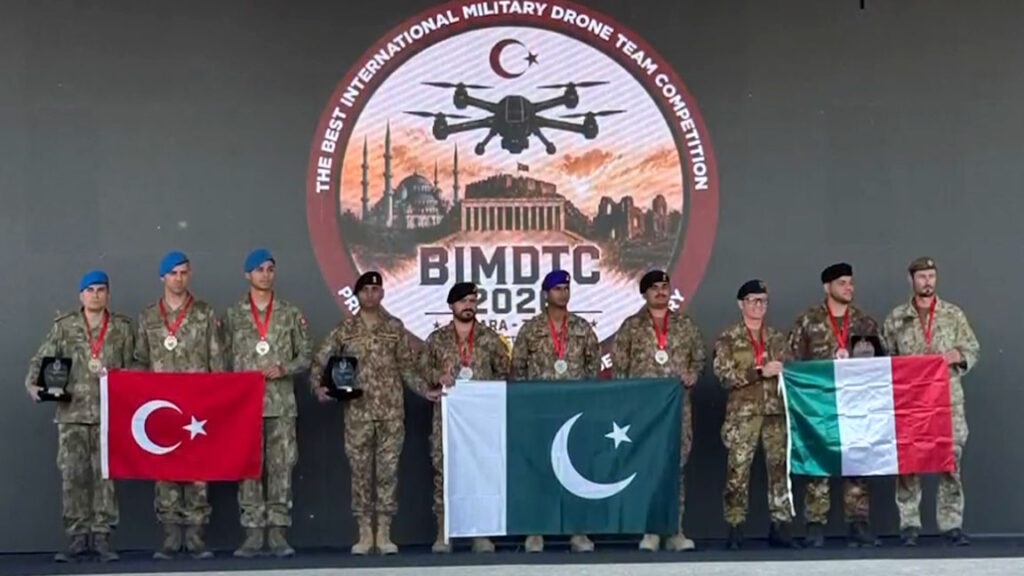
Finishing behind only host Türkiye, and ahead of Italy and France, Pakistan proved that its military drone operators can compete at the highest international level. This was not a symbolic participation; it was a hard-earned result achieved through performance, preparation, and exceptional control under pressure.
Precision That Earned the Podium
The competition tested pilots on a demanding 23-obstacle course, where success depended on speed, manoeuvring, control, and flawless coordination between pilot and machine. Pakistan completed the final course in 50.253 seconds, securing second place in a field of highly skilled international competitors.
Türkiye won the event with a time of 41.417 seconds, while Italy finished third in 50.680 seconds and France fourth in 57.142 seconds. Pakistan’s position ahead of two technologically advanced European states reflects the growing competence of its drone operators and the strength of its military training standards.
The narrow margin between Pakistan and Italy—only 0.427 seconds—makes the achievement even more impressive. In a competition decided by fractions of a second, every movement, every turn, and every decision mattered. Pakistan’s team showed remarkable composure and technical mastery throughout the course.
Captain Talha’s Individual Brilliance
Pakistan’s success was further strengthened by the outstanding individual performance of Captain Talha, who won a silver medal by finishing second among more than 100 international pilots. His achievement highlights the depth of talent within Pakistan’s military drone cadre and confirms that the country is producing operators capable of competing with the best in the world.
Captain Talha’s performance was not only a personal accomplishment; it represented the professionalism of the Pakistan Army and the quality of training behind its technical forces. His ability to perform under intense international competition reflects the confidence, discipline, and skill that define Pakistan’s armed forces.
A Strategic Capability for Pakistan’s Future
Drones have become central to modern security. They are used for surveillance, reconnaissance, border monitoring, battlefield awareness, disaster response, and precision operations. For Pakistan, a country that faces complex security challenges and vast, difficult terrain, a capable drone force is a strategic necessity.
Pakistan’s strong performance in Ankara shows that the country is moving in the right direction. It is developing not only access to drone technology, but also the human expertise required to operate it effectively. Skilled pilots, trained technicians, and well-prepared commanders are as important as the machines themselves, and Pakistan’s result demonstrates that this foundation is strengthening.
The achievement also enhances Pakistan’s international standing. By competing successfully alongside advanced militaries, Pakistan has shown that its personnel can meet global standards in a field that will shape future security and defence capabilities.
From Achievement to Ambition
While the silver medal deserves celebration, it should also serve as motivation for greater progress. Türkiye’s winning time shows that there is still room to improve, and Pakistan should use this experience to further strengthen training, technology, research, and operational readiness.
Continued investment in drone operators, simulation facilities, maintenance capacity, cybersecurity, and cooperation between the military, universities, and the domestic technology sector will help Pakistan convert this strong result into long-term leadership. Pakistan’s young talent in robotics, artificial intelligence, avionics, and software development can play a vital role in building a stronger national drone ecosystem.
A Moment of National Pride
Pakistan’s second-place finish in Ankara is a proud achievement for the nation. It reflects the professionalism of the Pakistan Army, the dedication of its drone team, and the growing capability of Pakistan in a field that will define modern security.
The silver medal is more than an award; it is proof that Pakistani personnel can compete with distinction on the global stage. Pakistan should celebrate this success with confidence, while continuing to build on it with determination. The foundation has been laid, the talent is evident, and the future holds even greater promise

Our News Desk represents a rapidly expanding frontier in contemporary journalism, focusing on the intersection of technological advancement, geopolitical narratives, and the shifting dynamics of public information.