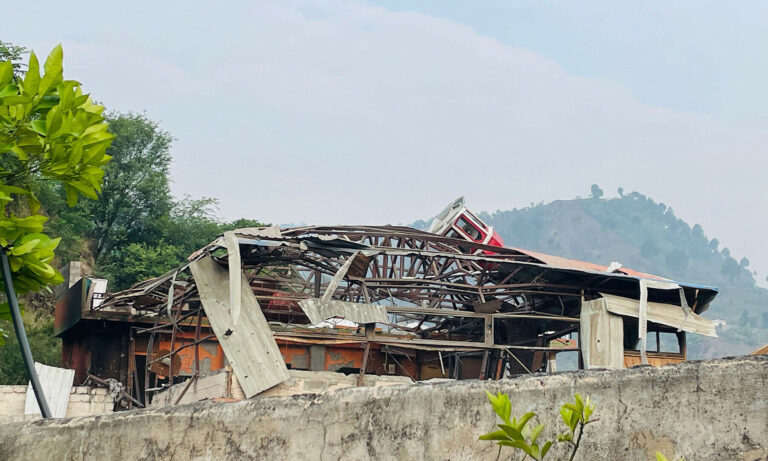
Pakistan topped the Germanwatch Climate Risk Index 2025, alongside Belize, as the nation hardest hit by extreme weather events in 2022. It ranks as the 5th most climate-vulnerable country in the world according to the Global Climate Risk Index, and 23rd out of 194 countries on the 2024 Inform Risk Index. The 2022 floods alone affected 33 million people and caused damages of Rs 3.2 trillion ($14.9 billion). The federal budget for FY2026-27, tabled in June, does not match that risk profile.
The PSDP allocation for the Ministry of Climate Change and Environmental Coordination has decreased from about Rs 14.3 billion in FY2021-22 to Rs 2.48 billion in FY2026-27, a drop of 83% in five years. The federal PSDP now accounts for approximately 0.25% of the Ministry’s total PSDP.
Given that the government itself frames the budget as a climate budget, it’s difficult to get a handle on the numbers at first glance. In FY2026-27, the government expects to collect approximately Rs 2.026 trillion through climate and green-linked revenues and levies, including Rs 1.676 trillion from the Petroleum Levy, Rs 50 billion from a newly introduced Climate Support Levy, Rs 22.5 billion from an EV Adoption Levy, and Rs 70.8 billion from the Gas Development Surcharge. The income structure appears significant. Things are quite different on the spending side.
Around Rs 10.6 is spent on climate-tagged action for every Rs 100 collected through climate and green-linked fiscal measures. The remaining Rs 89.4 goes to the general treasury. The tax contribution by each Pakistani to climate change is an average of Rs 8,190 per year, whereas the direct climate spending per capita is only Rs 890 per year.
Where the Money Actually Went
The budget did increase one climate-related line item. Disaster allocations reached Rs 116.2 billion, a 132% increase over the previous year. This rise is a big one on its own. It indicates a strong preference for reacting to disaster rather than preventing it. The two approaches are not interchangeable. Disaster response spending covers emergency relief, displacement management, and infrastructure repair. Adaptation spending covers early warning systems, flood-resistant construction, irrigation modernization, and land management. One is reactive. The other is structural.
Climate experts have repeatedly criticized what they describe as “anti-climate policies” in the budget, particularly attempts to tax renewable energy, which they argue undermine the climate-smart policy direction encouraged by recent IMF and World Bank programmes. The Resilience and Sustainability Facility of the IMF mandates that at least 30% of the project appraisal weighting of the infrastructure projects take climate adaptation and mitigation criteria into account. In the outgoing fiscal year, at least Rs 86 billion worth of PSDP projects were tagged as climate adaptation. Budget tagging, however, is not the same as budget delivery. Even a project that is climate-sensitive needs to be designed, funded and implemented to yield a climate outcome.
Dr Fahad Saeed, who leads the Weather and Climate Services think tank in Islamabad, has pointed out that scientific evidence is missing from Pakistan’s climate policymaking. The government allocates money for climate action without conducting a cost-benefit analysis based on evidence, and without knowing whether the money will be invested in mitigation, adaptation, or loss and damage.
What the Gap Costs
If climate change continues its current trajectory, Pakistan’s GDP faces a shrinkage of up to 21.1% under a high-emission scenario. Agriculture, forestry, and fisheries alone are projected to account for a combined 12% loss in Pakistan’s GDP, the highest impact among all countries analyzed in the Asia-Pacific Climate Report 2024. Agriculture in Pakistan depends significantly on the Indus Basin, producing about 90% of the country’s food. Extreme heat events in Pakistan have become up to 30 times more likely. Outburst floods from glacial lakes, seasonal dry spells, and irregular monsoon patterns are well documented and frequent.
The Rs 2.4 billion allocated for climate resilience projects in FY2026-27 is $8.6 million. The PSDP package consists of ecological restoration, youth green skills and urban resilience projects. These are worth doing. They are not scaled to the problem.
Pakistan has always and correctly said in international forums that it is responsible for less than 1% of global GHG emissions and is facing costs that are equivalent to a much higher proportion of the climate damages caused globally. The cost of reconstruction from the 2022 floods was already more than USD 14 billion. The need for international climate finance is clear and undeniable. It does not, however, address the question that the domestic budget poses: If Pakistan is concerned about the most vulnerable populations, why does the revenue collected by the country through the levies it imposes, which are linked to the climate, not reach the same groups?
Unless climate revenues are connected to climate outcomes through transparent financing, measurable results, and institutional accountability, Pakistan risks taxing climate vulnerability without reducing it.
The position that Pakistan is in on the Global Climate Risk Index is a result of decades of exposure, geography, and low adaptive capacity. A budget that raises Rs 2 trillion in climate-related revenues and allocates Rs 212 billion for climate action steps will not fill that gap. It provides funding for a system in which the fiscal logic of climate doesn’t follow the physical one. Closing the gap between what Pakistan collects in the name of climate and what it spends on climate outcomes is a policy choice. The FY2026-27 budget did not make it.

Our Editorial Desk is the intellectual engine of Digital Debate, responsible for the rigorous research that anchors every conversation. Our team deep-dives into data, checks every source, and consults academic literature to move beyond headlines and identify the questions behind the questions.