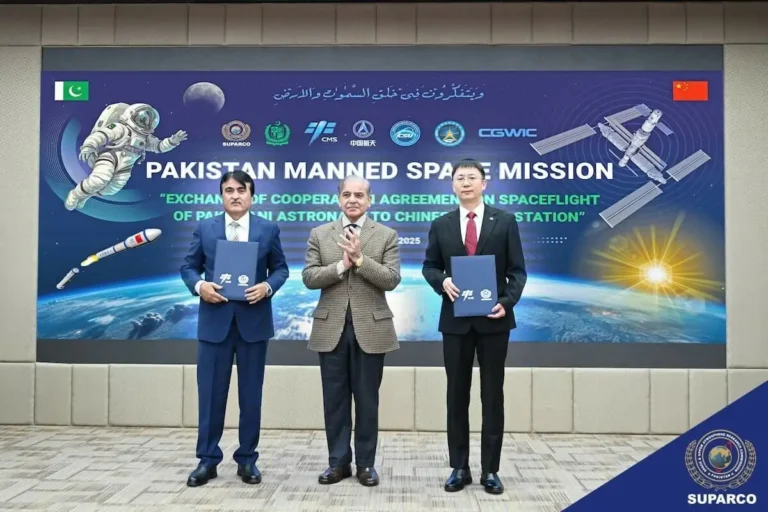

Pakistan launched Quantum Valley Pakistan on Wednesday, a national initiative to link the country’s youth, startups, and entrepreneurs with global tech hubs like Silicon Valley and Boston. Federal Minister for Planning, Development and Special Initiatives Ahsan Iqbal called the launch the start of a new direction for Pakistan’s economy, innovation, and technology.
“Today is not merely the inauguration of a project; it marks the beginning of a new direction for Pakistan’s future,” Iqbal said at the ceremony in Islamabad.
The event brought together Tim Rowe, CEO of the Cambridge Innovation Center (CIC), Dougan Sherwood, Partner at CIC, and Seena Amidi, Managing Partner at Plug and Play. The government signed two separate agreements, one between CIC and Quantum Valley Pakistan, and another between Plug and Play and Quantum Valley Pakistan, to strengthen technological collaboration and support the country’s innovation ecosystem.
Quantum Valley Pakistan will connect academia, startups, investors, industry, and government under one platform, with priority sectors including artificial intelligence, quantum computing, FinTech, AgriTech, biotechnology, Med Tech, and autonomous technologies. The Global Acceleration Program anchors the plan: selected startups get 15 weeks of structured mentorship, followed by a two week immersion in Silicon Valley or Boston, where entrepreneurs work directly with international investors and tech companies to refine their products and business models.
Ashan Iqbal linked the initiative to the government’s broader economic targets, a $1 trillion economy by 2035 and a $3 trillion economy by 2047, along with a goal of raising exports to $100 billion by 2035. “Achieving a $1 trillion economy by 2035 is certainly difficult, but it is not impossible,” he said, pointing to Pakistan’s roughly 260 million population and nearly 60 percent youth share as an economic asset the country needs to convert into foreign exchange earnings.
Quantum Valley Pakistan builds on the National Centres set up in 2017 for AI, cybersecurity, big data, cloud computing, robotics, GIS and space technology, applied mathematics, and livestock and genomics. It also extends the government’s URAAN Pakistan framework, launched in 2024, under the “E Pakistan and digital economy” pillar. Iqbal said the initiative marks a shift in Pakistan’s IT sector, from exporting services to building its own tech products, platforms, and startups, and framed it as a step toward turning the country’s young population from job seekers into creators of knowledge and technology.

Our News Desk represents a rapidly expanding frontier in contemporary journalism, focusing on the intersection of technological advancement, geopolitical narratives, and the shifting dynamics of public information.