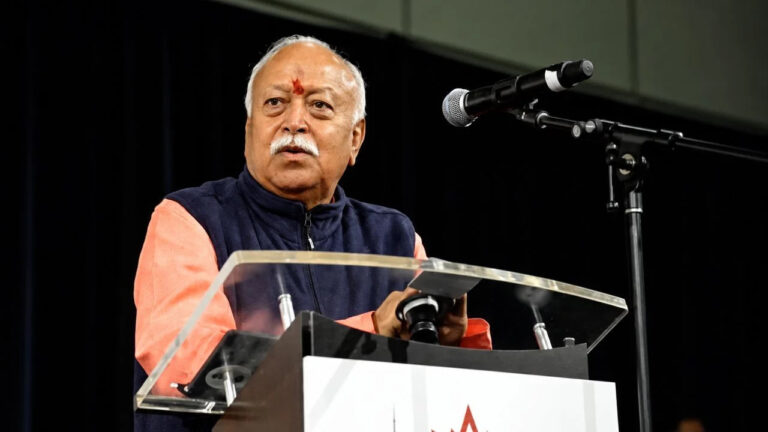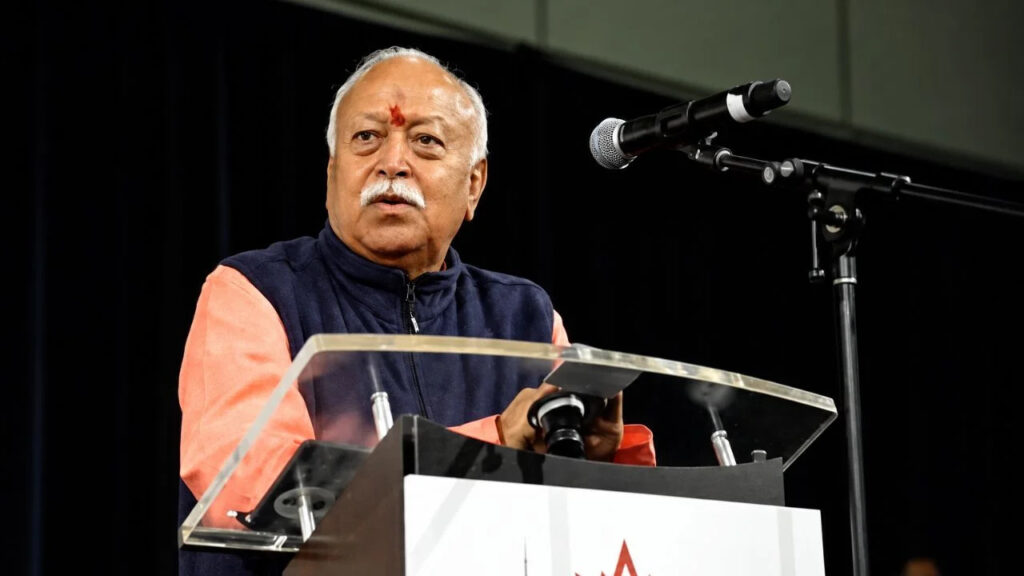

London, September 7, 2026 — Hundreds of protesters gathered in Parliament Square on Sunday to oppose the UK leg of RSS chief Mohan Bhagwat’s three-nation tour, which also included stops in New York and Toronto. The demonstration, organised by the South Asian Solidarity Group with support from the Indian Workers Association (Great Britain) and other diaspora organisations, marked the culmination of a week of controversy including an unannounced visit to a central London gurdwara.
The Rashtriya Swayamsevak Sangh (RSS) is a Hindu nationalist volunteer organisation founded in India in 1925. Widely seen as the ideological parent of India’s ruling Bharatiya Janata Party, the RSS promotes Hindutva a doctrine defining Indian national identity in Hindu cultural and civilisational terms.
During his London visit, Bhagwat described Hindu identity as a matter of nature rather than narrow religion, and urged British Hindus to prioritize loyalty to their country of residence, using the phrase karma bhoomi (“land of duty”).
Critics, however, argue that this framing implicitly casts religious minorities particularly Muslims and Christians as outsiders to full national belonging, pointing to what they describe as majoritarian politics that have fueled polarization in India.
Why Protesters Objected
More than 20 diaspora and civil society groups reportedly signed a letter warning officials that the visit could embolden RSS-linked activity in Britain and deepen divisions within the diaspora. The letter also cited a British High Commission report said to describe the 2002 Gujarat riots in terms of ethnic cleansing. Some campaigners whose specific organisations remain unconfirmed described the RSS as authoritarian and militarist, with roots in European fascism. Protest signs read “fascism is not welcome in London,” a characterization RSS supporters reject. Bhagwat’s stop at the Khalsa Jatha British Isles Gurdwara reportedly occurred without the congregation present, and the Sikh Federation UK criticized the arrangement, saying it undercut the RSS’s stated message of unity. Much of the protest’s energy was also aimed at British authorities for extending a formal welcome without addressing the group’s ideology.
A Tour Marked by Secrecy
Organisers say most of the UK schedule was not publicly announced, with venues and timings often surfacing only after events had already occurred. Some protesters speculated without confirmation from tour organisers that this was a deliberate response to backlash faced earlier in New York and Toronto.
At a closing reception at the Bentley Hotel on Gloucester Road, a crowd gathered with barely a day’s notice after word spread informally. Multiple attendees reported that Bhagwat left through a back or service exit rather than the front entrance where protesters had assembled. This detail remains officially unconfirmed, though it has been consistently repeated by those present.
More than 100 British Hindu organisations issued statements backing the tour, according to their own count. Many diaspora members say they know the RSS primarily through local volunteer work, and see its centenary messaging on social harmony and civic duty as an affirmation of identity rather than a political statement.
The Core Disagreement
At its heart, the dispute reflects two different standards of judgment: supporters evaluate the RSS by its stated values and community service, while critics judge it by its historical record and political influence. Both perspectives capture something real about the organisation which is why the same tour reads as outreach to one side and reputation-laundering to the other. Sunday’s protest didn’t resolve that divide; it simply made visible how deep it runs.

Our Editorial Desk is the intellectual engine of Digital Debate, responsible for the rigorous research that anchors every conversation. Our team deep-dives into data, checks every source, and consults academic literature to move beyond headlines and identify the questions behind the questions.