Islam and secularism was written by Sheikh Naquib Al-Attas, a prominent Muslim Malaysian philospher and a sufi. It was originally published in 1978 by Angkatan Belia Islam Malaysia (ABIM). Sheikh had dedicated this book to the Muslim Youth.
Islam and secularism, in my opinion, has done a marvellous job in connecting all the dots regarding Islam as a worldview and secularism as another (contradictory) worldview.
Synopsis and Thematic Analysis:
Sheikh Naquib Al-Attas starts his argument in a very interesting way. He says that it must be clear that I am not attacking any “secular” Muslim state or government. Rather, this project is intended to understand secularization as a “philosophical program”. (See page 05 of the preface). In his opinion, secularism is just another “closed worldview” and it has its own “assumptions” and “conclusions”. Before moving towards “secularism”, he explains the contemporary Christian background. The contemporary Christian background is very important to understand “secularism” and the contemporary knowledge set. Christianity and Secularism are closely connected to each other. He then moves towards describing “secular”, “secularization”, and “secularism” which, in my opinion, is the most important discussion of the book. Further, he explains the current Muslim dilemma and gives a detailed roadmap of how Muslims can get back to their tradition and understand Islamic epistemology and the Islamic worldview.
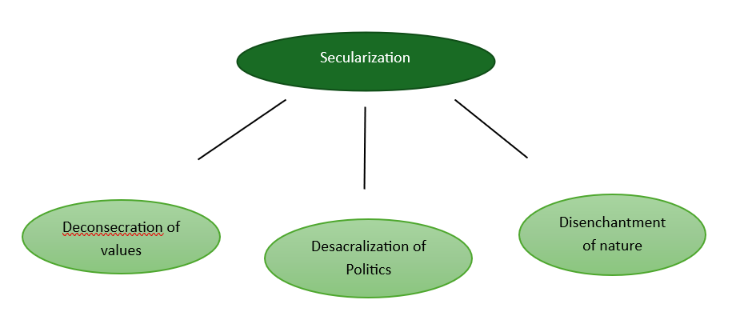
For Al-Attas, secularization is the deliverance of man “first from religious and then from metaphysical control over his reason and his language”. (See page 17). It is a call for the man to turn his attention away from the worlds beyond and towards “this” world and “this” time. The integral components of secularization are “the disenchantment of nature”, “the desacralization of politics”, and “the deconsecration of values”. Hence, for Sheikh, secularization is not neutral and has a fixed worldview which contradicts the worldview of Islam.
The root of the Muslim dilemma, for Al-Attas, lies in “the confusion and error in knowledge,” which leads to “the loss of adab” which is the inability to recognize and place things in their proper order. These two conditions reinforce each other, forming a vicious cycle that produces unqualified leaders, who in turn perpetuate the chaos. Externally, this internal decay renders the Muslim community fragile and vulnerable to foreign influences, particularly the penetration of secular Western worldview and values.
Al-Attas emphasizes that external forces can only take effect because the internal intellectual and spiritual defenses have already collapsed. Muslims’ own neglect and disunity provide the opening for external powers. Therefore, de-westernization of knowledge (Islamization of knowledge) is the solution: liberating the Muslim mind from secular control and re-establishing an epistemological framework centered on Tawhid and adab.
The major themes are: Epistemological imperialism, de-westernization of knowledge, and the loss of adab.
Critical Evaluation:
Syed Muhammad Naquib Al-Attas pioneered the concept of “Islamization of knowledge”. He is considered as one of the few contemporary Muslim philosophers who was well-read in traditional Islamic sciences and theology. “Prolegomena to the metaphysics of Islam” is considered to be his magnum opus.
The word secular has a connotation of time and location, time means “now” or “present”, and location means “the world” or “worldly”. (See page 16). So, it means the present age or time. Secularization, on the other hand, is a process through which a man gets control on his reason and leaves his “primitive” and “outdated” beliefs behind. Secularization claims that nature, politics, and values are not divine or constant. (See page 18). It is “historical” and “neutral” process through which every human is bound to go through. This is the point where Al-Attas builds his argument against secularization. If nature is not sacred and divine, if it is only for the man to exploit it and use it according to his need, then who on earth would want to save the planet from the climate crisis? A secular man considers nature/earth his property, but the Quran claims it as a “sign” of God and God’s creation. If politics and power are not sacred, then why would anyone use his/her power consciously? If values are relative and always “changing”, then how will we evaluate our actions? This is why Al-Attas made it clear right in the beginning of his book that it is not a response to any “secular government” or “state”, rather it is an attempt to explore secularism as a worldview and as a deen. Here also comes a very interesting point that “secularism or secularization is NOT anti-religion (ladeeniyat), rather it has a religion of its own”. Secularization is open-ended, relative, and ever-changing, but secularism is not. Secularism is closed-ended with a specific value system. For example: Secularism believes that the state and religion are two separate entities and this value is placed at the core of it. Here it doesn’t believe in the deconsecration of values. Here it will not change this value according to time and place. (See page 19).
Islamization, on the other hand, is a process of creating harmony between soul, mind, and body. In Islamic worldview, nature is a “sign” of God and hence is sacred and divine. Man is the “Khalifa” of God on Earth and therefore responsible for his/her actions. Islamic values are fixed and beneficial for the entire humanity. In this way, Islamization and Secularization are two “contradictory” worldviews. Two contradictory Deens. This is why Al-Attas calls for Islamization of Knowledge. He believes that knowledge and language has been hijacked. Muslims were supposed to look at the world from a different lens. Degrees, books, universities, etc. will not change the condition of Muslims because knowledge itself has been corrupted. Muslims, according to Al-Attas, need to go back to their own tradition. Their own language. Their own metaphysics. They need to correct their definitions. This is the only way one will be able to engage with this contemporary modern world. We need our own tools to first understand this era and then only we will be able to engage effectively with it.
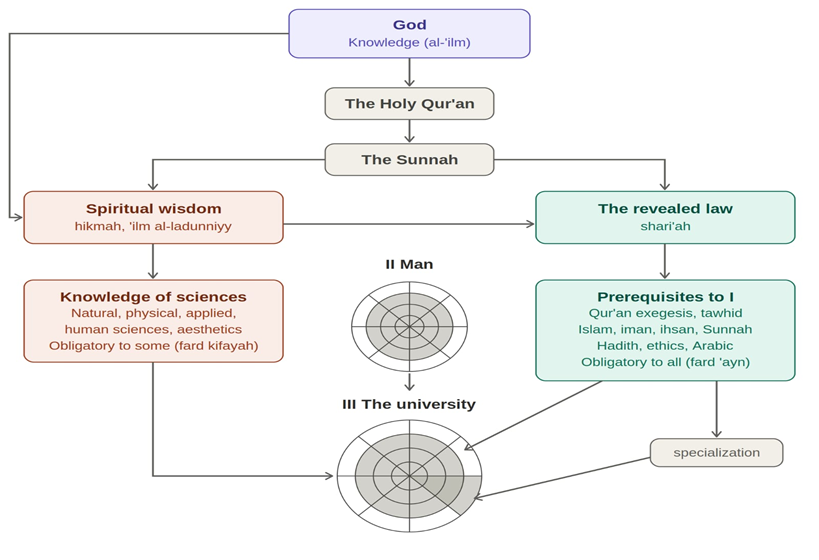
It is important to note here that Al-Attas has discussed secularism from one perspective only. For example: he uses the state and religion separation point, but not every type of secularism has same values. American secularism, for example, would be very different from the British secularism. So, what type of secularism are we really discussing? This is something which is not very clear in the book and I would like to further read about it in near future.
Conclusion and Recommendation:
Secularization pushes the man towards a “perpetual” cycle of becoming with NO clear direction. You have to keep learning, unlearning, changing, etc. but where would you stop? Is there any end point?
Islamization pushes the man towards a very specific direction i.e.: Akhirah and the hereafter. This worldly life will end. We will face death eventually. So, our actions need to be reversed engineered directly from the Akhirah. If not, then where are we exactly going? What is the plan?
فَأَيْنَ تَذْهَبُونَ
“So where are you going”?
(Surah At-Takwir, verse 26)
I believe that this book is a perfect start for anyone who wants to learn about the current dominant education system, knowledge, secularism, Islamic worldview, and other related fields. It is easy, coherent, and beginner friendly with a lot of references from the Quran.
My favourite part about the book is how Sheikh has tried to engage with secularism as a proper worldview and a system rather than just saying that it is simply an “anti-thesis” of religion (which is the most dominant and popular way of looking at it). Moreover, after getting a basic understanding of secularism, I would suggest the readers to read Talal Asad, Saba Mehmood, Charles Taylor, and Wael Hallaq to further deepen their understanding about secularism, which is the central theme of this book.
Noor Afza
The author holds a bachelors degree in Political Science. Her areas of interest are Islamic Intellectual history, South Asian history, the subjct-state relationship, and political philosophy.