Afghanistan’s fivefold increase in opium production exposes the limits of the Taliban’s counter-narcotics campaign. A ban can destroy crops, but it cannot erase the poverty, market incentives, and trafficking networks that make the drug economy resilient.
For three years, the Taliban administration presented its prohibition of opium cultivation as evidence that Afghanistan’s narcotics problem could be brought under control through political will and strict enforcement. The dramatic decline in cultivation after the 2022 ban appeared to support that narrative. But the latest United Nations Office on Drugs and Crime (UNODC) survey delivers an uncomfortable reality: Afghanistan’s opium economy was not defeated; it was waiting for the conditions to favour its return.
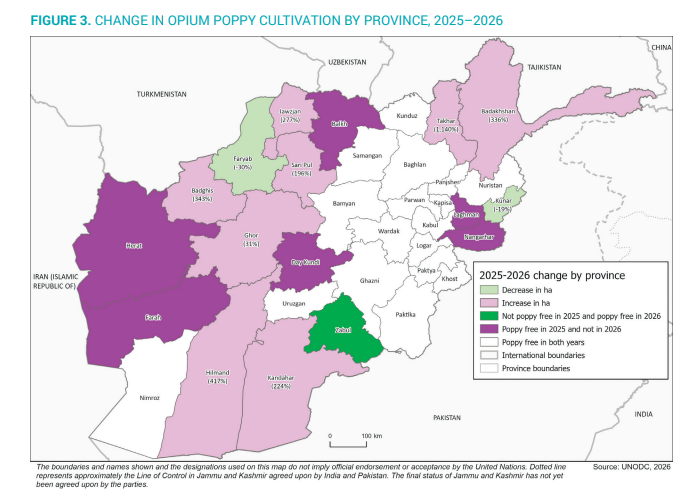
In 2026, cultivation increased from approximately 10,000 hectares to more than 43,000, while production rose fivefold, reaching nearly 1,500 tonnes. This is not simply a reversal in agricultural trends. It exposes a fundamental weakness in the Taliban’s counter-narcotics strategy: the ability to prohibit a crop is not the same as the ability to eliminate the economic system that sustains it.
The distinction matters because the Taliban’s ban was initially judged largely by what disappeared from the fields, rather than by what happened to the farmers, traders and networks that depended on the opium economy. Cultivation declined, but the underlying demand for opiates did not vanish. Nor did Afghanistan’s economic vulnerability, the established trafficking infrastructure, or the financial incentives associated with the trade. The result is a policy that achieved a visible short-term reduction without demonstrating that the foundations of illicit cultivation had been dismantled.
A prohibition without alternatives is a temporary victory
The Taliban’s enforcement campaign raises a question that cannot be answered through eradication figures alone: what was supposed to replace opium as a source of livelihood?
For rural households facing limited employment, weak infrastructure, restricted access to markets and persistent economic hardship, poppy cultivation is not simply a choice between legal and illegal agriculture. It is an economic calculation. Opium has historically offered farmers access to buyers, credit arrangements, and a relatively valuable commodity in an environment where legitimate agricultural opportunities are often limited. A ban removes that income source, but unless another viable source replaces it, the incentive to return remains.
This is precisely where the Taliban’s strategy appears weakest. Enforcement can make cultivation dangerous, but it cannot make legal agriculture profitable by decree. UNODC’s findings show that farmers are increasingly concealing poppy plots within cereal fields, inside walled compounds, and through staggered planting and harvesting. In other words, the campaign has not eliminated the incentive; it has encouraged adaptation. The return of cultivation across 16 provinces suggests that the problem is no longer confined to isolated pockets of resistance.
The administration cannot indefinitely claim success through the number of fields eradicated while the overall production trend moves in the opposite direction. If the ban is to be more than a coercive intervention, the Taliban must demonstrate that farmers can earn a sustainable income without returning to illicit cultivation. That requires investment, functioning markets, access to finance and agricultural infrastructure, not merely threats of punishment.
“The real beneficiaries of prohibition may not be the farmers“
There is another contradiction in Afghanistan’s opium economy. Even after production fell sharply, prices remained substantially above pre-ban levels. UNODC places the average price of dried opium at approximately $500 per kilogram in 2026, compared with less than $100 before the ban. It also estimates that traders generated around $525 million from opium sales during the year.
This raises an important political-economy question: who absorbs the cost of prohibition, and who captures the profits when supply is restricted?
Farmers face the immediate threat of eradication and the loss of their livelihoods. Meanwhile, traders and intermediaries operating within a high-price, supply-constrained market can continue to benefit. The survey does not establish precisely how profits are distributed across trafficking networks, but it makes clear that the opium economy remains commercially significant. A reduction in cultivation, therefore, should not automatically be interpreted as a reduction in the power or profitability of the wider drug trade.
The Taliban’s counter-narcotics campaign must be assessed against this distinction. Targeting farmers and destroying crops is considerably more visible than dismantling financial networks, tracing illicit proceeds and disrupting the organisations that move drugs across borders. Unless enforcement reaches the entire supply chain, the burden of the ban risks falling disproportionately on vulnerable agricultural communities while more powerful commercial actors adapt.
A renewed threat to Regional Security
The resurgence also carries consequences beyond Afghanistan. Pakistan, Iran and the Central Asian states sit close to established trafficking corridors, and any sustained increase in Afghan production could intensify pressure on their border and law-enforcement institutions. A renewed supply of opium could also strengthen trafficking networks at a time when UNODC identifies signs of declining opiate stocks and tighter heroin availability in destination markets.
This creates a dangerous possibility: the very conditions that made the ban appear effective could now encourage a renewed expansion. High prices, potentially depleted stockpiles and continuing international demand provide incentives for cultivation to recover. If production continues to rise, trafficking networks will have opportunities to rebuild supply and exploit regional vulnerabilities.
For Pakistan in particular, the issue should be viewed through both security and economic lenses. Border enforcement and intelligence cooperation remain necessary, but they cannot substitute for regional mechanisms that address trafficking finance, organised criminal networks and cross-border supply chains. A fragmented response will allow illicit markets to shift routes and exploit differences in enforcement capacity.
There is also a need for caution. The UNODC survey identifies a significant increase, but it does not establish that every increase in Afghan production will translate directly into a corresponding rise in trafficking through Pakistan or other neighbouring states. That risk must be monitored through seizures, forensic analysis and intelligence-sharing rather than treated as an automatic outcome.
Taliban must answer for more than the ban
The survey also exposes a wider problem of governance. The Taliban administration has made counter-narcotics enforcement a visible part of its claim to authority, yet sustainable control requires more than demonstrating the capacity to prohibit. It requires the ability to provide economic alternatives, maintain credible monitoring, and prevent powerful criminal networks from benefiting from the restrictions imposed on ordinary farmers.
The disagreement between UNODC’s estimates and the lower figures presented by the de facto authorities makes independent verification even more important. If the administration disputes the scale of the resurgence, transparent data and credible monitoring should be part of its response, rather than allowing competing claims to obscure the underlying problem.
International actors also have responsibilities. Demanding eradication without supporting alternative livelihoods is a policy contradiction. Development assistance, agricultural infrastructure, market access and employment programmes must be designed to make legal production economically competitive. At the same time, financial investigations, regional law-enforcement cooperation and demand-reduction programmes must target the wider networks that profit from the trade.
Afghanistan’s opium resurgence should therefore end the illusion that the 2022 ban resolved the country’s narcotics problem. It demonstrated that cultivation could be suppressed through force, but the 2026 figures show how fragile that achievement was without structural economic change. The Taliban may have banned the poppy, but it has not abolished the reasons Afghanistan keeps growing it. Until those reasons are addressed, every declaration of victory will remain vulnerable to the next harvest.
Read More: The Kremlin’s Afghan Gambit

Our News Desk represents a rapidly expanding frontier in contemporary journalism, focusing on the intersection of technological advancement, geopolitical narratives, and the shifting dynamics of public information.