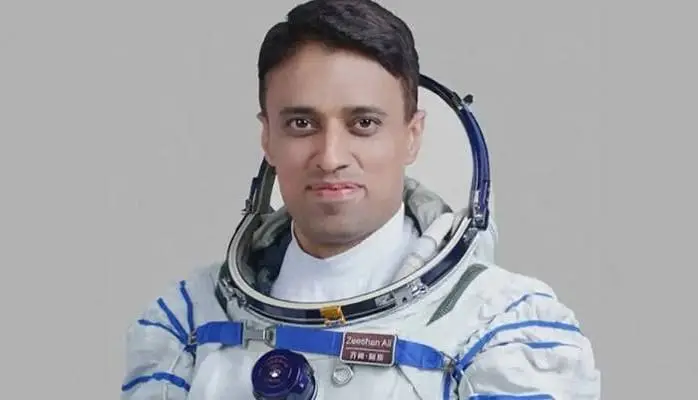
Muhammad Zeeshan Ali lifts off on 25 November as the first Pakistani in space and the first foreign astronaut to visit China’s Tiangong station. The milestone is secure. The programme behind it still has to be built.
At 5:18 am Pakistan time on Wednesday, a countdown at Jiuquan will reach zero. Pakistan will then cross a line it has never crossed before.
The China Manned Space Agency announced that Shenzhou-24 will lift off at 8:18 am Beijing time on 25 November. Ali will fly as a payload specialist alongside Chinese astronauts Tang Hongbo and Wu Yi, becoming the first foreign astronaut to visit Tiangong and the first Pakistani to travel to space. He is expected to spend about a week in orbit and return aboard Shenzhou-23.
How the mission came to be
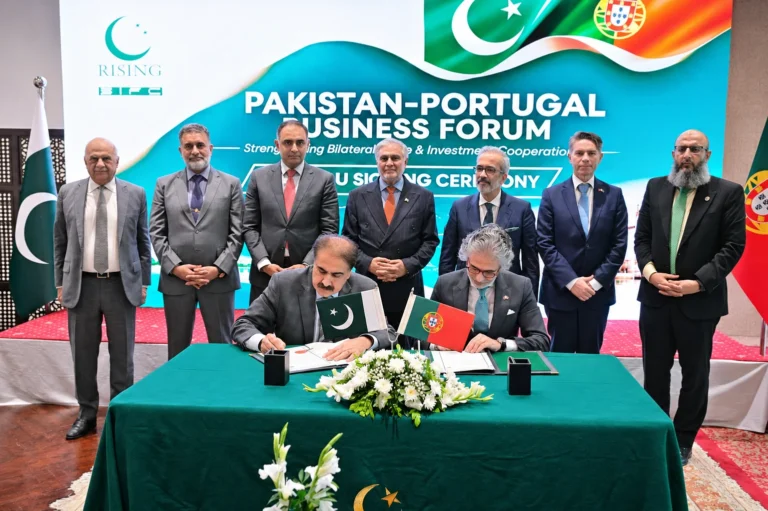
This flight was not an accident of diplomacy. Pakistan and China conceived the mission in 2019, according to SUPARCO’s Amer Gilani. In February 2025, the two countries signed an agreement under which China, for the first time, agreed to train a foreign crew member.
Ali and Khurram Daud trained in China after three rounds of screening, and Daud serves as the backup. Both are experienced military pilots, Ali from the Pakistan Air Force and Daud from the Pakistan Navy. Ali said he arrived at the Astronaut Centre of China carrying the hopes of 250 million Pakistanis.
A mission with scientific substance
Ali is not flying as a passenger. The mission builds on four Pakistani biotechnology experiments, selected by Chinese institutions from more than 300 proposals submitted to SUPARCO by universities. They address food security and climate change.
Every experiment is built and pre-tested in SUPARCO’s own laboratories before Chinese engineers sign off. SUPARCO’s Uzair Ansari called this a rare case of Pakistani technology validated on an international platform. It is also the first batch of national experiments from any foreign country to fly aboard the station.
China’s visible commitment
Beijing invested in making the flight work. Chinese authorities provided language instruction, bilingual operating documentation and halal meals. Ali trained in spacecraft and station operations, emergency procedures and Chinese technical commands, and the crew rehearsed handovers and responses to equipment problems together. The flight also marks the 75th year of Pakistan–China diplomatic relations. Prime Minister Shehbaz Sharif said the mission would add new dimensions to the brotherly relationship.
Part of a deeper partnership
The flight sits within an established record. The cooperation has already produced Chinese-launched Pakistani satellites, a joint satellite-navigation system, and a Pakistani-built rover due to fly on China’s Chang’e-8 lunar mission around 2028. The crewed flight extends that partnership from hardware into people.
The strategic reading
A first flight carries three kinds of value.
Diplomatic capital. Few partnerships grant access to a national space station. This one signals a level of mutual trust that Pakistan can draw on in technology, trade and strategic cooperation.
Technology validation. Pakistani-built experiments cleared Chinese engineering review and will operate in orbit. That builds credibility for SUPARCO and the universities behind the proposals.
Human capital. A trained cadre, a Mandarin-speaking space team and a body of university researchers are lasting assets, whatever happens to any single mission.
The mission’s scope should be stated plainly. The stay will last about a week, aboard a Chinese-built spacecraft launched from a Chinese site. Career crew members serve far longer rotations, and only a handful of states, led by the United States, Russia and China, have launched their own crewed spacecraft. That is the context, not a reason for hesitation. Every national space programme began with access, training and a first flight.
A programme beyond launch
Three commitments would give the milestone lasting substance.
First, establish a funded, multi-year human-spaceflight research programme, with transparent selection and a predictable timetable for university participation.
Second, publish a post-mission scientific account identifying participating institutions, completed experiments and the next stages of analysis. Celebrate the achievement while allowing researchers to assess its results.
Third, connect space research with practical needs through follow-up partnerships involving universities, agricultural researchers and relevant industries. Useful applications require institutions capable of carrying discoveries beyond the laboratory.
Pakistan has earned a moment of pride through preparation and sustained cooperation. When Ali lifts off, the country will see one Pakistani enter orbit. The larger achievement will come when that journey opens a dependable path for many more Pakistanis to contribute to science.
Read More: The Dawn of Pakistan’s New Frontier in Space

Our Editorial Desk is the intellectual engine of Digital Debate, responsible for the rigorous research that anchors every conversation. Our team deep-dives into data, checks every source, and consults academic literature to move beyond headlines and identify the questions behind the questions.