A state that demands the world deny haven to its enemies now harbours a woman convicted of crimes against humanity, and the same contempt for law runs from Gaza to Kashmir.
On 16 July 2024, Abu Sayed, an English student at Begum Rokeya University, stood before the police in Rangpur with his arms spread wide and was shot dead. Two days later, Mir Mugdho, a university student, was killed in Uttara while he handed out water to exhausted protesters. They are two of up to 1,400 people the United Nations human rights office estimates were killed in the crackdown of July and August 2024, and the woman convicted of ordering it sleeps tonight under the protection of the Government of India.
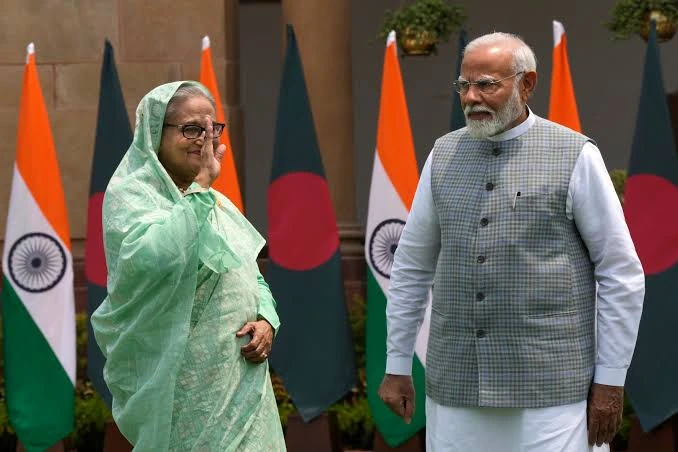
Bangladesh’s International Crimes Tribunal sentenced Sheikh Hasina and her former Home Minister, Asaduzzaman Khan Kamal, to death in November 2025 for crimes against humanity, and Kamal too is in India. The verdict did not rest on Bangladeshi testimony alone. In February 2025, the UN had already found that her government was behind systematic attacks on protesters that may amount to such crimes, and when the sentence came, it called the verdict an important moment for the victims. Dhaka has since completed every legal formality for her return, and the decision now lies with the Modi government. What exactly does New Delhi believe it is protecting?
What the Law Demands
Whatever New Delhi tells itself, the General Assembly settled the law half a century ago. Resolution 3074 of 1973 sets out how states must co-operate in arresting and extraditing those responsible for war crimes and crimes against humanity.
It forbids asylum to anyone where there are serious reasons to believe they committed such crimes, and it holds that they should, as a rule, be tried in the country where the crimes took place. The extradition treaty India signed with Bangladesh in 2013, and amended in 2016 to make returns easier, places murder and culpable homicide beyond the reach of its political-offence exception.
If a woman convicted over the killing of hundreds of young Bangladeshis cannot be returned under that treaty, who could be?
India’s Ministry of External Affairs answers every request by calling it “a matter of law and justice” and pointing to Indian courts, and each month of that refrain is another month bought for Hasina. The only door the treaty leaves open is a claim that Dhaka acts in bad faith, and the findings of the United Nations have already shut it. New Delhi has never been shy of demanding fugitives from other states. In April 2025, it secured Tahawwur Rana, accused over the 2008 Mumbai attacks, from the United States and celebrated his arrival as a triumph of the very co-operation it now refuses Dhaka.
From Harbouring to Hosting
New Delhi has gone well beyond harbouring her. It let Hasina address press audiences in its capital in January and again in August 2026, and when Dhaka protested, it called the organisers a ‘private media entity‘, as if a convicted fugitive living under the protection of the Indian state could speak to the world’s press without that state’s leave.
Leaders of the banned Awami League regroup in Kolkata and Delhi, while Bangladesh’s Home Minister Salahuddin Ahmed has told Parliament that the government will not allow conspiracies hatched across the border to destabilise Bangladesh. Bangladeshi investigators say the murder of Sharif Osman Hadi, the 32-year-old leader of Inqilab Mancha (Platform for Revolution) shot in the head in Dhaka in December 2025, was planned by figures in the Awami League and its student wing, the Chhatra League, and the men accused of it remain in India seven months after New Delhi agreed in April 2026 to send them back.
International law speaks to this as well, through the Friendly Relations Declaration of 1970, which the General Assembly adopted without a vote and which the International Court of Justice has relied on as evidence of customary law. It requires every state to refrain from acquiescing in organised activities on its territory directed towards civil strife in another.
In strategic terms, New Delhi is holding Hasina as a card, a client kept in reserve to unsettle a government in Dhaka that it did not choose and cannot command. Salahuddin has said as much, warning that India cannot play the Hasina card and still ask Bangladesh for friendship.
The Debt Delhi Collects
Delhi’s sense of entitlement has a history. On 16 December 2024, Prime Minister Narendra Modi marked the anniversary of 1971 as ‘India’s historic victory‘ without once naming Bangladesh, and Asif Nazrul, then law adviser to the interim government, answered for the nation when he wrote that India had been ‘an ally in this victory, nothing more’.
Bangladeshis bled for their freedom in 1971, and India entered that war as an ally with its own reasons to see Pakistan broken. In the half century since, Delhi has treated its part in the war as a debt that Bangladesh must go on repaying, with the Awami League as its collector. Under Hasina, the instalments came in kind, as the ports of Chattogram and Mongla opened to Indian cargo bound for the northeast and Dhaka kept silent while Indian guns fired across the border.
Felani Khatun was 15 when Amiya Ghosh, a constable of India’s Border Security Force (BSF), shot her on 7 January 2011 as she climbed the border fence at Anantapur in Kurigram, and her body hung from the barbed wire for hours before anyone took it down.
A BSF court acquitted him in 2013 and again at a retrial in 2015, and her father’s petition has waited in India’s Supreme Court for more than a decade. Hasina’s government let both verdicts pass, and her foreign minister, AK Abdul Momen, went so far as to argue that the border’s victims were sometimes armed and to tell journalists to investigate the transactions behind the crossings rather than the killings.
Her fall has not ended the slaughter, and Ain o Salish Kendra (Law and Arbitration Centre), a Bangladeshi rights organisation, counted 34 Bangladeshis killed by the BSF in 2025 and more than 600 since 2009. Is this how a friend guards a border?
The Same Hands in Gaza
Anyone in Dhaka who still doubts the Modi government’s contempt for law should look at Gaza, where more than 74,000 Palestinians have been killed since October 2023. A UN Commission of Inquiry concluded in September 2025 that Israel has committed genocide there.
In January 2024, the very month the International Court of Justice found that some of Israel’s acts in Gaza appeared capable of falling within the Genocide Convention, New Delhi licensed a shipment of ordnance to Israel from the state-owned Munitions India Limited. Four months later, Spain refused port entry to the Marianne Danica, which had sailed from Chennai for Haifa carrying 27 tonnes of explosives. Where did India imagine those explosives would fall?
The Indian news site The Wire reported in 2024 that an Adani joint venture with Israel’s Elbit Systems in Hyderabad had sent more than 20 Hermes 900 military drones to Israel. India abstained in September 2024 when the General Assembly demanded an end to the occupation and urged states to halt arms exports that might be used in the occupied territory.
When Israel shut Palestinian labourers out of their jobs, India sent around 16,000 workers within a year under a government-to-government agreement to take their places on Israeli building sites, and in February 2026 Israel agreed to take 50,000 more. A government that finds every legal obstacle to returning a woman convicted of crimes against humanity found none at all to filling the jobs of Palestinians whom Israel had locked out.
Then Modi flew to Israel. In February 2026, he paid his respects at Yad Vashem in Jerusalem, where Israel remembers the Holocaust, the crime that taught the world what ‘never again’ must mean. He addressed the Knesset, Israel’s parliament, and Benjamin Netanyahu hailed him as ‘a brother’, although the International Criminal Court has sought Netanyahu’s arrest since November 2024 for war crimes and crimes against humanity in Gaza.
Did anyone in Modi’s delegation speak the name of Hind Rajab, the six-year-old who pleaded down a telephone line for rescue before she was killed in Gaza City in a car full of her dead relatives? The Indian state now shelters one leader convicted of crimes against humanity and embraces another wanted for them. India is a party to the Genocide Convention, which obliges it to prevent genocide and makes complicity in genocide a crime, and after the findings of the ICJ and the Commission of Inquiry, no Indian minister can claim not to have known.
Hindutva, Zionism and Hasina’s Bargain
Modi’s embrace of Netanyahu grows from roots older than either man. In 1923, Vinayak Damodar Savarkar, the father of Hindutva (Hindu nationalism), wrote that Palestine should be restored to the Jews, and in 1947 he welcomed the UN partition vote that India had opposed. Sandeep Chakravorty, India’s consul general in New York, told a private gathering in November 2019 that Kashmiri Hindus could return to the Valley on the model Israel had built in the Middle East, adding, ‘If the Israeli people can do it, we can also do it.’
While Modi was in Israel, the Organiser, the weekly of the Rashtriya Swayamsevak Sangh (RSS), marked the visit by celebrating Savarkar’s Zionism. The joint statement Modi signed with Netanyahu set the Hamas attack of 7 October 2023 beside the Pahalgam attack of April 2025 in Indian Occupied Jammu and Kashmir, so that Kashmir and Gaza appeared as a single front in a shared war on ‘terror’.
Watch here: Why a Hindu Opposes Hindutva
Hasina’s tie to Israel was of another kind, hidden and transactional where Modi’s is open and ideological. In February 2024, she called the war on Gaza a genocide, yet from 2015 onwards her government had spent around $190 million on spyware and crowd-control systems, at least $40 million of it on technology of Israeli origin, and in 2021 it had quietly struck the words ‘except Israel’ from Bangladeshi passports.
One Israeli system, sold by a company run by the former Israeli intelligence commander Tal Dilian, went to the National Telecommunication Monitoring Centre while it was headed by the then Major General Ziaul Ahsan, who is on trial before the International Crimes Tribunal for crimes against humanity over the enforced disappearance and killing of 104 people, and who stands accused with Hasina in the 2015 disappearance of Salahuddin Ahmed, the Home Minister who now warns of plots from across the border.
The Adani Group, which controls the port of Haifa and builds drones with Elbit in Hyderabad, also sold Hasina’s government electricity under a 2017 contract that a Bangladeshi review committee found to be costing up to 50% more than it should. Delhi supplied the patronage and Tel Aviv the instruments of a single circuit of surveillance and force, and the students of July 2024 broke its Bangladeshi link with their bodies.
What Kashmir Knows
As a Kashmiri, I know this state intimately. India chaired the Security Council’s Counter-Terrorism Committee in 2022 and lectures the world that no state may shelter those who direct violence against a neighbour, and in May 2025 it fired missiles into Pakistan on that very claim. At home, the same state has carried Kashmir’s political leadership into Tihar Jail. India’s National Investigation Agency is asking the Delhi High Court to send Yasin Malik, chairman of the Jammu Kashmir Liberation Front, to the gallows. In March 2026, a special court in New Delhi sentenced Asiya Andrabi, founder of the women’s movement Dukhtaran-e-Millat, to life imprisonment and gave 30 years each to her colleagues Sofi Fehmeeda, who uses a wheelchair, and Nahida Nasreen. The judge reasoned that because they had shown no remorse, the court owed them no compassion.
Andrabi’s husband, Dr Muhammad Qasim Faktoo, a leader of the pro-freedom Hurriyat movement, has been in prison since 1993, longer than the 27 years Nelson Mandela spent in apartheid’s jails. He earned his doctorate behind bars, and their son Ahmed bin Qasim says he has never seen his father under the open sky. Masarat Alam Bhat, chairman of the Muslim League Jammu Kashmir and of the All Parties Hurriyat Conference, was brought to Tihar in 2019 after almost a decade of near-continuous detention under the Public Safety Act, a law that permits imprisonment without trial. The courts quashed one detention order after another, and in 2026 he still had to petition the Delhi High Court to be allowed to telephone his family in Srinagar.
Kashmir’s best-known lawyer has fared no better. Mian Abdul Qayoom, who has practised law since 1974 and was elected president of the Jammu and Kashmir High Court Bar Association again and again from 1986, was seized on the night of 4 August 2019, hours before the Modi government revoked Article 370 and stripped the state of its autonomy, and was flown to a solitary cell in Agra more than 1,000 kilometres from home.
He suffered a heart attack in custody, and when he challenged his detention, the High Court in Srinagar upheld it and told him to shun his ideology and ask the government for release. Arrested again in June 2024, he now stands trial under India’s anti-terror law, the Unlawful Activities (Prevention) Act, as the alleged conspirator behind the 2020 killing of a fellow lawyer.
Before any court has ruled, the Jammu and Kashmir Police seized his property on the orders of its director general, Nalin Prabhat, and announced the seizure as action against a “Pakistani agent and terrorist”. The High Court has also refused medical bail to an elderly man with heart and kidney disease. This is the “law and justice” to which New Delhi says Hasina’s fate must be left.
The Indian state hanged Maqbool Bhat, one of the founders of the Liberation Front, in 1984 and buried him inside Tihar. When Afzal Guru, convicted over the 2001 attack on India’s Parliament after a trial many Kashmiris believe was unfair, was hanged in the same jail in 2013, his family learned of it from television, and the jail’s letter reached their home in Sopore two days after he had been buried there. With what face could such a state ever plead a death sentence, or the fairness of a trial, as its reason to keep Hasina?
A Guest of Delhi
Dhaka holds more cards than it has played. The Ganges Water Treaty that Hasina signed in 1996 expires on 12 December 2026, the very month she has promised to come home, and in late October, Bangladesh said India had still not answered its request to negotiate a renewal. Veena Sikri, a former Indian high commissioner to Bangladesh, said in May 2026 that Delhi had made clear the talks must cover all bilateral issues and not the Ganges alone. Dhaka should take India at its word and put Hasina’s extradition and the return of the men accused of killing Hadi on that table.
Geography is the other card. India’s eight northeastern states hang from the narrow Siliguri Corridor, and when Muhammad Yunus, then head of the interim government, said in China in March 2025 that the region was landlocked and that Bangladesh was the only guardian of the ocean for it, Delhi withdrew Bangladesh’s transshipment facility within a fortnight. Its fury over a sentence about the map showed how much India depends on Bangladeshi soil, and every transit permit Dhaka signs should now carry the price of that dependence.
India treats international law as a code that binds its neighbours and never binds India. The people of Bangladesh are now learning what the people of Indian Occupied Jammu and Kashmir have known since 1947 and the people of Palestine since 1948. Dhaka must also carry the case beyond diplomatic letters, to the Human Rights Council and to every government that lectures the world about safe havens, and ask each of them whether the standard they hold Pakistan to applies to India as well. The martyrs of July did not stand before the guns so that the woman who ordered the shooting could live out her days as a guest of Delhi.
Read More: Bangladesh’s 2026 Election and the Struggle for a New Identity

Muzammil Ayub Thakur
Muzammil Ayub Thakur is a prominent UK-based pro-independence Kashmiri political activist, human rights advocate, and the president of the World Kashmir Freedom Movement (WKFM). He also serves as Director of the Kashmir Centre and is known for campaigning for Kashmiris’ right to self-determination and highlighting human rights concerns in the region.