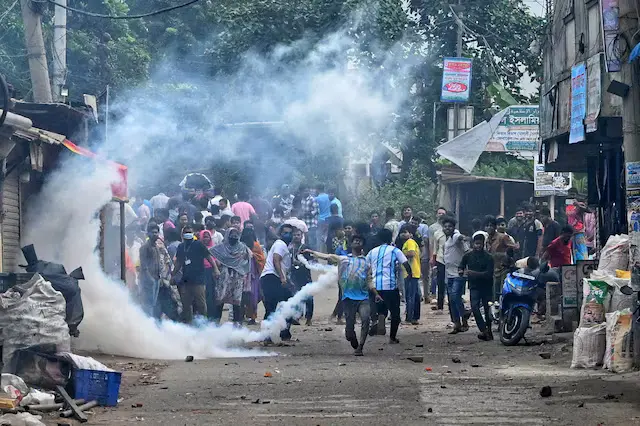

Garment workers in Bangladesh are demanding a minimum monthly wage of 30,000 takas, about $242, up from 12,500 takas. They say rising food, housing and transport costs have eroded their purchasing power. Clashes broke out Wednesday in Savar and Gazipur, where police used tear gas and sound grenades against protesters blocking highways.
Hundreds of factories have shut during a crucial production period for spring and summer export orders. A six-member wage board, with worker and owner representatives, agreed to implement a revised pay structure from December. It did not discuss the size of any increase, and first salaries under the new scale arrive in January.
The sector employs about four million workers and generates more than 80 percent of Bangladesh’s export earnings. It supplies brands including H&M, Zara and Walmart, and Bangladesh is the second-largest garment exporter after China. H&M says some factories closed temporarily, though it has seen no major supply-chain disruption. Manufacturers cite rising costs, regional competition, energy uncertainty and weaker demand as pressures on their margins.
Economist Selim Raihan says the industry can absorb a significant rise if productivity improves. He warns that prolonged unrest threatens delivery reliability and buyer confidence more than higher wages do. A scale without a figure leaves the core dispute open, so unrest may continue. A similar cycle played out in 2023, when some worker groups called the raise too small.

Our News Desk represents a rapidly expanding frontier in contemporary journalism, focusing on the intersection of technological advancement, geopolitical narratives, and the shifting dynamics of public information.