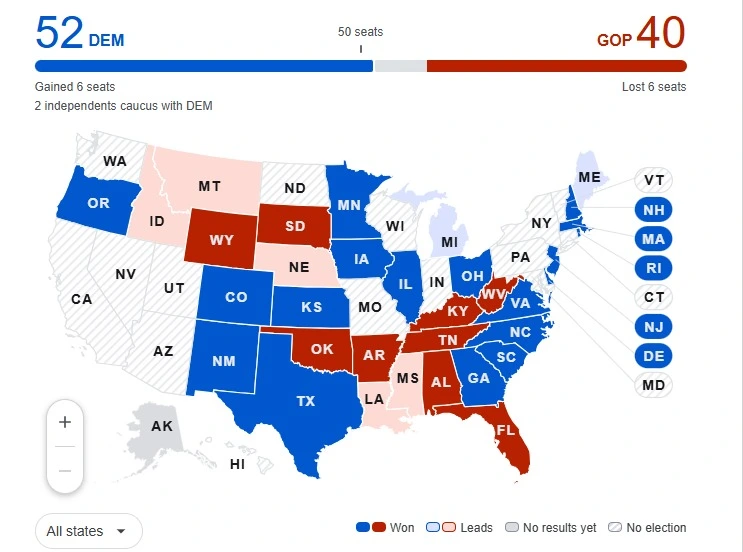
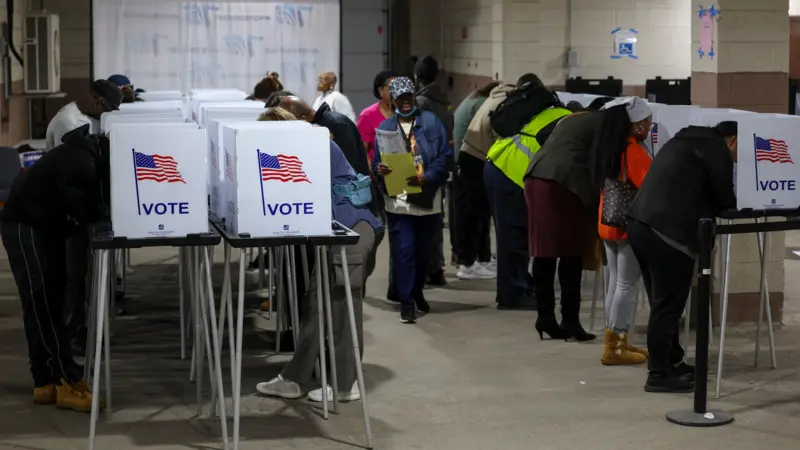
Americans woke up to a different Washington today. Democrats have won control of both the House and the Senate. Republicans had held a 53-47 Senate majority before voting began. That cushion has now disappeared.
A Night the Map Turned Blue
Start with the Senate, because that map tells the clearest story. Democrats flipped seats in Kansas, Iowa, Ohio, North Carolina, South Carolina, and Texas. Kansas elected its first Democratic senator since 1932. In North Carolina, Roy Cooper beat the candidate Trump himself had chosen. Many of these states were treated as safe Republican ground only months ago.
Even redrawn maps did not save the party. Democrats won two toss-up Florida seats that Republicans had gerrymandered, which Trump carried by ten points in 2024. They also protected their own ground, including Jon Ossoff’s seat in Georgia. Before the vote, polls put Trump’s approval near 38 percent. Few Democrats expected a victory of this scale.
Why did it happen? Voters kept naming the same worry: the cost of living. Diesel hit a record $6.52 a gallon in September. Inflation also rose from 3 percent to 3.7 percent. Add an unpopular war with Iran, and the mood becomes easy to read. Elections are often simple. People judge what their wallets feel.
Trump’s Reactions, Told in Three Acts
Here is where it gets interesting. Trump reacted in three different ways in a single evening. First came the graceful note. He told The New York Times, “I am absolutely willing to accept those results,” and promised to work with Democrats. That deserves credit. In October, he had said he would accept the results only if the elections were honest. Calm acceptance is good for any democracy.
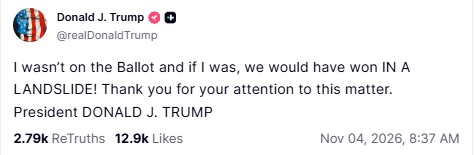
Second came the excuse. In a Truth Social post, he said he had not been on the ballot and would have won in a landslide if he were. Does that sound familiar? For weeks, he asked rally crowds to pretend he was on the ballot. You cannot invite voters to treat an election as a referendum, then disown the verdict. Logic does not work that way.
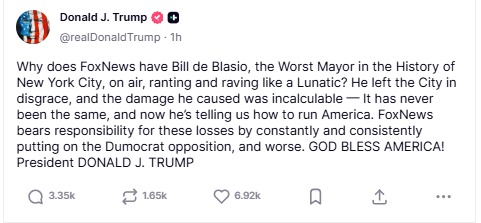
Third came the blame. On Fox News, he said he was “a little surprised” and expected Republicans to do better, pointing to his tremendous rallies. He also said Democrats had fought hard and done a good job. Then he blamed Republican candidates who, in his view, had fought him. Minutes earlier, he wrote that “Fox News bears responsibility for these losses.” He also posted a picture of a red veto hat. That is quite a range for one night.
Notice what is missing. In the reactions reported so far, prices and the war barely appear. Candidates, television hosts, and campaign tactics took the blame. Voters’ own stated worries did not. A leader who studies the messenger more than the message will struggle to read the next one.
What Divided Government Means Next
Now the practical part. With both chambers, Democrats can block legislation and investigate the administration. Investigations may cover corruption allegations, the Iran war, and immigration enforcement. They can also slow judicial appointments and senior nominations in the Senate. Talk of impeachment may return, though for now it remains only talk.
Trump still holds one weapon: the veto. He hinted before the vote that he might become “Mr. Veto.” Democratic margins fall well short of the two-thirds needed to override him. So expect gridlock, not a clean reversal of policy. Both sides will fight for the story of who blocked whom.
For the Iran war, the biggest change is oversight. Congress controls funding and can demand answers about costs and authorisation. It cannot end operations with a single vote. But pressure now has real committees behind it, and that changes the political price of escalation.
A fair warning applies to Democrats as well. An NBC poll found only 29 percent of voters view the party positively. This win reflects frustration with Trump more than love for the opposition. Two years is a long time in politics, and 2028 is already watching.
Here is a question to leave with. Trump said he would work something out with Democrats. Will that become a plan or stay a figure of speech? Voters have given both parties a clear job. The next two years will show who listened.

Our News Desk represents a rapidly expanding frontier in contemporary journalism, focusing on the intersection of technological advancement, geopolitical narratives, and the shifting dynamics of public information.