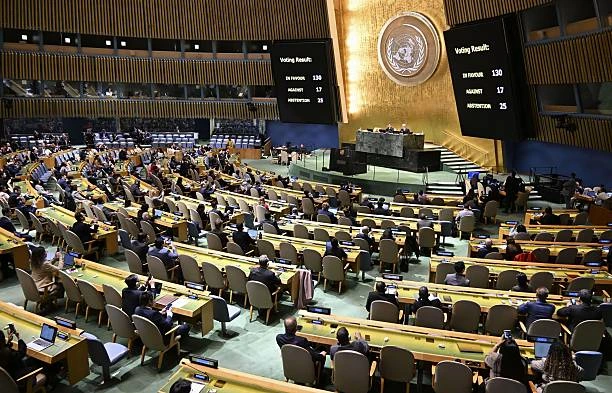
On November 2, the UN General Assembly’s First Committee adopted a Pakistan-Belarus resolution on regional conventional arms control. The vote was 180 to two, with no abstentions. India and Israel were the only states to vote against it.
The text argues that regional arms control matters because most post-Cold War threats arise between neighbouring states. That reasoning drew near-universal support. Indian diplomat Anmol Sher Bedi said security concerns cannot be confined within regional boundaries. His case is weaker than it sounds, because regional frameworks complement global ones and do not replace them.
Bedi also questioned fresh deliberations, noting consensus outcomes in 1993, 1999 and 2017. Those were non-binding guidelines, and 180 states clearly want to build on them. India also opposed the paragraph on South Asian proposals, suggesting discomfort with any regional framework involving Pakistan. It stood alone against a similar Pakistan-backed text in 2024, when 179 states voted in favour.
Israel’s position raises sharper questions. It abstained on that 2024 text, yet this year it voted no without detailed public explanation. An unexplained vote against a near-universal text invites suspicion, not confidence.
Regional arms control gives smaller states a practical way to reduce mistrust with larger neighbours. Both states resist limits on their strategic freedom, but 180-2 shows how few share that view. For Pakistan, the vote is a clear diplomatic gain. The burden now falls on India and Israel to justify standing alone.

Our News Desk represents a rapidly expanding frontier in contemporary journalism, focusing on the intersection of technological advancement, geopolitical narratives, and the shifting dynamics of public information.