For nearly a century, women in Kashmir have navigated layers of political upheaval: the end of Dogra rule, the partition-era accession disputes, the rise of occupying forces in the late 1980s, and the prolonged occupation that followed. Their experiences are often framed solely through victimhood, as widows, half-widows and survivors of violence. Yet historical records and contemporary accounts reveal consistent forms of agency and resistance. This resistance has operated through their own bodies and the bodies of loved ones, the preservation of memory and language, the raising of children, support for male relatives, the pursuit of education, and the realities of exile and displacement. These are not abstract strategies but practical, everyday acts shaped by the specific conditions of the Kashmir Valley.
Women in Kashmir have long been a site of both vulnerability and assertion. In the 1931 agitation against Dogra rule, women joined processions and faced gunfire; accounts record women such as Fazli and the pregnant Sajida Bano among those martyred. In later decades, particularly after 1989, Kashmiri women became a more contested terrain. Cases of sexual violence, including the widely documented Kunan-Poshpora incidents of 1991, produced long-term demands for accountability. Women also took part in protest, joining street demonstrations, funeral processions and sit-ins, and sometimes confronted the occupying forces directly.
The absence of loved ones forms another core axis of resistance. Enforced disappearances, estimated by the Association of Parents of Disappeared Persons at several thousand since the late 1980s, created the category of “half-widows”: women whose husbands remain unaccounted for. These women navigate legal limbo. Without a death certificate, they often cannot claim full inheritance, pensions or remarriage rights under prevailing interpretations of personal law. Organizations of relatives have held weekly sit-ins, collected documentation, and pressed courts and international bodies for information. Mothers and wives have repeatedly appeared at police stations, army camps and courts seeking news of detained or missing sons, husbands and brothers. This search is itself a form of public political action, forcing the private grief of families into the official record.
Memory functions as a deliberate counter to official narratives and to the passage of time. Oral histories collected from women across generations record participation in the 1930s protests, the Quit Kashmir movement of 1946, student demonstrations in the 1960s, and the mass protests of 1990’s, 2000, 2008–2010 and 2016. Songs and slogans, whether adaptations of older resistance forms or new compositions, circulate at funerals, weddings and private gatherings. Contemporary songs explicitly invoke historical dates of violence and resistance, refusing erasure. Memory work also includes the quiet archiving of photographs, letters and personal testimonies that document both loss and endurance. In a context where public speech has frequently been constrained, these practices keep alternative accounts alive within families and communities.
Language and cultural transmission serve related purposes. Kashmiri, as spoken and sung, carries idioms of place, history and emotion that official or administrative languages do not fully capture. Women have been central to maintaining these linguistic and cultural practices in the home, even as formal education expanded. Literature, poetry and everyday storytelling by women have recorded the texture of life under successive regimes and the costs of conflict. Preserving language becomes resistance when the occupying forces tend to erode its core.
Raising children in a conflict zone has meant shielding them from violence while also transmitting political consciousness and practical survival skills. Women have managed households when male relatives were detained, disappeared or killed, often becoming the primary earners. Support for male kin, including visiting prisons, organizing legal aid and maintaining social networks, has been a sustained form of solidarity.
Education has been one of the most consistent avenues of empowerment and quiet resistance. For women living in the conflict, education took on additional urgency: many pursued qualifications precisely because male breadwinners were absent or at risk. Women’s colleges became sites of political discussion and occasional protest. Even during curfews, communication blackouts and institutional disruption after 2019, families continued to prioritize schooling where possible. Education has enabled economic independence, legal literacy, and the ability to document and challenge rights violations.
Exile and displacement complete the picture. The conflict produced internal displacement, flight to other parts of India and the world, and migration across the Line of Control into Azad Jammu and Kashmir and Pakistan. Women who left the Valley have maintained ties through memory, advocacy and cultural work. Those who remained have absorbed relatives uprooted by violence or economic collapse. Exile can mean the loss of land, social networks and everyday familiarity with place; it can also mean new platforms for testimony and organizing. Diaspora women and those in camps have contributed to documentation efforts and international awareness, even while facing their own trauma and separation.
None of these forms of resistance exists in isolation. A half-widow seeking information about her husband simultaneously preserves memory and supports her children, and she may also pursue education or legal knowledge. A student protesting on campus draws on earlier generations’ public activism, and may also be a half-orphan still waiting for his father to return. A mother teaching Kashmiri songs at home sustains language while navigating the practical demands of living under occupation, with military personnel in every corner. Organizations ranging from early women’s welfare groups to later human-rights collectives and political formations have provided institutional vehicles, though many operated under severe constraints and some faced bans or designations as unlawful.
The historical record shows continuity as well as rupture. Women were visible in the anti-Dogra struggles of the 1930s, in the progressive nationalism of the 1940s, in the student activism of later decades, and in the mass protests of the post-1989 period. They have faced sexual violence, economic hardship and the psychological toll of prolonged uncertainty. They have also produced literature, legal challenges, educational gains and public protest. Claims about the scale of disappearances, the responsibility for particular atrocities, and the legitimacy of competing political projects remain deeply contested between international, Indian, Pakistani and Kashmiri narratives. What is less contested is the documented presence of Kashmiri women as historical actors who have repeatedly converted personal and collective loss into sustained forms of endurance and assertion.
In the present, after the unilateral and unconstitutional changes of 2019,in the altered administrative status of Jammu and Kashmir, speech, assembly and mobility are all under surveillance. Resistance continues through the memory that refuses silence, the language that carries history, the children who inherit both trauma and resilience, the family networks that sustain daily life, the education that faces regular shutdowns, and the experience of displacement that forces new strategies of survival. Disappearances, sexual violence, economic hardship for half-widows, and trauma are real and ongoing. Resistance through bodies, memory, verse, posts and images does not resolve the underlying political dispute, but it refuses erasure and keeps alternative narratives alive. Narratives that will be etched and preserved in our history, as it has always been. Despite the world ignoring us, at the best, or dismissing us, at worst.
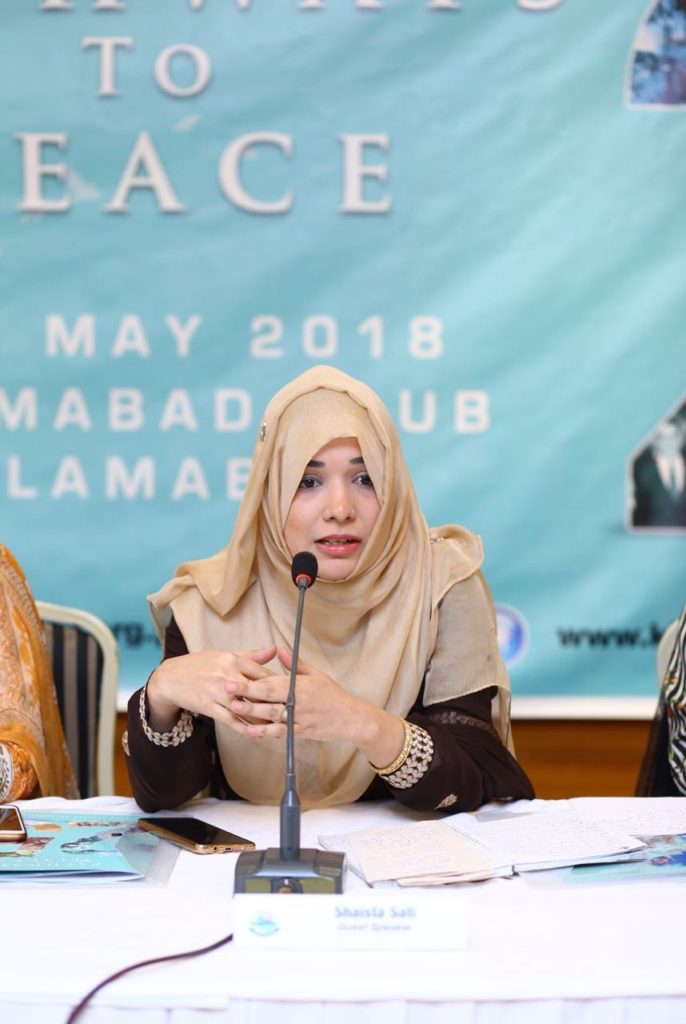
Shaistaepresentative for women's rights in conflict zones. Specializing in international jurisdiction and human rights documentation, she works to amplify the voices of Kashmiris through global advocacy, media commentary, and strategic policy engagement.