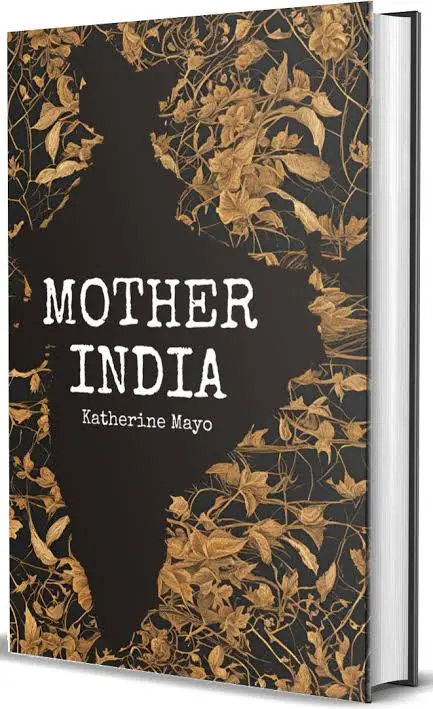
“Mother India” the grand slogan now repackaged as the promise of “Shining India”, offers the audience a radiant motherland draped in the golden robes of civilization, yet lift the veil, and the spectacle becomes rather horrific. Beneath the glittering mask emerges Kali, a fierce and bloodthirsty goddess of Hinduism, carrying the instruments of death and destruction. In Katherine Mayo’s Mother India, this darkness becomes the object of inquiry, examined with a torch in one hand and a colonial memorandum in the other.
Published in 1927, Mayo’s book appeared as India’s independence movement pressed hard against British rule. It presented itself as an investigation into Indian society, especially Hindu customs, condition of women, caste, sanitation, public health, sexuality, poverty, and politics. Its chapter titles sound like a courtroom drama staged by empire: “Slave Mentality,” “Early to Marry and Early to Die,” “The Earthly God,” “Behind the Veil,” “Less Than Men,” “The Sacred Cow,” and “Home of Stark Want.” One hardly needs a judge to guess the verdict.
Mayo’s central argument was simple, severe, and politically convenient: India was too socially diseased to govern itself. The timing was not accidental. Her critique became useful ammunition for those who wished to say, with the air of reluctant adults, “Independence? My dear, have you seen their customs, priests, and domestic arrangements?” Her project was the “white woman’s burden”, to save brown women from brown men, save India from itself, and, by a happy coincidence, keep the British Empire nearby to supervise them all.
Theme by theme, Mayo tours India’s wounds. On caste, she attacks hierarchy and degradation. On gender, she dwells on child marriage, widowhood, purdah, reproductive suffering, and the sacred authority of men. On religion, she sees priestly tyranny and ritual absurdity. On poverty, she describes hunger, disease, and overcrowding. On politics, she mocks nationalist leaders as men demanding liberty while tolerating slavery at home. In effect, she asks: “You want self-rule? Sir, your own household resembles a prison with incense.”
The backlash was volcanic. Gandhi famously dismissed Mother India as a “drain inspector’s report,” implying that Mayo inspected the filth and mistook it for the whole civilization. He had a point. Mayo did not write like a surgeon trying to heal a patient; she wrote like a prosecutor arranging evidence for conviction. She selected the most diseased examples, staged them dramatically, and then implied that imperial rule was not domination but adult supervision. This is not scholarship at its noblest. It is empire wearing reading glasses.
Mayo’s bias is hardly subtle. She treats societal evils of India as if they sprang from some uniquely Eastern moral defect, as though Europe had never invented patriarchy, class oppression, religious cruelty, racial hierarchy, industrial poverty, or empire itself. The British Empire, apparently, was passing by with tea and railways when it accidentally found itself ruling millions. How embarrassing and untrue.
Yet the unsettling fact remains. Mayo’s purpose was manipulative, but many of her accusations were not imaginary. A well-informed reader can reject her imperial conclusion and still admit that the social corpse she points toward is actually rotten. Caste was not a colonial hallucination, nor was Brahmin superiority invented by it. Women’s suffering was not an emotional undertone. Poverty was not poetic exaggeration. The “Earthly God” of husband, priest, caste elder, landlord, and patriarch had real worshippers and real victims, and it still does.
That is why dismissing the book as a mere conspiracy will be like living in an epistemic bubble. Mayo’s dishonesty lies not in criticizing India. India needed criticism then, and needs more of it now. Her dishonesty lies in using it to reach a false political conclusion. She took genuine issues and said, “therefore, empire.” The honest remedy could be, “therefore, reform; therefore, justice; therefore, the annihilation of caste; therefore, women’s freedom; therefore, economic dignity,” so eventually no priest, patriarch, or colonial officer gets to play savior.
However, here is the punchline India would be too deaf to hear: nearly a century later, not much has changed. The infrastructure is larger, the English smoother, the space missions grander, the billionaires richer, and the nationalism louder, yet every societal ill exists. Caste violence persists. Dowry deaths and honor killings persist. Women are still called goddesses, usually before being sacrificed in the name of custom and tradition. Poverty still sits beside luxury like an unpaid extra in a Bollywood film. The only difference is that the old “Home of Stark Want” has acquired LED lighting.
The Brahmin mentality, too, has modernized. It no longer arrives with a sacred thread. Sometimes it arrives with a foreign degree, a startup pitch, a gated apartment, and an excellent vocabulary of progress. It condemns discrimination online and panics when a daughter wants to marry outside caste. It quotes equality in public and practices caste segregation in private.
So what should we do with Mother India? Neither worship it nor burn it. Read it critically. Question its evidence, expose its arrogance, and reject its imperial remedy. But do not pretend that Mayo’s bad motives prove the wounds were imaginary. The British Empire deserves no credit for disguising domination as humanitarian concern, and the “white woman’s burden” deserves no medal for claiming authority over another society’s pain. Yet exposing Mayo’s purpose does not erase the realities she exploited.
The mature reader must hold two truths at once: Mayo’s narrative served empire, but India’s social issues were real, and they persist with an increased gravity. The frame was false; the spectacle was not. Mayo’s dishonesty lies not in exposing genuine suffering, but in exploiting it to legitimize the British Empire. For today’s reader of Mother India, honesty requires refusing both colonial insult and nationalist anesthesia. This is because colonialism has ended, but the vicious goddess of Kali, underneath the mask of Mother India, still grips society by the throat with caste, patriarchy, poverty, and hypocrisy being many of her blood-soaked claws, meanwhile obstructing the artificial lights of “Shining India” only to make its shadow loom larger and darker.