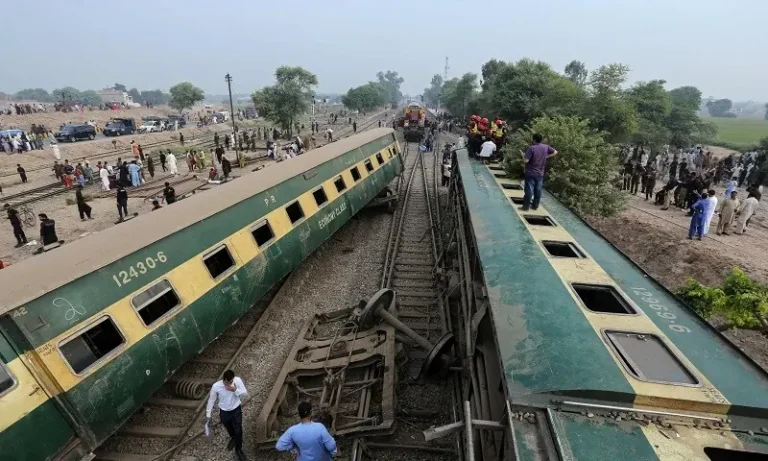
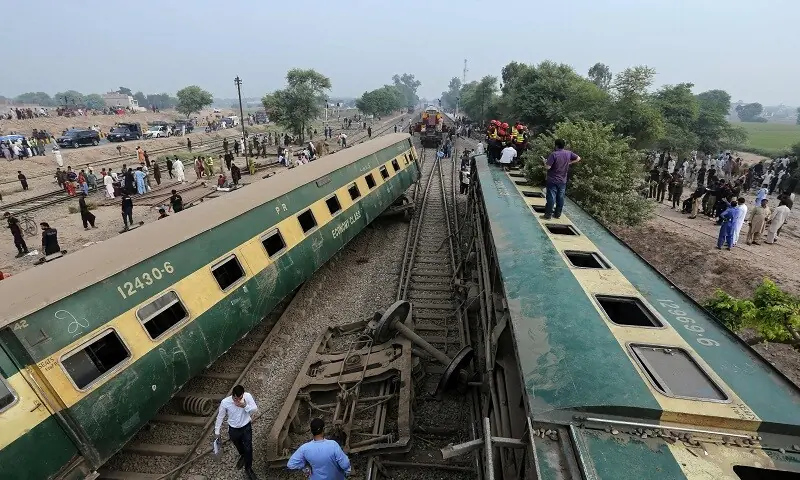
How many derailments will it take before Pakistan Railways treats them as a pattern? On 13 October, the Rehman Baba Express left the tracks near Sher Shah Railway Station in Multan, and seven passengers died.
Less than two weeks earlier, two other passenger trains derailed in Punjab. After each accident, the response is the same: a statement of concern, an inquiry, then silence. This derailment should not end that way.
The cause is not yet known, and nobody should claim to know it before the inquiry reports. Pakistan Railways’ early assessment points to a coach fault, and some passengers say workers repaired nuts and bolts on a coach near Rohri before the train reached Multan.
Between 14 and 15 coaches derailed. Early counts put the dead at four to five and the injured at 30 to 49.
Those numbers will keep changing as hospitals update their records.
The questions should not change: why did this happen, who is responsible, and what will be done before the next train departs?
A familiar pattern
The Multan derailment follows a long run of warnings. On 1 October, the Shalimar Express and the Pakistan Express derailed in separate incidents, and no one was injured. On 5 July, a Shalimar Express coach left the track near Khanewal. Each of these should have prompted a public safety review.
The country has seen worse. On 7 June 2021, two trains collided near Ghotki in Sindh and at least 65 people died. An early railway assessment pointed to a broken welded joint on the track.
Whether the trigger is a track defect, a coach fault, a signalling failure or human error, the wider problem is the same. Pakistan’s railway operates with assets and safety systems that have not received sustained investment.
Track, rolling stock, accountability
The first weakness is the track. Officials have said about 86 percent of the network’s bridges are more than 100 years old. They also say the bridges are safe because of regular maintenance. Age alone does not make a bridge unsafe, but it raises the importance of inspection, load control and timely replacement.
Pakistan Railways’ own 2023/24 yearbook reports 14,021 bridges nationwide, including 3,001 on closed sections.
The second weakness is rolling stock. Pakistan Railways had 446 diesel locomotives on 30 June 2024, and 19 percent of diesel electric locomotives were unserviceable. The average diesel locomotive worked only 11.04 of every 24 hours it was available, excluding time under repair or awaiting repair.
These figures describe a fleet under strain. Passenger coaches and freight wagons need the same scrutiny. A derailment involving 14 coaches cannot be explained by one component alone. Investigators must check maintenance records, wheelsets, bogies, couplings and the checks made before departure.
The third weakness is accountability. After every major accident, authorities announce an inquiry. The Federal Government Inspector of Railways has been appointed for the Multan derailment, with hearings set for 17 and 18 October.
But inquiry reports are often delayed, summarised selectively or never published in full. Without public findings, railway staff cannot learn precise lessons, victims cannot know what failed, and officials face little pressure to fix systemic faults. An inquiry that is never published does not make trains safer.
Modernisation plans do not fix today’s risk
Supporters of the government may say modernisation is under way, particularly through the China Pakistan Economic Corridor and the ML-1 project. ML-1, the Karachi to Peshawar main line, is central to Pakistan Railways’ plans. It runs about 1,726 kilometres and carries most of the country’s passenger and freight traffic.
But a plan does not replace track that must be safe today. Recent reporting says work on the Keamari to Hyderabad section had reached only 4 percent, and the Khanewal to Shorkot section via Faisalabad had reached 10 percent, with funding shortages cited.
The Ministry of Railways has itself acknowledged that overage rails on ML-1 range from 45 to 90 percent across nearly 2,300 kilometres, and overage sleepers range from 30 to 95 percent across about 500 kilometres. A project that will take years cannot answer a safety failure that happens now. Trains are running today, on track and with rolling stock that need immediate attention.
What must change
First, the Railways Ministry should publish every accident inquiry report within 90 days of completion. Each report should name the technical cause, identify who was responsible, list corrective actions and set deadlines. Where publication would compromise security, the ministry should release a detailed public version with only narrowly defined material redacted.
Second, Pakistan Railways should complete an independent safety audit of all passenger coaches, locomotives and heavily used wagons within six months. The audit should prioritise wheelsets, bogies, braking systems, couplings and maintenance documentation. Coaches that fail the standard should be withdrawn from passenger service, not repaired informally and returned to the line.
Third, the government should create a protected railway safety fund, run by the Railways Ministry with independent oversight. It should pay for urgent track renewal, bridge rehabilitation, signalling upgrades and inspection equipment. The fund must be shielded from diversion to other spending, and Parliament should receive quarterly public progress reports.
Pakistan needs a railway in which safety data are public, maintenance is verifiable and failure carries consequences. Statements of grief after each derailment cannot substitute for that. The passengers on the Rehman Baba Express expected one thing: to reach Peshawar alive.

Our Editorial Desk is the intellectual engine of Digital Debate, responsible for the rigorous research that anchors every conversation. Our team deep-dives into data, checks every source, and consults academic literature to move beyond headlines and identify the questions behind the questions.