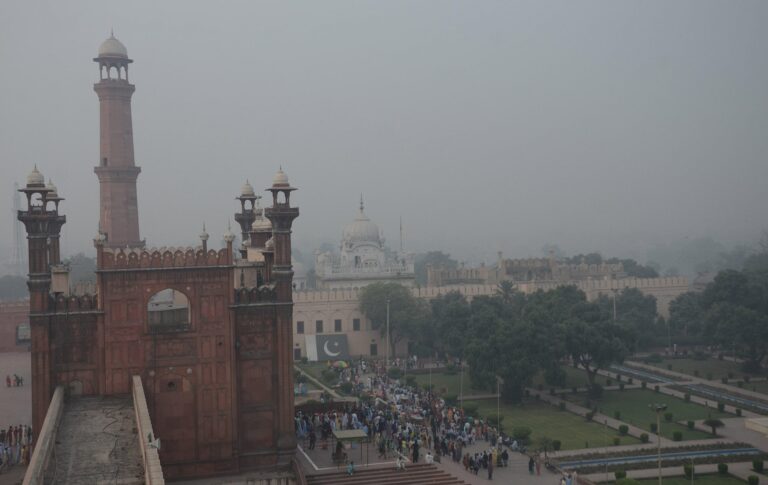
Lahore has again been ranked the most polluted city in the world, with an overall Air Quality Index (AQI) of 199, which falls in the unhealthy range. In Gulberg the reading has touched 300, which is classed as very unhealthy. Kahna Nau, Burki Road, Model Town and DHA Phase 6 also report dangerous levels.
This is a public health emergency that returns every year, and it affects millions of people who have to live, work, study and travel in the same polluted air.
The causes are known
Lahore’s smog has causes that everyone can name. Ageing buses, motorcycles, rickshaws and poorly maintained trucks release harmful gases and fine particles. Factories, brick kilns, construction sites and open waste burning add more.
During the crop season, smoke from burning residue on nearby farms drifts into the city and mixes with local emissions. None of these sources is new, and none is hidden. Yet every year the city responds as if the smog were a surprise.
Weather makes it worse. Wind speed is currently around five kilometres per hour, too low to disperse pollutants. Particles stay near the ground and settle over homes, schools, markets and hospitals. Even people who do not smoke, do not work outdoors and take precautions at home breathe this air, simply because they live in Lahore.
What it does to the body
The health cost is larger than the ranking suggests. PM2.5, the finest particulate matter, is small enough to pass the body’s natural defences and reach deep into the lungs. From there it can enter the bloodstream and harm other organs.
Long exposure worsens asthma and bronchitis and raises the risk of heart attacks and strokes. Children face greater danger because their lungs are still developing and they breathe faster than adults. The elderly, pregnant women, outdoor workers and people with existing medical conditions are also at higher risk.
For these groups, an AQI near 300 means every school run, every commute and every hour outdoors carries a real health cost. Public health and environmental policy cannot be separated, because the air people breathe affects their wellbeing more than almost any other public service.
Officials usually respond with advisories, monitoring reports and promises of enforcement. An advisory tells people the air is unsafe, but it does nothing to make it safe.
Asking citizens to wear masks, skip outdoor exercise and keep children indoors puts the burden on the people who are already affected, while the main polluters keep operating with few consequences.
The forecast of rain today and tomorrow has raised hopes, and it should bring some relief. Rain settles dust and particles, so many residents may wake to clearer skies. But the relief will be brief. Once the clouds pass, the same vehicles will be back on the roads and the same factories will resume emitting.
What Lahore needs to do
The city needs a clean air strategy that runs all year and treats pollution as a failure of governance, not a matter of weather. Vehicles that fail emission tests should be taken off the road, not just fined and allowed to continue.
Factories should be monitored continuously, with published penalties for violations. Brick kilns should switch to cleaner technology, and construction sites should be required to control dust. Waste burning should be stopped through enforcement and a better waste collection system.
Farmers should also get affordable alternatives to crop burning, because blaming them without offering any will change nothing.
Public transport matters just as much. If Lahore offers safe, affordable and reliable alternatives to private vehicles, fewer people will rely on cars and motorcycles.
School buses, carpooling and better traffic management can also cut congestion near schools, where idling vehicles add to pollution just as children arrive and leave. Other cities have done this.
Beijing, for example, cut its average PM2.5 level from roughly 90 micrograms per cubic metre in 2013 to about 58 in 2017 through sustained action on vehicles, industry and coal.
Above all, enforcement has to be consistent. A rule announced during a smog emergency and forgotten once the air clears will not solve anything. Lahore has plenty of warnings.
What it lacks is sustained political will. Each year the city issues notifications, records alarming readings and waits for winter to end.Lahore deserves more than temporary relief and repeated advisories. Clean air should be treated as a basic public service.
Until polluters face real consequences, transport and industry are reformed, and enforcement becomes routine, the city will keep topping global pollution lists. The real question is whether Lahore’s people will ever be able to breathe freely again.

Our Editorial Desk is the intellectual engine of Digital Debate, responsible for the rigorous research that anchors every conversation. Our team deep-dives into data, checks every source, and consults academic literature to move beyond headlines and identify the questions behind the questions.