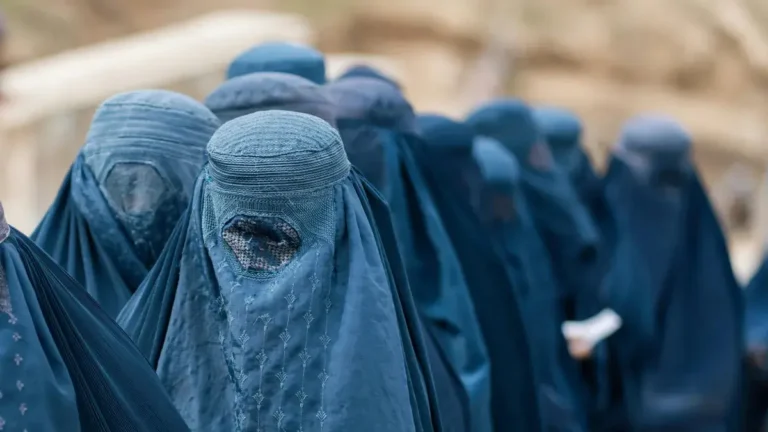
Pakistan’s National Assembly sat for nine sittings this past May. Women on reserved seats showed up more often than men on general seats, at the best-attended sitting and at the worst-attended one alike, according to a Free and Fair Election Network review of the record. Every one of those women got her seat from a party list. None of them was ever on a ballot that a voter actually marked. There’s something almost absurd about a system that produces lawmakers who outwork the ones who had to win an election, while never once having to win one themselves.
Here’s how the mechanism works. Pakistan sets aside 60 of the National Assembly’s 342 seats for women, and 17 of the Senate’s 96. After the votes are counted, each party’s share of those seats is calculated in proportion to the general seats it won, and the party’s own priority list, drawn up before polling day, decides who fills each one. Each province is treated as a single constituency, which means there’s no requirement, none, that the women on a list come from different districts, or from anywhere outside the provincial capital at all.
Nobody serious is arguing Pakistan should stop reserving seats for women. The argument is about what the current design leaves out. And to be fair to the design: it works, in the narrow sense that it was built to. Roughly 17 to 18 percent of the National Assembly is female, which is close to the global average, and only about 11 of 264 directly contested seats went to women in 2024, a shade over four percent, despite a legal floor requiring parties to field women on five percent of general tickets. Scrap the quota, and there’s no evidence the open track would do any better. It has already had its chance and come up short.
What the quota was never built to check is geography. Fourteen of the last National Assembly’s 60 reserved-seat women came from Lahore by itself, and 57 percent came from just six cities: Islamabad, Rawalpindi, Karachi, Lahore, Peshawar, Quetta. Provincial assemblies, run on the same closed-list logic, tell the same story with different numbers attached. Punjab’s reserved-seat women are 59 percent Lahori. Sindh’s are two out of three Karachiites. Balochistan draws almost three in every four of its reserved-seat women from Quetta, and Khyber Pakhtunkhwa isn’t far off, with half from Peshawar. Twenty-three districts in Punjab alone have never sent a single woman to a reserved seat, and Balochistan and the rest add dozens more to that list. A mechanism built to widen who gets represented has, instead, drawn an ever-tighter circle around a handful of provincial capitals.
There’s a deeper issue underneath the geography, which is that the reserved list was always supposed to feed the open one. Where the quota works as designed elsewhere, it also grows the number of women who can win seats nobody set aside for them. Pakistan’s own numbers don’t show that happening. Three election cycles after the five percent candidacy rule took effect, women’s share of general seats hasn’t moved. The reserved list and the open ballot run as two tracks that rarely cross.
Rwanda is the clearest counter-example anywhere in the world. Its constitution reserves 24 of 80 Chamber of Deputies seats for women, a 30 percent floor, filled through local administrative councils rather than party lists. But in 2024, women also took roughly half of the 53 directly contested seats on top of that floor, which is how the chamber ended up 63.8 percent female, the highest share on earth. The reserved seats function as an on-ramp there. In Pakistan, they function as a cul-de-sac. Uganda and Kenya solve the accountability problem a different way, electing their reserved-seat women directly, one per district or county, so each answers to an actual electorate rather than a party office.
Pakistan signed up for something closer to Rwanda’s standard when it ratified the Convention on the Elimination of All Forms of Discrimination Against Women back in 1996. The Committee’s General Recommendation 23 on political life says outright that mechanisms like reserved seats are meant to be temporary bridges to full participation, not a permanent structure that stands in for it. A system that hits its numbers every cycle while cutting the women who fill it off from any real electoral mandate is keeping the letter of that promise. It isn’t keeping the spirit of it.
Three fixes would close most of the gap, and none of them touches the quota itself. FAFEN’s own proposal is the cheapest: require party lists to reflect divisions within a province instead of letting every name come from the capital. A more ambitious version, worth a pilot rather than a mandate, would borrow Uganda’s model for a handful of seats, letting voters in underrepresented divisions choose their own woman directly. And the five percent general-ticket rule needs teeth it currently lacks, placement rules that force parties to actually run women where they can win, so the reserved list starts functioning as training ground instead of a permanent siding.
Pakistan already has women legislators who show up and do the work, more reliably than plenty of their male colleagues who won a contest to get there. What it doesn’t have yet is a system that lets those women, or whoever comes after them, point to an actual majority of voters and say: they chose me.

Muhammad Waleed Akhtar is a graduate in International Relations from International Islamic University, Islamabad. His work focuses on South Asian security dynamics and regional institutional frameworks.