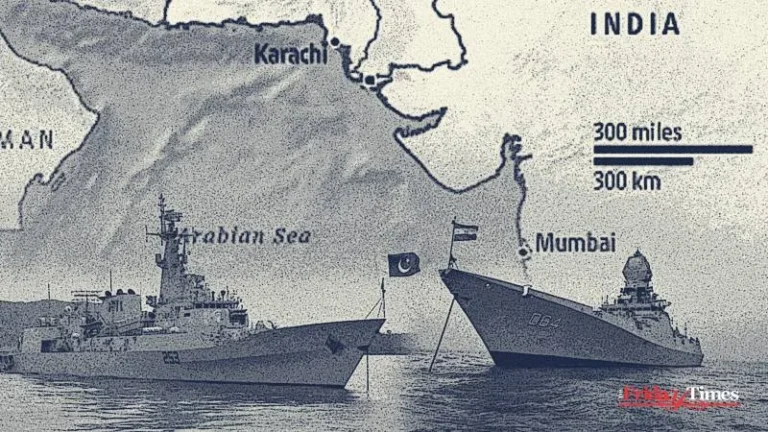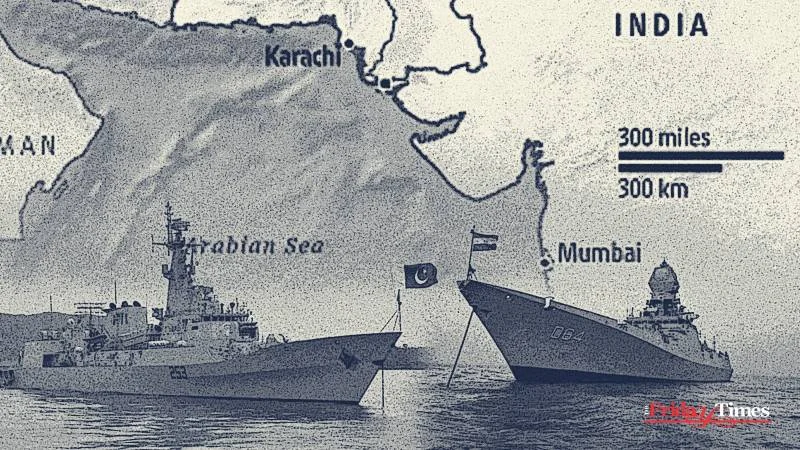

The maritime balance of power in South Asia is usually a hardware game, with analysts looking to such indicators as the number of submarines and aircraft, and the stretch of coastline covered by coastal patrol units. Those comparisons are important, but they don’t really answer the more significant question: What is the hardware worth when the time comes for you to decide? May 2025 provided the clearest possible answer to that question. India’s navy was six to seven times larger than Pakistan’s. It stayed 400 to 500 miles off Karachi, and it did not move. That is not a statement about machines. It is a statement about the men and women behind them.
It is important to understand the reasons for the structural size of the Indian Navy’s acquisition requirement before analyzing what the Indian Navy is buying. Pakistan has about 1001 km of coastline with the maritime threat environment on the eastern side. India has 7,000 kilometers of coastline, with exposure to the east, west, and south simultaneously. By geography alone, it has a much larger area of maritime responsibility. If India buys 46 C295 maritime patrol aircraft, it is incorrect to believe that all 46 will be targeted at Pakistan. The patrolling requirements in the Indian Ocean are legitimate and are not related to Pakistan.
That said, the principle governing Pakistan’s posture remains unchanged: even if only one of those aircraft or one of those submarines could be redirected toward Pakistan, preparation is necessary. Assurances are useless in military planning. It works on capabilities.
The Nuclear Submarine Question
The SIPRI report indicating India has deployed 12 nuclear warheads at sea deserves careful analysis. Two categories of nuclear submarines exist in any fleet. The first is a submarine powered by a nuclear reactor but carrying conventional missiles. The second, known as SSBN, is armed with missiles that can be equipped with nuclear warheads. India is building and deploying vessels in the second category and has claimed aspirations to scale up the program greatly.
What this means for the Indian Ocean is not subtle. Nuclearization of the Indian Ocean is no longer a distant prospect. It is a continuous process and primary motivator for India’s growing undersea nuclear capability. China will respond to this by expanding its own presence in the ocean. Pakistan will have to rethink its own deterrence system. The arms race that security analysts have warned about for a decade is now underway, and it is being conducted beneath the surface where it is less visible to the public but no less consequential.
India’s ambition is to become a blue-water navy and a net security provider, which is the designation the United States and its Indo-Pacific partners have assigned to it. The real objective of that Indo-Pacific strategy is to constrain China’s rise. India is selected as the instrument. Every submarine India orders, every maritime patrol aircraft that it operates, every carrier task force that it puts together works towards that containment goal. Pakistan is a secondary consideration in that strategic calculus. The problem is that weapons built for one purpose can be redirected, and neighbors operating at close range cannot afford the luxury of assuming benign intent.
The lesson that May 2025 teaches is one that military professionals understand and civilians tend to underestimate. Technology does not fight wars. People plan them, execute them, and decide whether to prosecute them when the cost becomes apparent. By any rational standard, India was overwhelmingly dominant in terms of the number of ships at sea in May 2025. It was what the decades of planning, strategizing, acquisition, and training of operators had yielded from both armies: the product of human capital.
Pakistan has invested in the right people for a long time. This investment was rewarded in May 2025. It will need to keep paying dividends as India continues to acquire platforms and as the complexity of the regional security environment grows.
India’s Frustration and Its Tactics
In the wake of Pakistan’s performance in May 2025, India did not question its assumptions. It was to intensify what security analysts describe as below-the-belt tactics. The EU Disinfo Lab has exposed the creation of Pakistan-centric narratives through fake social media profiles and false narratives, targeting Pakistani institutions, exposing fault lines in Balochistan, and attempting to undermine the domestic consensus behind Pakistan’s external policy.
This is not a new approach. The scale and sophistication are new. India has been caught running foreign interference operations in Canada, the United States, and Australia. Its former navy personnel were arrested in Qatar. In May 2025, its minister employed rhetoric that a career diplomat would never resort to, and it was its own unique expression of the frustration in New Delhi.
Frustration at the strategic level translates into two things: visible military posturing, which is manageable because it is visible, and covert destabilization efforts, which are more dangerous precisely because they are not. The war being fought via agents in Balochistan and Khyber Pakhtunkhwa, via radio in regional languages, via funding for groups whose agenda is to separate young Pakistanis from the institutions they belong to is a war that needs to be fought differently.
The War That Citizens Must Fight
Kinetic capability is the responsibility of the armed forces. The information war is the responsibility of everyone. This is not always well differentiated. In May 2025, citizen journalism filled a gap that the numbers could not fill. There were 40 English-language channels broadcasting the Indian story to the world. Pakistan had far fewer. The only thing that made up for this imbalance was ordinary Pakistanis who knew what was going on and were the ones who told the world the truth.
The same holds regarding internal security. Police and spy services can’t be stationed in every corner of the world. Communities are. Civilian intelligence is not new; people who see strangers, suspicious vehicles, or odd behavior report it to a readily available source. It is a model that Pakistan has successfully implemented since 2007, and the evidence indicates that it is effective. The big question is whether the nation can get back to that level of collective focus again.
The generational communication gap is where this effort is most vulnerable. The consequences are evident in the recruitment of young people by militant groups and in the political disenfranchisement of educated young people in contested provinces, when parents and children do not speak, when institutions do not reach young people, and when the space left by parents and institutions is filled by foreign-funded narratives aimed at exactly that age group. Closing that gap is not a military operation. It is a social one, and it begins in households.
Pakistan’s Strategic Advantage
Pakistan’s most significant strategic asset in the current environment is not its deterrence capability, though that matters. It’s its diplomatic positioning. Pakistan is connected with close ties with both China and the United States and Russia and Saudi Arabia and Iran without being a client of any of them. In a world where the US is working hard to forge an anti-China alliance, while China is working hard to withstand it, Pakistan’s role as a bridge in the middle is realistically important.
That positioning needs to be protected. It is eroded each time Pakistan suffers internal instability and external actors take advantage of it; each time a contested province becomes a liability rather than a part of the national security system; and every time a Pakistani citizen consumes foreign-made content on his own country without questioning its source and intent.
The Indian Ocean is being nuclearized. The arms race is on the fast track. The covert war against Pakistan’s cohesion is running at full intensity. These are the conditions under which Pakistan must operate, and it is operating effectively. However, for effectiveness, the state, the military and the citizens must all work together. In his book On War, Carl von Clausewitz defined alignment as the prerequisite for success in any battle. That precondition has not changed. It never does.