AT A GLANCE
- The development: During May–October 2026, approximately 79% of students undergoing UKVI credibility interviews were assessed as non-credible, with a 73% refusal rate for Pakistani interviewees.
- The context: Pakistan’s refusal rate was lower than five other nationalities listed. Crucially, these figures represent outcomes for a selected interview cohort, not overall student visa refusal rates.
- The response: Islamabad should strengthen student guidance and recruitment agent oversight while seeking structured bilateral engagement with London to examine documented decision inconsistencies.
What Happened
A UK Visas and Immigration (UKVI) sector briefing recorded 9,043 non-credibility findings from 11,415 interviews conducted between May and October 2026.
The reported refusal rate among Pakistani interviewees was 73%. Common concerns cited by caseworkers included insufficient knowledge of courses and institutions, unclear study plans, English language proficiency, and the financial credibility of funding sources.
UKVI cautioned that the six-month figures might not represent full annual outcomes. The available extract does not establish Pakistan’s overall student visa refusal rate or disclose the total number of Pakistani applicants subjected to interviews.
Under the Home Office’s assessment framework, credibility interviews help caseworkers determine whether applicants genuinely intend to study in the United Kingdom.
Reported Refusal Rates Among Interviewed Applicants
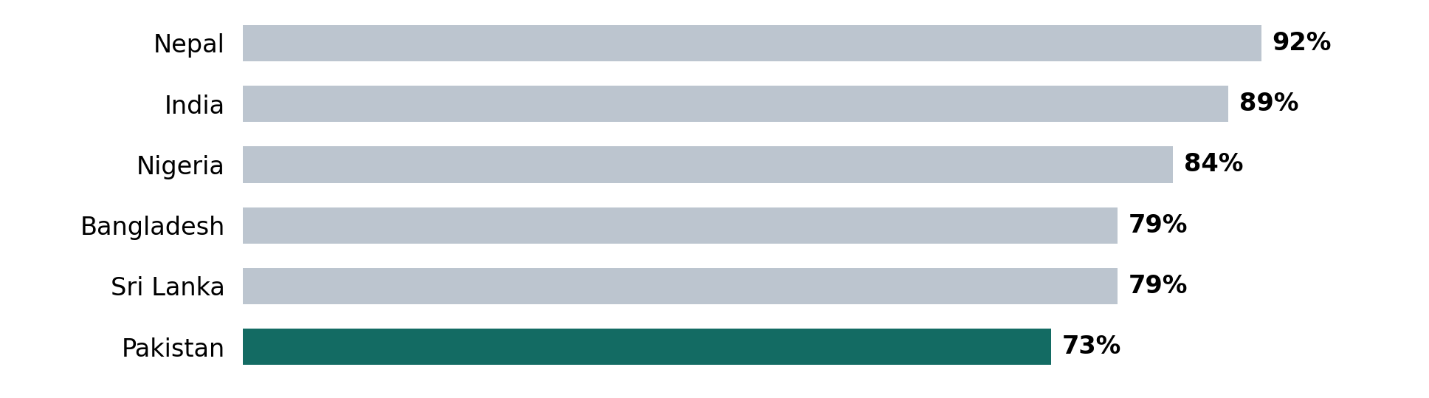
UKVI sector briefing figures for May–October 2026 illustrate that high interview refusal rates span multiple major sending nationalities, rather than affecting Pakistani applicants in isolation:
| Nationality | Interview Refusal Rate | Cohort Assessment Context |
|---|---|---|
| Nepal | 92% | Assessed non-credible during May–October 2026 UKVI interview sample. |
| India | 89% | Assessed non-credible during May–October 2026 UKVI interview sample. |
| Nigeria | 84% | Assessed non-credible during May–October 2026 UKVI interview sample. |
| Bangladesh | 79% | Assessed non-credible during May–October 2026 UKVI interview sample. |
| Sri Lanka | 79% | Assessed non-credible during May–October 2026 UKVI interview sample. |
| Pakistan | 73% | Assessed non-credible during May–October 2026 UKVI interview sample. |
Who Said What
“There is very much a focus on genuine students, though we acknowledge that we don’t always get the decisions right.”
“Families commit tuition deposits and living expenses before receiving a visa decision. Poor counselling and unclear funding evidence can cause severe financial and educational consequences.”
Digital Debate Policy Review
Cautioned that six months of data might not represent a full year, while identifying Pakistani students in the sample as the cohort most statistically likely to lodge asylum claims.
Clarified that the genuine-student requirement does not mechanically require applicants to explain or compare Britain against alternative study destinations.
Reading the Figures
- Selected Cohort: The 73% figure concerns only interviewed Pakistani applicants—who are typically flagged for additional scrutiny—and cannot establish the overall visa refusal rate across all applicants.
- Shared Challenge: Substantial refusal rates across several major nationalities (India 89%, Nigeria 84%, Bangladesh 79%) demonstrate that preparation and caseworker consistency represent wider structural questions.
- Separate Measures: The asylum comparison requires its own distinct statistical context and cannot mechanically determine an individual student applicant’s intent.
Why It Matters
Families frequently commit non-refundable tuition deposits and substantial travel expenses before receiving a visa decision. Substandard counselling, unsuitable course selection, or ambiguous financial documentation can therefore result in severe financial distress.
Pakistan’s policy response requires coordinated action across the Higher Education Commission (HEC), the Ministry of Federal Education, the Pakistan High Commission in London, and British universities. Key priorities include enforcing transparent agent fees, establishing clear deposit-refund terms, and offering robust pre-departure guidance.
Applicant preparation must prioritize genuine educational understanding over memorized interview scripts. Simultaneously, Islamabad should pursue structured engagement with London to address documented decision inconsistencies using refusal records.
What to Watch
Refusal Reasons & Patterns
Whether recurring refusal grounds reveal genuine student preparation deficits or inconsistent caseworker assessment across visa processing hubs.
University Recruitment Adjustments
Whether UK universities alter recruitment policies in Pakistan, audit recruitment agent partnerships, or introduce fairer tuition deposit-refund terms.
Official Bilateral Follow-up
Whether Islamabad secures complete nationality-level visa data and establishes an official review channel with London to examine documented decision errors.
Diaspora, Visas and Remittances: How Bilateral Mobility Shapes Economic Ties ↗

Our News Desk represents a rapidly expanding frontier in contemporary journalism, focusing on the intersection of technological advancement, geopolitical narratives, and the shifting dynamics of public information.