On 29-31 May 2026, the 23rd IISS Shangri-La Dialogue was held in Singapore, featuring defense ministers, military leaders, and security experts from more than 40 countries to Asia’s most pivotal annual security gathering. The setting was familiar, but the context was not. The Iran war has created the worst energy crisis in decades. The Strait of Hormuz continues to be a disputed region, commerce has been interrupted, and each Indo-Pacific country is reassessing its security dependences in real time. In that context, the words spoken in the dialogue were important. What they didn’t say, and who did not show up, was more important.
For the second consecutive year, China’s Defense Minister was absent. However, Beijing dispatched a lower-level military delegation and scholars to take the place. The absence is a deliberate posture. China regards the Shangri-La Dialogue as a US-anchored forum where Beijing’s increasing assertiveness in the South China Sea and its position on Taiwan make it, as one regional analyst put it, a convenient target. During the forum, China’s PLA representative highlighted Beijing’s Global Security Initiative, stating that the world was facing several interconnected challenges due to hegemonism, nuclear risks and the weakening of arms control mechanisms. That is the message Beijing chose to send through the corridor rather than from the podium. It’s a message that’s carefully choreographed to not be confrontational while it promotes an alternative security system.
Washington stepped in to fill the void. In his remarks, US Defense Secretary Pete Hegseth stated that China is the most important long-term threat to a secure Indo-Pacific, urged allies to increase defense budgets, and highlighted the Trump administration’s “peace through strength” policy as the guiding principle for US involvement in the Indo-Pacific. Hegseth’s speech arrived two weeks after the Trump-Xi meeting in Beijing, the first public sign of the US strategic posture in the region since the summit’s trade pledges. Allies such as Japan, the Philippines, Australia and Vietnam were closely watching for a shift in Washington’s posture after the trade commitments reached at the summit in Beijing. There was none. Tone on Taiwan, South China Sea and Chinese military modernization was unchanged.
The Structural Tensions the Dialogue Exposed
The three-day summit was dominated by defense spending, China’s role in the Asia-Pacific and lessons from the Ukraine. Countries seem to have embraced the idea that they must spend more on their own defense, and that the Iran war proved that energy supply routes are not immune from attack, and that American security guarantees have geographic and political limits.
One of the key substantive outcomes was a new GUIDE process on critical underwater infrastructure, which highlights concerns about the fragility of undersea cables and pipelines that support the data and energy flows that underpin the Indo-Pacific economy. Sidelines events also highlighted the AUKUS updates. These are not abstract security arrangements. They are responses to a concrete and accelerating threat environment in which the rules governing undersea infrastructure have become a live operational question.
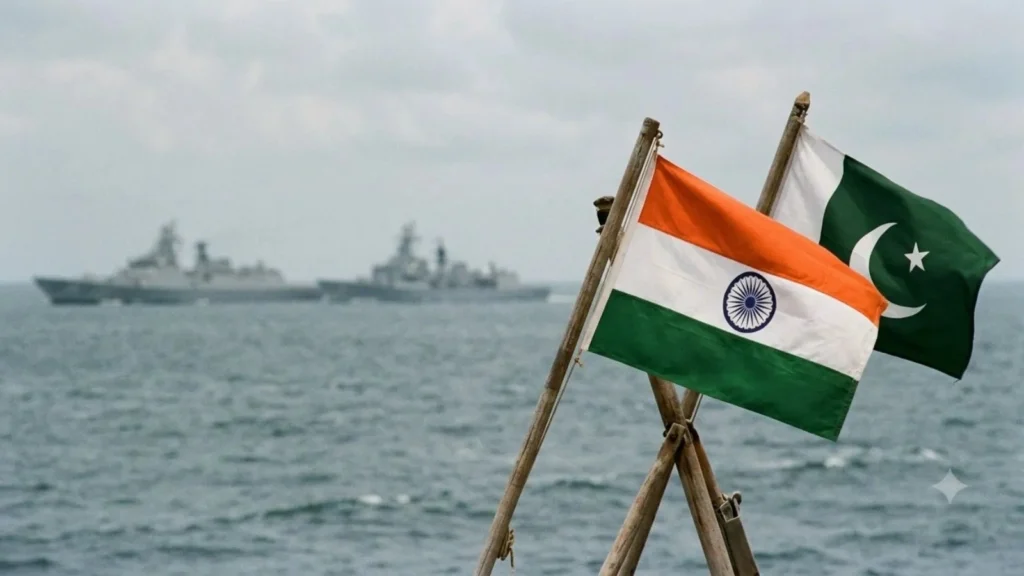
The IISS Asia-Pacific Regional Security Assessment 2026, which preceded the dialogue, highlighted that the region had witnessed interstate conflicts in Thailand and Cambodia, India and Pakistan and Pakistan and Afghanistan over the past year alone, and that the region is now facing a level of interstate conflict not seen in decades. The India-Pakistan conflict of 2025 was not looked upon as a bilateral situation, but as a regional one in the context of instability. Several discussions at the forum touched on the strategic implications of India’s Operation against Pakistan and Pakistan’s reaction, with a particular focus on the effectiveness of Chinese military technology in actual combat.
Asia Times called the Shangri-La of 2026 an unequal triangle where the US is the anchor of a multilateral security framework it constructs, China is on the sidelines, militarily dominant but diplomatically retreating, and India is at the table, for the second time in 23 years. That framing captures the structural reality of the forum precisely. The dialogue has never been a neutral platform. It marks a US-centric security structure that China is more at ease with, and in which smaller Indo-Pacific powers are growing more adept. The 2026 edition did not resolve any of the region’s fault lines. It mapped them with unusual clarity. That, for a forum of this kind, is both its purpose and its most honest achievement.

Our Editorial Desk is the intellectual engine of Digital Debate, responsible for the rigorous research that anchors every conversation. Our team deep-dives into data, checks every source, and consults academic literature to move beyond headlines and identify the questions behind the questions.