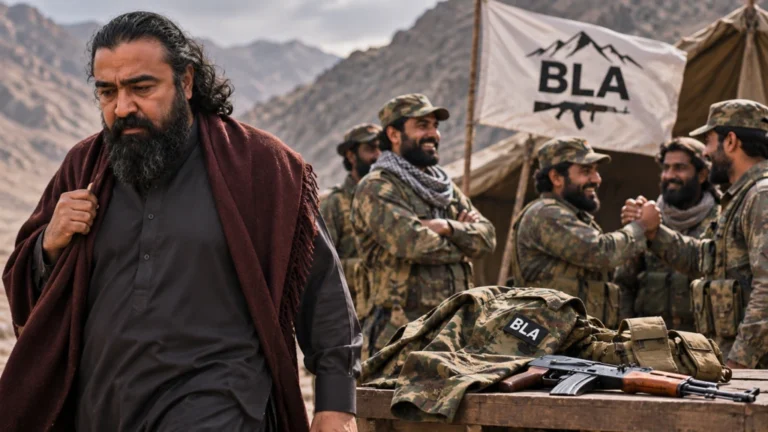
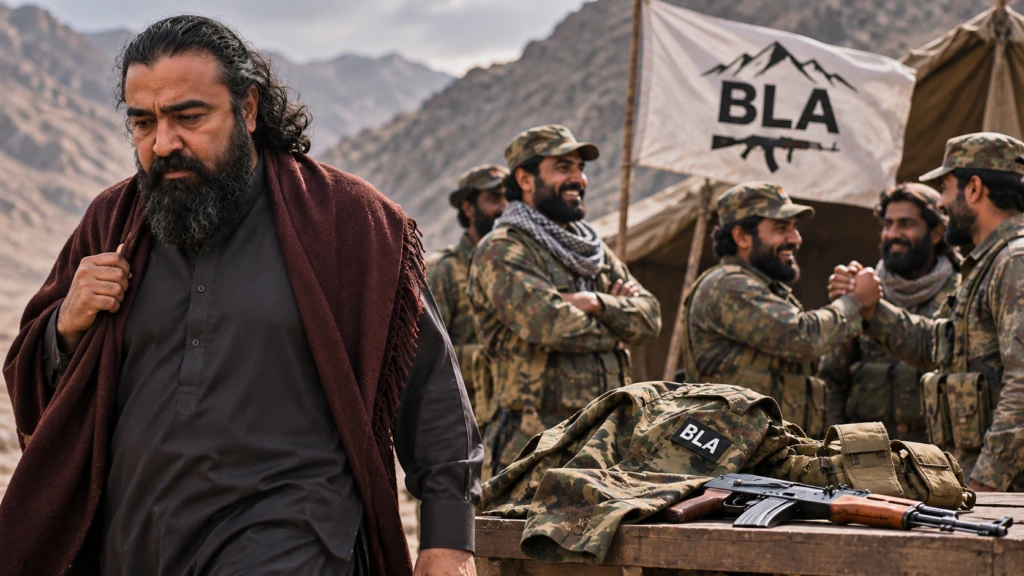
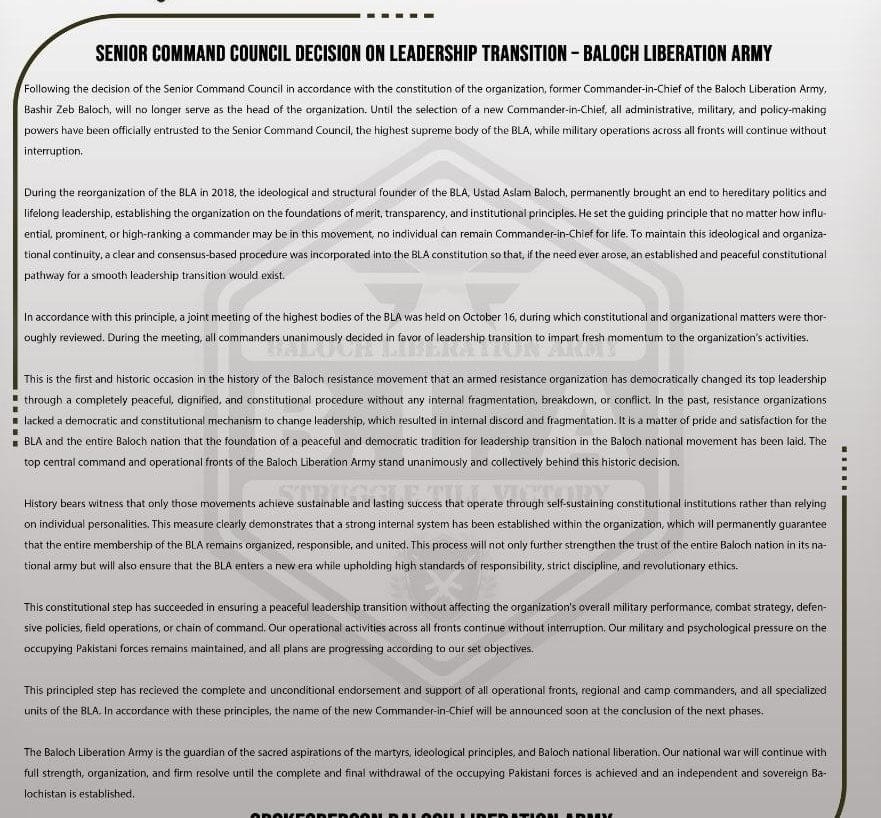
Bashir Zeb’s removal from the Baloch Liberation Army (BLA) leadership signals a potentially significant internal power struggle rather than routine succession. The announcement that authority is transferring to the Senior Command Council raises questions about organizational cohesion, command accountability, and competing leadership ambitions. Although the BLA describes the transition as constitutional and unanimous, the circumstances surrounding the decision suggest deeper structural tensions.
The leadership crisis also coincides with growing divisions within Hyrbyar Marri’s rival BLA faction, commonly associated with the Free BLA. These parallel developments raise an important question about whether the organizations are experiencing independent crises or moving towards organizational realignment.
Why Was Zeb Removed?
The BLA’s official statement presents Bashir Zeb’s removal as a constitutional transition intended to strengthen collective leadership and institutional continuity. According to the announcement, commanders unanimously supported the change during an October 16 meeting of the organization’s highest decision-making bodies. However, the emphasis on constitutional legitimacy and organizational unity may also reflect an effort to contain perceptions of internal fragmentation.
According to sources familiar with the internal disputes, Bashir Zeb’s authority had reportedly been curtailed during February and March 2026. These sources attribute the decision to disagreements over operational planning and substantial casualties sustained during Operation Herof 2 earlier that year.
Pakistan’s military reported killing approximately 216 militants during the weeklong confrontation. The BLA separately acknowledged 93 fighters killed, highlighting substantial differences between official Pakistani accounts and the organization’s own casualty claims.
Nevertheless, major operational losses can generate dissatisfaction among field commanders, particularly when strategic objectives appear disproportionate to the human costs. Such losses may weaken confidence in centralized leadership and encourage influential commanders to demand greater oversight of military decision-making processes. Sources also identify Captain Rahman Gul as a prominent critic of Bashir Zeb’s leadership, particularly regarding operational planning and organizational accountability. They further suggest tensions involving Sarfaraz Baloch, reportedly associated with the spokesperson identity Jeeyand Baloch, although these details remain unverified.
If substantiated, these disagreements would indicate a broader challenge to Zeb’s leadership rather than an isolated dispute over operational performance. The central issue is whether the council represents genuine institutional reform or a redistribution of authority among influential commanders themselves.
How Does Leadership Work?
The BLA’s organizational structure reportedly combines centralized political leadership with regional commanders, specialized operational formations, and separate communication and logistical functions. Such arrangements create significant challenges when central leadership decisions conflict with the preferences of commanders exercising influence over individual units.
The Senior Command Council’s assumption of administrative, military, and policymaking responsibilities therefore represents an important development in organizational governance. However, the existence of a formal council does not necessarily establish democratic accountability, transparent decision-making, or effective institutional control internally.
Armed organizations frequently depend upon informal loyalty networks, personal authority, access to financial resources, and relationships between senior and field commanders. These arrangements can become vulnerable when operational setbacks undermine a leader’s reputation or generate disagreement over organizational strategy and priorities.
The BLA statement repeatedly emphasizes peaceful succession, constitutional procedures, and organizational discipline, suggesting an effort to establish institutional legitimacy internally. Yet the announcement provides limited information regarding council membership, leadership selection procedures, voting arrangements, or mechanisms for resolving future disagreements.
Consequently, the transition could strengthen collective leadership, but it could equally institutionalize competition among commanders seeking greater organizational influence themselves. These uncertainties become especially important when examining the simultaneous leadership disputes within the rival BLA faction associated with Hyrbyar Marri.
Why Are Factions Divided?
The divisions within Hyrbyar Marri’s faction appear to reflect longstanding disagreements concerning leadership authority, decision-making, and organizational representation among rival commanders. Dissident commanders reportedly established a Reforms Command Council and challenged the authority of existing leaders, including Marri and Free Baloch.
Reports of resignations within Marri’s Free Balochistan Movement further suggest political dissatisfaction, although their organizational implications require independent verification. Importantly, the political Free Balochistan Movement and Marri-associated armed networks should not automatically be treated as identical organizational structures. Nevertheless, parallel disputes suggest that leadership legitimacy has become an increasingly contested issue across different strands of Baloch militancy.
One possible explanation concerns the widening divide between established leadership personalities and commanders demanding greater influence over operational decisions themselves. Another concerns differences in organizational priorities, institutional accountability, resource distribution, and the relationship between political leadership and armed activities. Such disagreements are particularly consequential because centralized authority becomes difficult to sustain when influential commanders question its effectiveness or legitimacy.
The simultaneous crises therefore indicate structural vulnerabilities, although available evidence does not establish coordination between the two internal leadership disputes.
Will Both Factions Unite?
The possibility of reunification deserves consideration because simultaneous leadership challenges could create opportunities for renegotiating relationships between previously divided organizations.
However, leadership removal alone does not establish that rival factions have resolved their ideological, institutional, personal, or strategic disagreements internally. A genuine merger would require agreement over political leadership, decision-making authority, organizational identity, and the distribution of influence among commanders.
Three broad outcomes remain possible: continued independent restructuring, limited political rapprochement, or further fragmentation caused by competing leadership claims and loyalties.
Individual commanders could also shift allegiances without producing a comprehensive merger or resolving longstanding disputes between the organizations themselves. The emerging pattern therefore suggests a crisis of leadership legitimacy rather than definitive evidence of an impending organizational union or consolidation.
The more significant development may be the challenge to personality-centered leadership models within organizations historically shaped by influential individual commanders. Whether the new councils establish durable institutional authority will depend upon their ability to secure acceptance across rival leadership constituencies.
For Pakistan’s security environment, these developments should not automatically be interpreted as organizational weakening or reduced militant operational capabilities. Ultimately, the BLA’s parallel leadership crises reveal contested authority, institutional weaknesses, and uncertain succession arrangements, while reunification remains speculative.

Our News Desk represents a rapidly expanding frontier in contemporary journalism, focusing on the intersection of technological advancement, geopolitical narratives, and the shifting dynamics of public information.