
The Claim and What Came With It
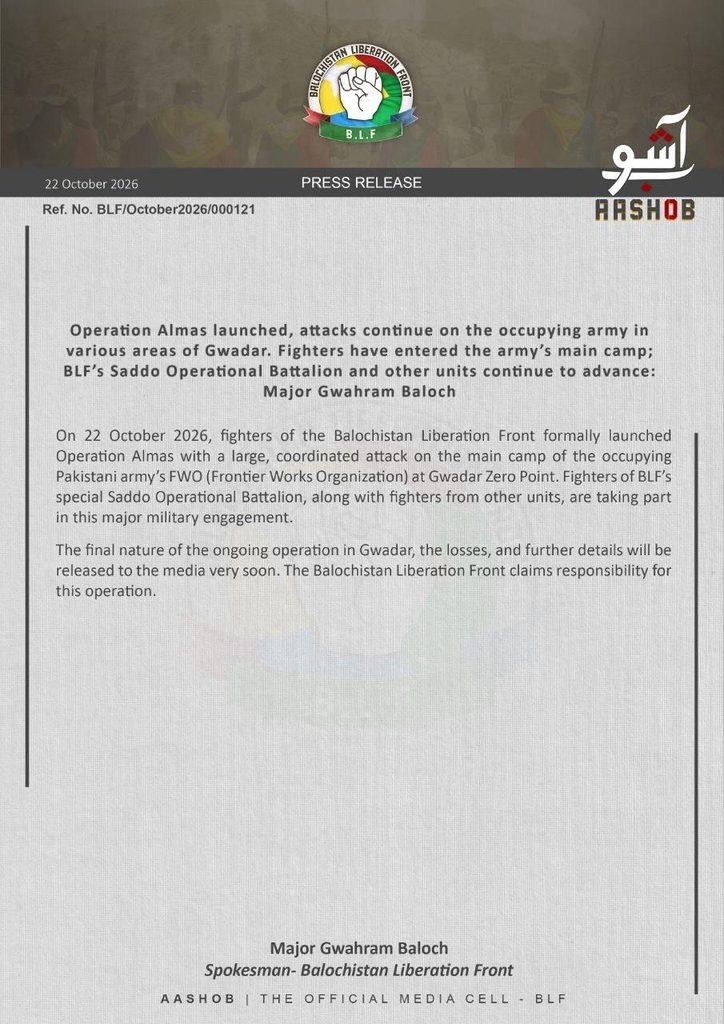
When the Balochistan Liberation Front’s media wing put out its press release on Thursday announcing “Operation Almas,” a large and coordinated attack on the FWO camp at Gwadar Zero Point, the statement did the work it was designed to do, because within hours Indian outlets and sympathetic social media accounts were repeating it as though a major military engagement had been established as fact, even though the document itself contains almost nothing that can be checked. It names a target and a unit, announces that fighters have entered the army’s main camp, and then defers the losses, the outcome and every other detail to some unspecified moment “very soon,” which is a curious way for a group to behave if it had actually achieved something worth counting. Armed organisations that win tell you what they won, with figures and names and images, because the tally is the whole point of the exercise, whereas a statement that asserts success while postponing all proof is built to occupy the first few hours of the news cycle, when verification is at its weakest, and not to survive the second day.
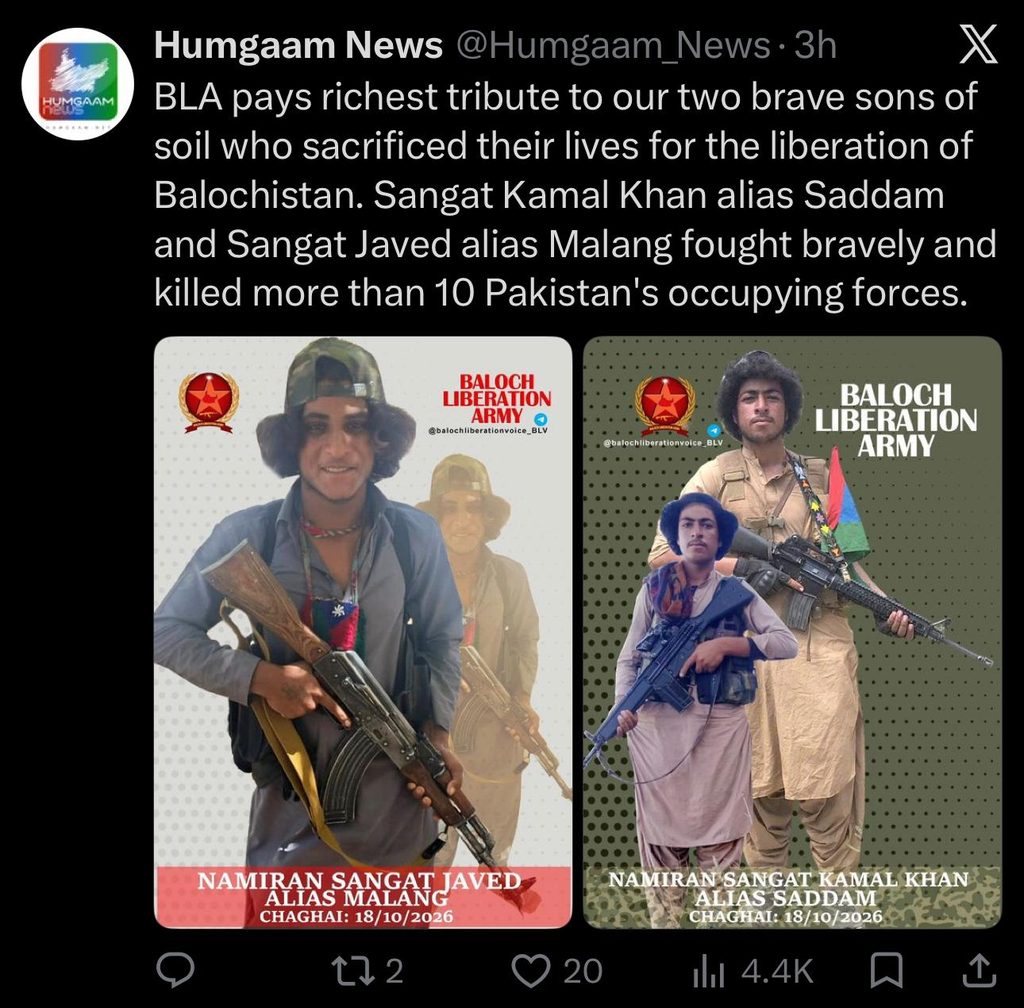
The material circulating alongside the release does not improve the picture. The Bolan News post is carefully worded and reports only that the BLF has claimed to have launched an operation, so it relays an assertion without confirming it, and the video attached to it, at least in the screenshot we have, shows foliage and nothing else, with no identifiable camp, no uniforms and no exchange of fire. The Humgaam News post is stranger still, since it is a BLA tribute to two fighters dated Chaghai, 18 October, which means a different organisation, a different district and an event four days before Gwadar, carrying its own unverified claim of more than ten soldiers killed, and placing it in the same feed as the Gwadar claim gives the impression of a sustained, multi-front campaign when what it actually does is stack unrelated assertions from separate groups on top of one another.
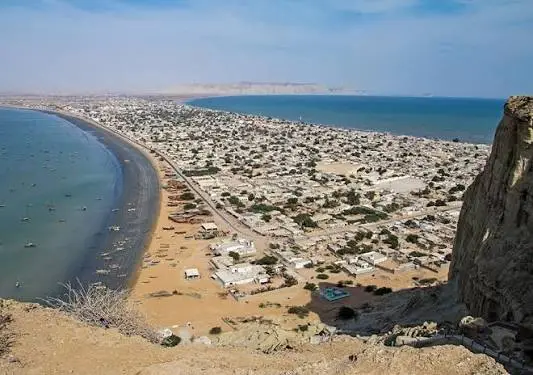
The story also grows as it travels, because the BLF’s own release speaks only of an attack on the camp, yet a report by an Indian outlet adds a suicide bomber detonating an explosives-laden vehicle at the gate, female fighters joining the assault, and a flag hoisted at Gwadar Zero Point, which it describes as the border station with Iran. None of those details appears in the original release, and the geography is simply wrong, since Zero Point is a junction within the Gwadar urban area and the Iranian frontier lies a considerable distance to the west, so a claim that misplaces its own objective was almost certainly not written by anyone who was standing there.
What the Record Suggests, and Who the Message Is For
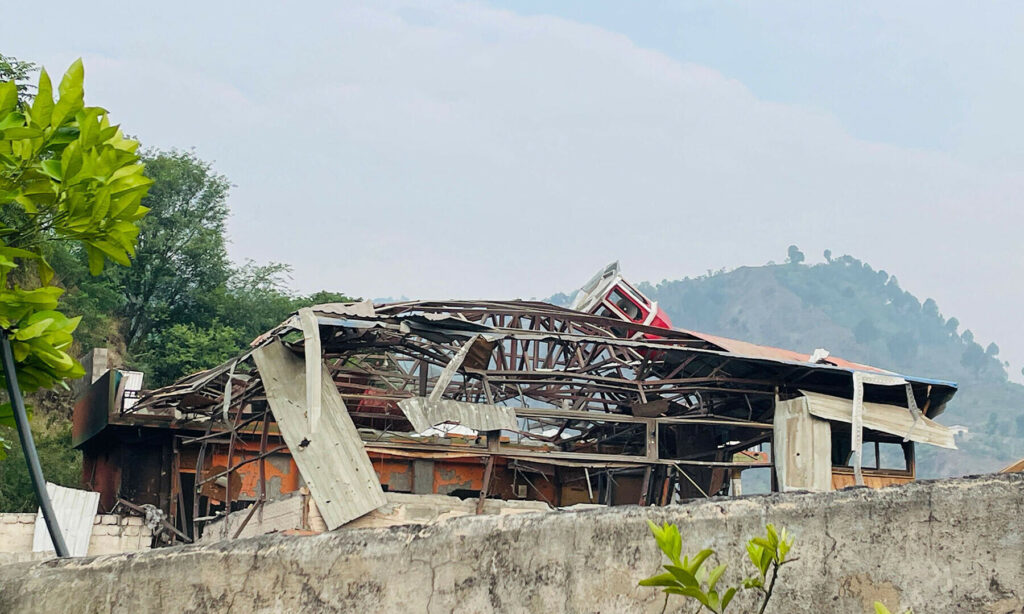
The account coming from the Pakistani side points in the opposite direction. Pakistan Observer reports that security forces responded and killed three militants, and that the target was a construction-related camp which had already been vacated, while the security update in your material speaks of attacks on three locations being beaten back, three bodies being recovered and civilian vehicles being burnt by the attackers as they fled, and the joint statement from the Gwadar administration and police describes the circulating social media reports as baseless and says the situation around BP 250 and the surrounding areas is under control. Those are early accounts, partly resting on a single outlet, and the joint statement gives no figures on casualties or damage, so a full ISPR statement and independent confirmation from journalists or hospital sources in Gwadar will matter a great deal in the coming days, but there is still a real difference between an account that is incomplete and one that contradicts itself, and the BLF’s version belongs to the second category.
Gwadar was not chosen at random, and the history shows a pattern that has repeated itself with remarkable consistency over the years. In May 2019 three gunmen stormed the Pearl Continental hotel and killed five people, four of them hotel employees and one a Pakistan Navy sailor, in 2021 a suicide attack on a convoy carrying Chinese workers killed two local children, and in March 2024 the attack on the Gwadar Port Authority complex ended with ten dead, of whom eight were the attackers themselves and two were soldiers. Each time the target was symbolic and tied to CPEC, the attempt at spectacle was brought to an end quickly by security forces, and a propaganda effort followed to recast the outcome as something else, and the West Point Combating Terrorism Center has noted that the BLA-J, the BLF and the BLA-A regularly claim attacks, with the BLA-J alone claiming 284 of them in each of 2023 and 2024, which is a useful reminder that claiming costs nothing and that the volume of claims says very little about capability or control of territory.
The choice of the FWO as the named target also tells us who the message is really addressed to, since the organisation is an army-linked engineering body central to CPEC infrastructure, and a claimed strike on its camp is meant to unsettle Beijing and foreign investors and to hand diaspora and foreign media a headline about a state losing its grip, not to seize or hold ground, because these groups hold none. The language of liberation also sits uneasily beside a record of Gwadar attacks that have killed hotel staff and local children and, on this occasion, reportedly left civilian vehicles burning in the street. On what is publicly available today, “Operation Almas” is a claim and not a demonstrated event, because the BLF release offers no verifiable results, the supporting material is either unrelated to Gwadar or shows nothing, the amplified versions contain details missing from the original while misplacing the objective, and against all that stand reports of a foiled attack that the state should now back with a complete and checkable account.
The claims around “Operation Almas” collapse under their own weight: the BLF’s press release announces fighters inside the main camp yet offers no casualty figure, no captured position and no proof, the video shows only foliage, the BLA tribute from Chaghai predates Gwadar by four days and has nothing to do with it, and the later additions of a suicide bomber, women fighters and a flag raised at a “border station with Iran” appear nowhere in the original statement and misplace Zero Point, which is a junction inside Gwadar. Against this stands the report that security forces killed three militants at a camp that had already been vacated, and until the BLF produces evidence that can be verified, what it has put forward is a narrative and not an operation.

Our News Desk represents a rapidly expanding frontier in contemporary journalism, focusing on the intersection of technological advancement, geopolitical narratives, and the shifting dynamics of public information.