Until March 2026, Pakistan’s ports were not a part of the global shipping conversation. By May 2026, they were already on the agenda of shipping boards around the world, from Hamburg to Singapore. The Strait of Hormuz has been effectively closed to commercial shipping since February 2026, when the United States and Israel launched strikes on Iran. The Islamic Revolutionary Guard Corps (IRGC) responded by limiting passage for the vessels.
Transit insurance jumped threefold in no time. Maersk, Hapag-Lloyd, and CMA CGM stopped operations in the Gulf. About 20% of the world’s seaborne oil and gas transport was delayed in its transit through the Strait. The world looked for alternatives. Pakistan’s ports offered one.
Karachi port handled 8313 containers in the first 24 days of March 2026, which is equal to its entire 2025 annual container transshipment. South Asia Pakistan Terminal handled 5286 of those. Hutchison Port processed 1827. Port Qasim, located 35 kilometers east of Karachi, processed 3,485 containers simultaneously, which was the overflow from an operational capacity stressing Karachi. On March 11, a dedicated feeder service was launched between Karachi and UAE ports, Fujairah and Khor Fakkan. This was not luck. It was geography and a decade of infrastructure spending colliding with a crisis.
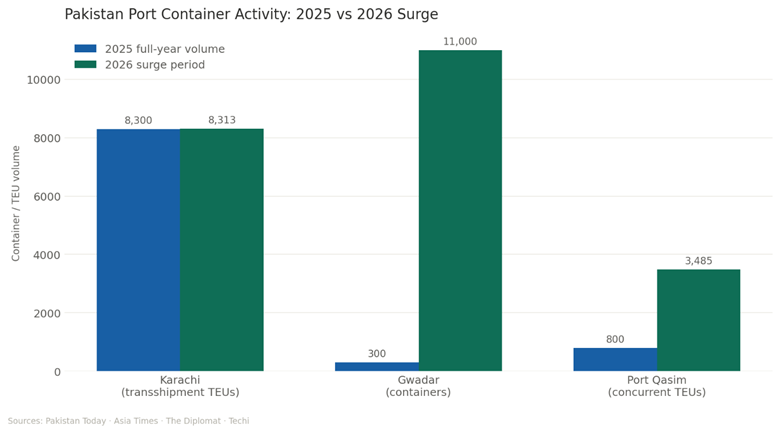
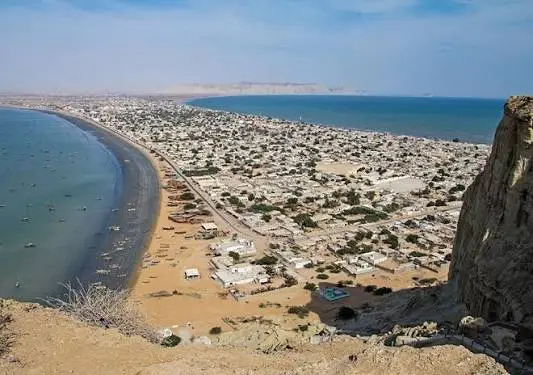
Gwadar Port handled approximately 11,000 containers in April 2026. For comparison, the port processed about 8300 containers for the entirety of 2025. Four transshipment vessels called at Gwadar during April alone, compared to one commercial vessel call in all of 2025. By the end of April, Gwadar had cumulatively handled approximately 23,953 tons of cargo from 2025 to 2026, the majority processed in 2026.
The most recent vessel arrival reinforced this trend. On May 11, MV Yuan Hang Wei Ye docked at Gwadar carrying around 34,000 tons of cargo, comprising about 20,000 pieces, offloaded for onward shipment to Abu Dhabi and Kuwait.
What Pakistan did with the moment
The government moved on two tracks simultaneously. On the regulatory side, Pakistan’s Commerce Ministry issued the Transit of Goods through Territory of Pakistan Order 2026 on April 25, formally legalizing third-country cargo destined for Iran through six overland routes connecting Karachi, Port Qasim, and Gwadar to two Iranian border crossings at Gabd and Taftan. The Gwadar-Gabd corridor shortens the journey to the Iranian border to about two to three hours, as opposed to the 16 to 18 hours from Karachi. Over 3,000 Iran-bound containers were stranded at Karachi when the order came into effect.
On the pricing side, the Maritime Affairs Ministry announced sweeping tariff reductions on May 11. As berthing fees for container ships were cut by 25%, port charges on international transshipment containers were slashed by 40%, transit container cargo charges were reduced by 31%, and one month of free storage for general cargo was introduced against the standard five-day allowance at other Pakistani ports. Gwadar Port Authority Chairman Noorul Haq Baloch termed such incentives as some of the kindest arrangements ever provided in any Pakistani port.
The overland corridor carries a strategic dimension that goes beyond container counts. By establishing integrated transit points of Gwadar, Karachi, Port Qasim, Taftan, Gabd, Quetta, Khuzdar, and Ormara, Pakistan is doing more than just transiting trade. It is also reshaping the geopolitics of the Indo-Pacific maritime system and the axis between Washington, Tehran, Beijing, and the region. The corridor also bypasses Afghanistan entirely. Since border clashes between Pakistan and Afghanistan at the Torkham and Chaman crossings were effectively closed in late 2025 and early 2026, the Gabd-Rimdan trade route is now Pakistan’s main westbound route.
What the Numbers Represent
The upsurge in Karachi showcases three structural advantages that Pakistan has. First, its location. Karachi is located about 400 nautical miles from the Strait of Hormuz. Close enough to provide an alternative for goods to the Gulf; far enough away to stay out of the fighting zone. Gwadar, in Balochistan, is located 87 kilometers from the Iranian border, directly at the mouth of the Gulf of Oman. There is no other port in the South Asian region with that status.
Secondly, the China-Pakistan Economic Corridor. CPEC’s $62 billion investment connects Gwadar to western China through a 1,100-kilometre motorway between Karachi and Lahore, a rebuilt Karakoram Highway, and nine new multipurpose berths at Gwadar with dredging planned to 20 meters. Traditional Gulf shipping routes are vulnerable to disruptions, and CPEC’s land corridor can be replicated by no other Omani or Indian port for northward transport to Central Asia or Western China.
Third, policy response. Pakistan revised its transshipment regulations to allow cargo handling at both seaports and airports. The government lowered port fees and fast-tracked clearance of pending cargo. More than 300 ships carrying 450,000 TEUs were stranded or anchored, according to the National Institute of Maritime Affairs, with Gulf ports, including Jebel Ali, coming to a standstill. The Pakistan government tried to capture a portion of that stranded traffic.
For the first time in Gwadar’s history, the region became part of the transshipment network. The Malaysian cargo vessel MV Riva Glory docked with more than 14,000 metric tonnes of transshipment goods on board. Another ship moved cargo as shipping firms sought new routes around the troubled Gulf. The numbers are relatively small. But Gwadar recorded only one commercial vessel call in all of 2025.
Pakistan is no longer only a passive beneficiary of rerouted shipping. It is now a working corridor for goods destined for Iran that can’t sail through the sea. The Gwadar-Gabd route is estimated to cut transport costs by 45 to 55% compared with routes from Karachi to the Iranian border. The structural attractiveness of this trade in Pakistan is not only due to proximity but also to this cost advantage, irrespective of the resolution of the Hormuz situation.
The Constraints are Real
The opportunity is genuine. So are the limitations. Pakistan Ships’ Agents Association (PSAA) Chairman Mohammed A. Rajpar made it clear that Gwadar is not yet a true deep-water port. Standard container ships require a draft of 13 to 14 meters. Gwadar’s designed draft of 14 meters has not been maintained due to the cost of dredging. Pakistan’s only true deep-water port today is Port Qasim, with a draft of 16 meters. The transshipment model comes to a halt before it starts if the mother vessel cannot dock.
Security is a separate concern. According to research published by Springer Nature, separatist activity and insurgency in Balochistan pose a major threat to the operations in Gwadar. Communication problems and the lack of a qualified local workforce lead to operational uncertainty. Global shipping lines demand predictability. A port that experiences periodic communication blackouts cannot compare with Oman’s Salalah Port, which processes more than 7 million TEUs annually without communication blackouts.
The capacity ceiling is also visible. Port Qasim is currently operating at 65% capacity and Karachi Port at 52%, even before the crisis surge. The Ministry of Maritime Affairs has already formed a committee to look into locations for new deep-sea ports, and it has admitted that all three existing ports are on the verge of becoming capacity-constrained by 2035 to 2045 under normal growth expectations. The current surge compresses that timeline.
The US naval blockade of Iranian ports from April 13 adds another layer of legal complexity. Whether the overland corridor from Pakistan to Iran survives diplomatic pressure from Washington, particularly given Pakistan’s concurrent dependence on IMF support, is a question that no port tariff reduction can answer.
Where Things Stand
Pakistan’s trade deficit ballooned to $4.07 billion in April 2026, its highest level since June 2022. The ports are busier than at any point in recorded history. The overland corridor to Iran is open and legally formalized. In April 2026, Gwadar had higher container traffic than the entire year of 2025. The tariff reductions announced on May 11 are the most aggressive pricing move Pakistan has made in its ports’ history.
None of that resolves the underlying tension. Pakistan is managing a windfall that arrives with geopolitical strings attached, infrastructure gaps it cannot close quickly, and a security environment in Balochistan that insurers continue to flag. The containers are moving. Whether they continue to move after the Hormuz situation is over is the main question that remains. Crisis-driven traffic is still temporary. What Pakistan builds while the traffic is here determines whether any of it stays.

Our Editorial Desk is the intellectual engine of Digital Debate, responsible for the rigorous research that anchors every conversation. Our team deep-dives into data, checks every source, and consults academic literature to move beyond headlines and identify the questions behind the questions.