
Rahmat Ali gave Muslim statehood a distinctive political identity. His birth anniversary invites Pakistan to consider how the achievement of sovereignty translates into security, opportunity and national cohesion.
Before Pakistan became a state, its name appeared on a pamphlet issued from Cambridge.
On 28 January 1933, Chaudhry Rahmat Ali published Now or Never: Are We to Live or Perish for Ever? His proposal challenged the constitutional direction being negotiated for British India. He argued that Muslims needed a separate political homeland, with authority over their collective future.
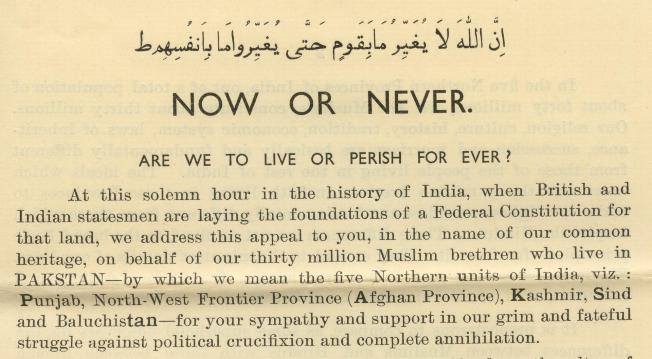
Today, on his birth anniversary, Pakistan should remember the significance of that intervention. Rahmat Ali’s contribution extended beyond coining a name. He helped turn a concern about Muslim political security into an identifiable territorial demand. Understanding that contribution requires examining his reasoning, persistence, and expectations alongside the realities of the state that eventually emerged.
A political alternative
Born on 16 November 1897, Rahmat Ali belonged to a generation confronting colonial rule and uncertainty over power distribution after British withdrawal. For him, independence raised another question: would Muslims have meaningful political authority within the constitutional settlement?
His 1933 pamphlet proposed a separate Muslim federation comprising Punjab, the North-West Frontier Province, Kashmir, Sindh and Balochistan. He based the demand on a distinct national identity shaped by religion, culture, history and social institutions. He feared that an all-India federation would leave Muslims politically subordinate. Naming the proposed homeland gave this argument clarity.
The strategic importance was considerable. A political demand becomes easier to communicate when people can identify its destination. Rahmat Ali supplied a durable expression for an aspiration that would subsequently acquire mass support.
His role should nevertheless remain distinct from those of other leaders. Iqbal’s political thought, Jinnah’s leadership, the Muslim League’s organisation and popular mobilisation contributed through different means. Rahmat Ali’s particular achievement lay in articulating and naming a separate national project.
Persistence under uncertainty
His proposal initially encountered dismissal from politicians across different camps. He continued advocating through the Pakistan National Movement and successive publications. His principal instruments were argument, correspondence and the printed word.
That persistence deserves recognition. He defended a position before its acceptance could be assumed and continued developing it without the resources of a major political organisation. His resilience was intellectual and political: a sustained effort to challenge what established actors considered feasible.
There were limits to this approach. Advocacy from Cambridge did not provide the organisational reach or negotiating influence available to leaders working within mass politics. His career illustrates the relationship between political imagination and implementation. An idea can expand the range of possibilities; securing it requires coalitions, institutions and decisions under constraint.
Recognising those limits does not diminish his contribution. It places it accurately within the wider independence movement.
The homeland he envisaged
Rahmat Ali’s central objective was collective self-determination. Muslims should possess the constitutional authority to develop their national life according to their own institutions and traditions. His pamphlet also presented separate political arrangements as a possible basis for peaceful coexistence, with neither community subordinated to the other.
His geographical vision differed from the eventual settlement. The original proposal centred on the north-west. Later schemes envisaged additional Muslim homelands elsewhere in the subcontinent. The two-wing Pakistan established in 1947 therefore did not reproduce his plans.
His disappointment concerned the terms and consequences of Partition. Cambridge’s historical account records his distress over mass killings and migration, together with dissatisfaction over the territories awarded to Pakistan. These differences should be understood as disagreement over the settlement, rather than reduced to a claim that he opposed the country’s existence.
National history can accommodate that complexity. The movement contained different conceptions of territory, constitutional protection and political strategy. Its participants did not need identical expectations to make consequential contributions.
From statehood to state capacity
Rahmat Ali addressed the need for a homeland. Pakistan today must address the quality and effectiveness of the state within it.
His immediate concern was recognition of separate nationhood. Pakistan now exercises sovereignty through its own constitutional institutions, foreign relations and national policies. The responsibility has consequently shifted from establishing political existence to making independence effective.
That requires reliable justice, economic opportunity, public services and institutions capable of sustaining confidence. External sovereignty is stronger when citizens trust the state’s conduct at home.
National cohesion also requires accommodation of provincial, linguistic, cultural and religious diversity. A shared identity gains strength when people experience fair treatment and meaningful participation. These are contemporary responsibilities; they should not be presented as policies directly prescribed in Rahmat Ali’s writings.
A fuller remembrance
Rahmat Ali died in Cambridge on 3 February 1951. His former tutor, Edward Welbourne, helped meet his hospital and funeral expenses, later reimbursed by Pakistan’s High Commissioner. His final circumstances were modest, despite the lasting significance of the name he had introduced.
Pakistan should make his writings accessible and teach them alongside other founding arguments. His contribution warrants serious study rather than a single commemorative sentence.
Rahmat Ali helped define the political claim to a homeland. Strengthening its institutions, protecting its citizens, and sustaining its cohesion remain the responsibilities of the state that bears that name.
Read More: Iqbal’s Question Still Hasn’t Been Answered

Our News Desk represents a rapidly expanding frontier in contemporary journalism, focusing on the intersection of technological advancement, geopolitical narratives, and the shifting dynamics of public information.