The contemporary transformation of the Indian state represents one of the most critical geopolitical shifts of the early twenty first century. Under the guise of civilizational revival, the ruling elite has deployed a sophisticated political project that systematically redefines the state’s foundational relationship with its majority religion. What makes this transformation uniquely dangerous is that it does not announce itself as a rupture with tradition. It presents itself as tradition’s most fervent restoration, clothing a modern ethno nationalist programme in the vocabulary of ancient civilizational pride. Hindutva, the ideology driving this transformation, has captured the pluralistic inheritance of Hinduism and converted it into a rigid, state worshipping instrument of majoritarian control. The primary victim of this political project is the ethical and philosophical integrity of Hinduism itself.
What Hindutva Stole from Hinduism
The distinction between Hinduism and Hindutva must be answered with precision before anything else can be said honestly. Hinduism, across the full range of its philosophical traditions, represents one of humanity’s most genuinely expansive spiritual achievements. It has historically lacked a singular founder, a universal central scripture, and the centralized doctrinal authority that produces inquisitions. The concept of loka sangraha, the universal common good, sits at the ethical center of this tradition. It is an active moral obligation demanding that those with capacity and standing deploy both in service of something larger than personal or communal interest.
Hindutva is something categorically different. Articulated by V.D. Savarkar in his 1923 tract “Hindutva: Who Is a Hindu?”, it defines Indian citizenship through a racialized and territorial logic demanding the coincidence of fatherland (pitrbhu) and holy land (punyabhu). This framework systematically categorizes Muslims and Christians as permanent civilizational outsiders. Hindutva ideologues assert that their ideology, defined as the total cultural and political essence of the nation, is the primary category, reducing the spiritual practice of Hinduism to a subservient instrument of state power. This structural inversion replaces a living and open spiritual path with a hard and securitized ideology. Scholars have described this as the “Semiticisation” of Hinduism, a process that reshapes a radically decentralized tradition into a monolithic and masculine belief system capable of sustaining an imperial security state. This is cultural self-colonization. The colonized reproduce the exclusionary paradigms of their historic colonizers while describing the reproduction as indigenous pride.
Institutions Hollowed from Within
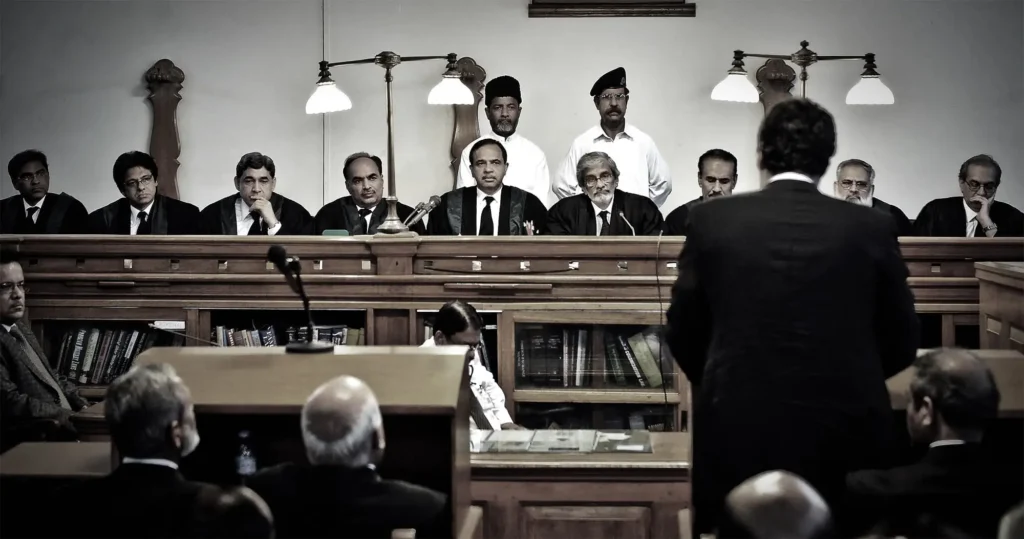
The Modi era did not invent this project. It inherited it, refined it, and elevated it to the operating doctrine of the Indian state. What distinguishes the present moment is the completeness of institutional capture. The Supreme Court of India, once celebrated as one of the most counter majoritarian judicial institutions in the Global South, has undergone a moral and operational decline that is difficult to overstate.
The executive exploited the Chief Justice’s administrative power over case allocation to route sensitive constitutional matters to sympathetic benches, thereby controlling judicial outcomes without any formal restructuring of the institution. What legal scholars’ term “autocratic legalism” is the operative framework. Democratic legality remains formally intact while substantive institutional checks are hollowed out from within. Special Investigation Teams constituted to establish accountability for mass communal violence buried eyewitness testimony when pursuing it would have implicated powerful interests. These are the mechanisms of a deliberate project rather than symptoms of institutional weakness.
Diaspora, Leicester and the Hinduphobia Weapon
The most consequential dimension of this project is its reach beyond Indian borders. The radicalization of Hindu diaspora communities, particularly within the United Kingdom, constitutes one of the genuinely underreported political stories of this decade. Through RSS affiliated networks and BJP linked organizations operating openly on British soil, substantial portions of the British Hindu community have been subjected to an ideological programme that reframes Hindutva chauvinism as authentic cultural preservation and constructs any critical engagement with it as an assault on Hindu identity itself.
The 2022 communal disturbances in Leicester demonstrated its consequences with painful clarity. Long regarded as a model of multicultural coexistence, Leicester experienced unprecedented street violence between communities that had shared the city peacefully for generations. The independent commission of inquiry supported by SOAS and LSE researchers concluded that the violence was preventable and fueled by systematic misinformation and external ideological mobilization through WhatsApp networks and coordinated grievance narratives. British state negligence created the vacuum. Hindutva filled it with accelerant and then characterized the resulting fire as spontaneous.
To protect these networks from scrutiny, Hindutva lobbying groups deployed the term “Hinduphobia.” This strategy conflates criticism of a political ideology with bigotry toward an entire people. Its use by organizations such as the Hindu American Foundation serves to suppress academic scrutiny and dismiss credible human rights investigations as “atrocity literature.” The 2021 “Dismantling Global Hindutva” conference was branded a call for “Hinducide,” a framing engineered for environments where fear of accusations of prejudice outweighs commitment to factual analysis.
Zionism, White Nationalism and the Arms Trade
The global architecture within which all of this operates becomes visible once one resists treating its components as isolated phenomena. Hindutva’s integration into a transnational network of far right, ethno nationalist and supremacist movements is defined by a convergence of targets, shared tactical playbooks, and common enemies. These include Muslim minorities, indigenous populations, and anyone who insists on naming structures of power with precision.
The ideological kinship between Hindutva and Zionism is not a contemporary marriage of convenience. Savarkar explicitly praised the Zionist project in Palestine as a historical template for his own vision of a Hindu state, recognizing that both ideologies rested on the same foundational logic. Both reject territorial citizenship in favor of ethno religious nationalism. That kinship has translated into direct policy mimicry. The revocation of Jammu and Kashmir’s special constitutional status can be seen with reference to Israeli West Bank settlement models, while the Citizenship Amendment Act’s religious test for refugees’ mirrors Israel’s Law of Return in its structural exclusion of Muslims.
India’s military industrial relationship with Israel has deepened in correspondence with these ideological alignments. Israel accounts for 15% of Indian arms imports according to SIPRI data for 2021 to 2025, supplying surveillance drones, air defense systems, and precision guided munitions. This relationship has continued without interruption through the ongoing destruction of Gaza. The alliance between Hindu supremacists and white nationalists may appear paradoxical, but shared Islamophobia and anti communist politics have proven sufficient to generate genuine operational collaboration. This reality is illustrated by the appearance of figures such as Tommy Robinson on Hindutva media platforms as strategic partners rather than embarrassing anomalies.
None of this analysis is complete without reckoning with caste, the subcontinent’s oldest and most durable system of internal oppression. Caste is a living system of inherited and racialized inequality that forecloses social mobility for those born into its lower orders and has replicated itself within diaspora communities across the world. Its erasure from Western human rights frameworks is a function of the same lobbying power that generates accusations of Hinduphobia.
B.R. Ambedkar, who understood caste from inside its most brutal operations and dedicated his intellectual life to its dismantling, represents a more genuinely emancipatory tradition than the more internationally celebrated figures whose accommodation of caste hierarchy consistently prioritized upper caste consensus over the liberation of those whom the system destroyed.
Upper caste background confers advantages within a system that one neither designed nor consented to inherit. The only defensible ethical response to unearned structural advantage is to deploy it against the structures that generated it. This is the most internally consistent position the tradition itself makes available because loka sangraha demands precisely this orientation. The accusations of self loathing, the smear campaigns, and the periodic physical intimidation carry no analytical content. They are simply the sounds a system produces when it registers genuine threat. What this system finds most difficult to absorb is the insistence of people within the tradition that the tradition is worth incomparably more than the political project that has seized its name.
Hinduism absorbed centuries of colonial assault and emerged, however transformed, with its essential pluralism intact. It would constitute a civilizational tragedy of an entirely different order if that pluralism were extinguished from within by people wielding its symbols while dismantling, one institutional compromise at a time, everything that made it worth defending. The longest victim of Hindutva is the tradition itself, whose philosophical depth and historical generosity are being traded for the temporary satisfactions of majoritarian power.

Rajiv Sinha is a British activist, local election candidate, and Director of Hindus for Human Rights UK. He specializes in diaspora mobilization against Hindu supremacy (Hindutva), local anti-fascist organizing, and campaigning for Palestinian rights. Sinha is recognized for leading multi-faith peace initiatives across the UK and challenging political violence and institutional bias internationally.